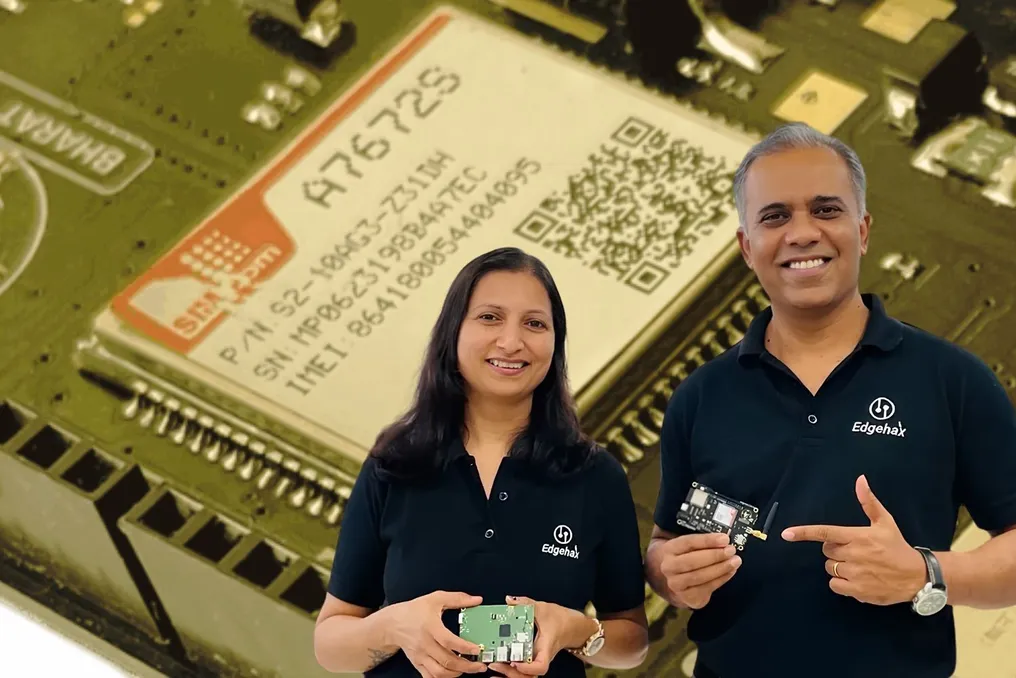
Despite significant hardware manufacturing in India, the country often relies on imported components. Computer modules and single-board computers, which serve as central elements for drones, industrial gateways, electric vehicles, and smart home devices, are mostly procured from abroad. This includes devices such as Raspberry Pi and Arduino boards, as well as foreign computing modules, putting Indian startups and manufacturers at risk of long lead times and uncontrollable overseas supply chains.
Solving the Dependency Problem
Edgehax, founded in Bengaluru in 2025, aims to eliminate this dependency by designing and manufacturing edge computing boards directly in India. The founders encountered this issue firsthand: Prabhu Stavarmath, CEO, spent over 15 years in IoT hardware, product development, and corporate sales, previously creating two hardware ventures—Bharat Pi and Refillbot—that served over 100,000 customers. Savitri Patil, COO, with experience in electronics and manufacturing, oversees operations, supply chain, and logistics. They concluded that the problem is structural: anyone producing a hardware product in India must start with an imported component responsible for its functionality.
Board Functionality and Applications
Edgehax creates a unified board that integrates computing power, connectivity capabilities, and storage. This board is equipped with CPU, GPU, and NPU blocks and supports connections via 4G, 5G, Wi-Fi, and LoRa, featuring built-in storage. It runs on the company's proprietary operating system, DvarOS, specifically developed for industrial edge gateways. These boards are capable of executing convolutional neural networks and transformer models directly on the device, supporting remote deployment and software updates. The company asserts that the entire design and prototyping process is carried out in India.
The same hardware is used in diverse applications: industrial gateways, humanoid robots, autonomous vehicles, drones, NavIC-based tracking systems for India's defense needs, and consumer IoT devices. The customer receives a ready-to-use plugin with local sourcing and technical support, instead of a complex set of imported parts. While Raspberry Pi and Arduino are natural analogues for these boards, Edgehax positions its solutions as industrial, locally manufactured, and backed by long-term supply.
Development and Market Achievements
Edgehax has provided development kits to over 100,000 students and faculty across more than 30 universities and IITs, establishing a base of early adopters who have spread the product primarily through word-of-mouth and are now actively involved in developing, testing, and refining the kits. Commercially, the platform is utilized by over 150 startups, OEMs, and large enterprises, with over 5,000 edge gateway boards currently in production. Institutional support has been secured: Edgehax won the NXP Silicon Seeds Startup Program 2025 to create a low-cost computing module on NXP chips, and it also received the MeitY Bhashini award for developing equipment for the government's voice AI platform. Furthermore, the company is a beneficiary of the next-generation incubation program managed by Software Technology Parks of India, which provides mentorship and funding up to 25 lakh rupees to startups from smaller towns.
In August 2025, the company raised ₹1.39 crore in a seed round led by Inflection Point Ventures to fund production scaling, product development, and entry into international markets in Singapore, the US, and Europe in collaboration with NXP. This growth coincides with increasing global demand: global spending on edge hardware is projected to roughly double by 2030, reaching nearly $59 billion compared to $26 billion in 2025. The founders' goal is to become the primary design and manufacturing partner for OEMs requiring ready-to-use and customizable hardware, and to provide Edgehax boards and tools to 100 million developers in the Asia-Pacific region, the US, and Europe by 2029.