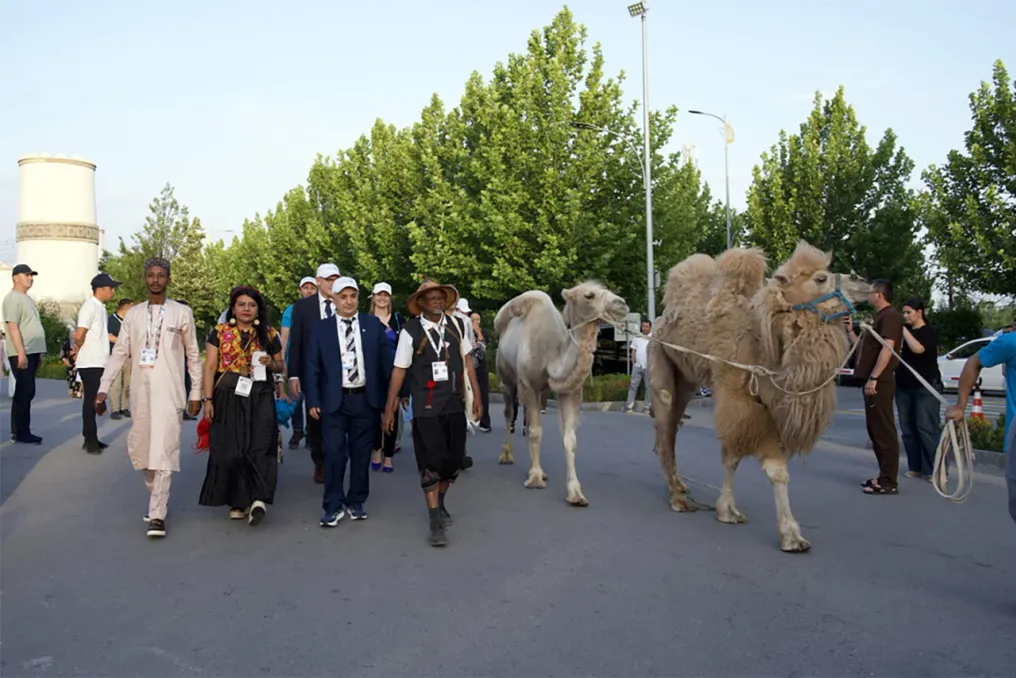
During the passage of the Silk Road Caravan through Samarkand, which in summer appears blue due to colorful domes and a sky-blue sky, it became evident that this hue in Central Asia symbolizes water—a critically scarce resource. Over 80 percent of the region is covered by deserts and steppes, and more than 26 million people suffer from drought.
Central Asia's Challenges
The Caravan entered Central Asia through Samarkand, a historical center of trade routes, where nature and lifestyles change annually due to soil exhaustion, water scarcity, and land degradation. The scale of the problem is illustrated by two facts: at least one-fifth of the region's territory has already degraded, and about four-fifths of all land is used for nomadic livestock farming. Thus, the well-being of the entire region depends on the condition of pastures, which directly affects food security and the ability of communities to withstand climate shocks.
Measures and Funding
In June, the Eighth Assembly of the Global Environment Facility was held in the city. Discussions on financing the fight against drought took place in close proximity to pastures, pistachio orchards, and forest areas. Aziz Abdukhakimov, Advisor to the President of the Republic of Uzbekistan on Environmental Issues and Chairman of the National Committee on Ecology and Climate Change, welcomed the Caravan, noting that the expedition revives the spirit of friendship and shared responsibility for the land that united peoples along the Silk Road.
Within the discussions organized by the UN Convention to Combat Desertification (UNCCD), three topics were focused on: ways to finance drought resilience, the state of pastures, and the livelihoods of herders. For Uzbekistan, the main event was the launch of the three-year project 'Carbon Farming for Climate Resilience and Sustainable Land Management,' funded by the Russian Federation and implemented by the UNCCD Global Mechanism. The project aims to test carbon farming methods to restore soil health and bring the country closer to land degradation neutrality. The work will be carried out over an area of 5,000 hectares involving a thousand small farms.
Furthermore, decisions on direct investments were made: an amount of 5.4 million US dollars was approved for the regional project 'Mountain Ecosystems of Central Asia' in partnership with the World Bank, and the 'Water and Land Resources' program was launched in Central Asia with a budget of 26 million US dollars. Within the GEF-8 cycle, 618 million US dollars were allocated to combat land degradation, which is 30 percent more than in GEF-7.
National Programs and Practices
At the national level, global priorities have been transformed into specific programs. The national initiative 'Yashil Maqon' provides for the annual planting of 200 million trees and shrubs with the aim of increasing the share of green zones in Uzbekistan to 30 percent by 2030 (currently 15 percent). Erkin Mukhitdinov, head of the Agency for Green Zone Expansion and Forest Fund, emphasized the need to involve international organizations to achieve this goal.
Land Restoration Examples
The first stop was at the Amankutan pastures in the Samarkand region. Restoration here is based on seasonal grazing rotation, careful selection of plant species, and strict control over livestock access. In the Bahri section, part of the Urgut forestry enterprise, where the forest covers about 700 hectares out of 1600, the typical regional problem was observed: overgrazing, grass thinning, and loss of the soil's ability to retain moisture. In arid zones, almonds and fodder grasses are planted, requiring minimal water, and some lands are closed for three to four years to restore vegetation.
Old methods are used in water collection areas: low earth embankments and terraces retain rainwater and meltwater near the roots of young plantings. Species selection is done individually for each plot—almond, acacia, elm, and other drought-resistant trees with deep root systems. Mobile apiaries demonstrate how land restoration generates income: bees pollinate grasses and shrubs, accelerating vegetation growth, and honey sales replenish the forestry enterprise's budget.
Haruna Abarchi, a herder from Niger and coordinator of the International Year of Pastures and Pastoralists in West and Central Africa, saw in the Uzbek hills a reflection of his native Sahel. He believes that it is important not to blindly copy, but to adapt effective practices, such as selecting plants for specific locations, which can be applied at home.
Pistachios as a Source of Income
In Sarykurgan, Nurabad district, the focus is on pistachios—a tree that requires patience but yields fruit for decades. Pistachio plantations are planted on the worst lands—exhausted, with damaged vegetation cover, and affected by uncontrolled grazing. An ambitious plan envisions that by 2036, pistachios will cover 50,000 hectares of the district. Expansion is supported by the state, using drip irrigation and local labor.
The choice of pistachios is due to their ability to tolerate poor soil and extreme temperatures, as well as long-term fruiting. A social model has been developed: while the trees are growing, residents receive payment for preparing planting pits and caring for seedlings. After fruiting begins, plots of five hectares are leased to low-income families. The projected income from one plot is about 50,000 US dollars, with maintenance costs around 10,000 US dollars. Dividing 50,000 hectares into such plots will provide a basis for about 10,000 families.
Forests Along the Zarafshan River
The route descended to the banks of the Zarafshan River, where the Zarafshan National Park is located. The park preserves rare *tugai* forests—river forests of the arid zone, which are among the most valuable ecosystems of the drylands of Central Asia. Their contribution is subtle but indispensable: roots stabilize the banks, crowns mitigate wind erosion and cool the air, and thickets serve as shelter for animals, including the Bukhara deer.
The boundary between forest and steppe is palpable. Stepping beyond the line of trees leads to heat, dust, and bare earth, while stepping back brings shade, birdsong, and the dense greenery of the river corridor. Conservation efforts extend beyond the park: staff conduct lessons in neighboring schools, invite artists, and develop ecotourism in surrounding villages, because the forest will be preserved if local residents find a personal reason to protect it.
Working with Salt in Arnasay
The Jizzakh region demonstrated another form of resilience through the Halophyte Garden in the Arnasay area. Halophytes are plants that are impervious to soil salinization or water scarcity. They are strategically important for Uzbekistan, as salinization, along with erosion and reduced productivity, is one of the main forms of land degradation in Central Asia, affecting a significant portion of irrigated lands.
The causes of salinization are varied: the very nature of agriculture in an arid climate, groundwater and mineral migration, poor drainage, and the legacy of large-scale irrigation, including a long dependence on water-intensive cotton. This garden, launched in spring 2026, functions as a living laboratory where salt-tolerant species are selected and propagated for conditions where ordinary crops cannot survive. Uzbek scientists have already described over 100 local species adapted to saline and arid landscapes, and a partnership with the Xinjiang Institute of Ecology and Geography of the People's Republic of China has added dozens of varieties to the trials.
Education for the Dry Century
The last stop on the route in Uzbekistan was the Central Asian University of Ecological and Climate Studies in Tashkent, or the 'Green University.' After a week of fieldwork, it became clear that money alone is insufficient for land restoration; specialists who know how to do it are necessary. The university rector, Professor Bakhtiyor Pulatov, stated that without a new generation of specialists capable of translating environmental challenges into financial strategies, even the most well-thought-out policy frameworks risk remaining only on paper.
The Further Path into the Steppe
From Uzbekistan, the Caravan continued its journey overland into Kazakhstan, where it encountered the blue color again—on the national flag and in the boundless steppe sky. During the journey, the expedition's signature color acquired a new meaning: in Central Asia, it became a symbol of water, resilience, and the fragile connections uniting people, pastures, and the landscapes of arid lands.