For nearly three decades, Indian states followed a similar economic development model: attracting manufacturing enterprises, announcing investments, and creating jobs. However, this paradigm is beginning to change amid global pressure on traditional employment.
Labor Market Challenges
Automation, artificial intelligence, and changing business models allow companies to achieve more with fewer employees. Even the largest technology corporations are slowing hiring rates despite revenue growth, and production is becoming increasingly automated.
This challenge is particularly acute in a young country where about ten million Indians enter the labor market annually, and colleges accept a record 45 million students according to the latest All India Survey on Higher Education. A fundamental question arises: how should states foster entrepreneurs rather than just create jobs?
Andhra Pradesh's Strategy
Entrepreneurs create companies that can become employers for decades, forming new industries and supply chains that governments cannot provide independently. The state of Andhra Pradesh is implementing one of the most ambitious government strategies to support entrepreneurship.
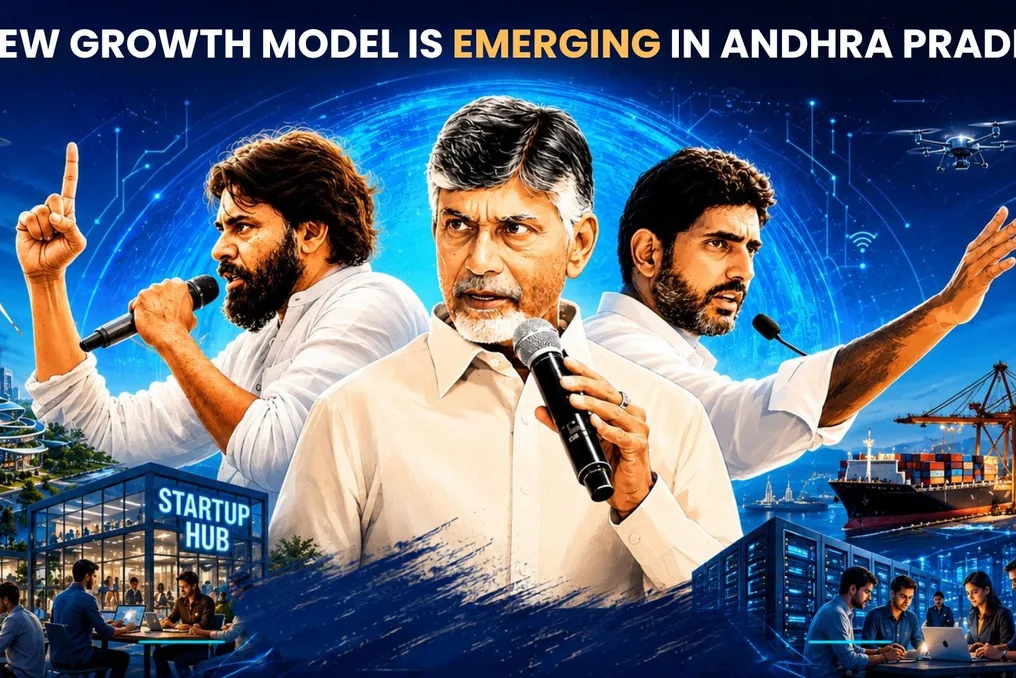
After the NDA coalition, including the Telugu Desam Party (TDP), Jana Sena Party led by Pawan Kalyan, and BJP, came to power in June 2024, it inherited a young state needing jobs. In the two years in power, Chief Minister Nara Chandrababu Naidu and Minister of IT, Electronics and Human Resource Development Nara Lokesh began building an 'entrepreneur economy,' turning entrepreneurship itself into public infrastructure.
This concept has roots in the ideas of economist Mariana Mazzucato, who argues that governments can act as entrepreneurs by funding research and taking early risks in innovations inaccessible to the private sector. Andhra Pradesh develops this idea by viewing entrepreneurship as public infrastructure, not just supporting innovation, with the goal of fostering thousands of founders across the state.
Shift from Industrial to Entrepreneurial Policy
Unlike most strategies focused on attracting companies, Andhra Pradesh aims to create conditions for the emergence of thousands of domestic enterprises. The policy recognizes that the government cannot employ millions of young people, and government hiring only partially addresses the needs of the young state. Only entrepreneurs can continuously create new markets and jobs at the scale required by the country.
This marks a transition from evaluating success based on memorandums of understanding and investment announcements to building long-term entrepreneurial potential. Krishnasharma Gudipudi, an ecosystem specialist who worked with Startup India and Andhra Pradesh Innovation Society, notes that the strength of the state lies in a 'policy-oriented mindset' that 'creates institutions that survive changes in individual terms of office.'
The Andhra Pradesh 4.0 MSME and entrepreneurship development policy, approved in October 2024, is guided by the mission 'One family—one entrepreneur.' The state's innovation and startup policy for 2024–2029 embodies this goal, aiming to nurture 20,000 startups over five years. It provides incentives for female founders, members of Caste, Indigenous populations, minorities, and people with disabilities, and plans to establish the Ratan Tata Innovation Hub in Amaravati with five regional centers for mentoring and access to venture capital.
Distributed Ecosystem Across the State
Another crucial element of the roadmap is the effort to distribute the technological ecosystem across the entire territory of the state, unlike its concentration in one city. Visakhapatnam in the north is becoming a knowledge and IT hub, where Google's AI headquarters has been chosen. Amaravati in the center is being restored as the capital and hosts the Quantum Valley Technopark. In the south, in the city of Sri City, electronics industry and Korean manufacturing are concentrated.
The government intends to create co-working spaces in all 26 district headquarters to expand opportunities beyond the capital. This path is more complex because it requires the government to simultaneously build infrastructure and trust in many locations, but a distributed ecosystem allows entrepreneurs to remain closer to home and attract talent that might otherwise leave.
Founder Needs and State Responses
The core needs of early-stage founders remain constant: capital, talent, affordable workspace, a strong community, and increasingly, powerful computing resources. In computing, the state has secured two critical assets: a Google AI center worth about $15 billion in Visakhapatnam, announced on October 14, 2025, which will bring gigawatt-scale infrastructure to the coast.
In parallel, the Quantum Valley Technopark in Amaravati, being built jointly with IBM and Tata Consultancy Services (TCS) around what partners call India's largest quantum computer, is designed to provide startups and researchers cloud access to advanced computing services even before the equipment goes live, with a deployment plan for September 2026. Over one hundred thousand Andhra Pradesh students have already enrolled in the national quantum computing course.
Regarding infrastructure and mentorship, the district hubs and the Innovation Hub reduce startup costs, while the AP Startup One portal simplifies registration. In terms of capital and market access, IT Minister Nara Lokesh is promoting the initiative to create an Indo-Korean startup corridor. Founders in the state express optimism but stress that it depends on the consistent implementation of plans.
The government is also focusing on execution: in March 2026, Minister Lokesh stated that the goal is not signing agreements but ensuring investments materialize locally, and that the number of jobs created is more important than the volume of contracts signed. In 23 months, the state has attracted 756 projects worth ₹21.64 trillion, setting the implementation deadline for approved projects as September 2026.
The Future of India's Economic Competition
In the next decade, the success of states will be determined not only by the factories they can attract but also by the number of entrepreneurs they can cultivate. In an AI-driven economy, employment cannot depend solely on a few large employers; it must come from thousands of new companies created annually. Factories create jobs, founders create industries, and industries create generations of jobs.
Successful states are those that build complete entrepreneurial ecosystems, integrating infrastructure, talent, capital, research, policy, and execution into a single development strategy. Andhra Pradesh has begun building this roadmap, and its success will depend not only on attracting investment but also on whether thousands of entrepreneurs choose to build long-term companies within the state.