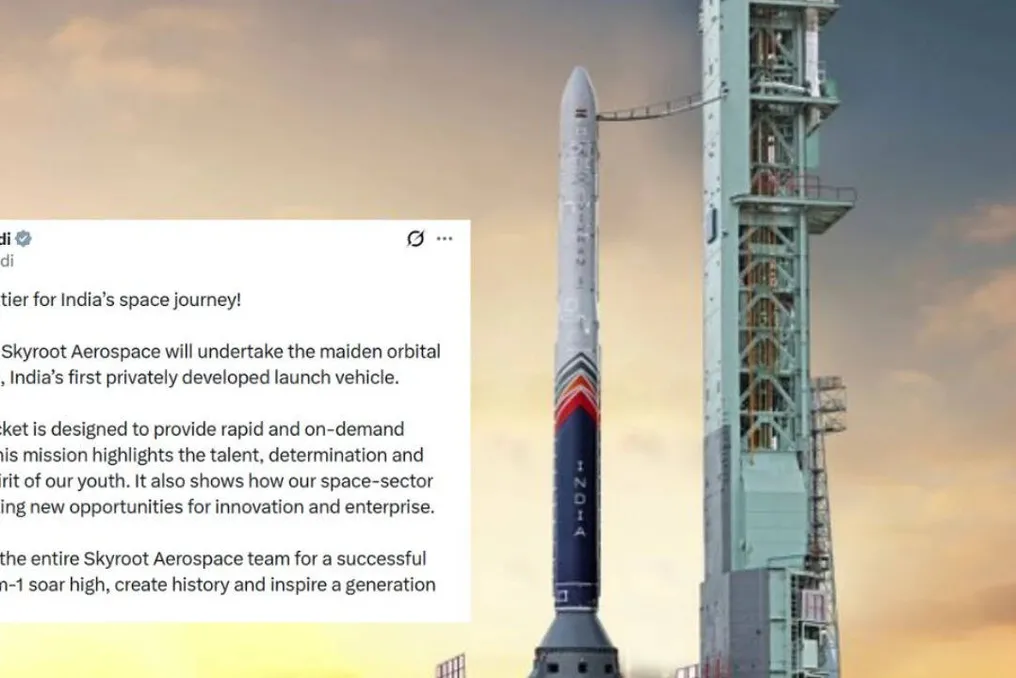
Prime Minister Narendra Modi highly praised the planned first launch of Vikram-1, which is the first privately developed orbital vehicle in India. He called this event a 'historic new milestone' for the country's space program. Skyroot Aerospace from Hyderabad was preparing for the Aagaman mission, which was set to launch from the Satish Dhawan Space Centre in Sriharikota.
Mission Details and Modi's Statement
The launch was scheduled for 11:30 AM and marked the first time an Indian private company would attempt to place satellites into low Earth orbit (LEO) using a self-developed launcher. Before the start, the Prime Minister posted on X, noting that the mission demonstrates the growing capabilities of India's private space sector.
Modi stated: 'A historic new milestone for India's space journey! Today at 11:30, Skyroot Aerospace will conduct the first orbital launch of Vikram-1, India's first private sector vehicle. This four-stage rocket is designed to provide fast and on-demand launch services.' He emphasized that the mission reflects the impact of reforms in India's space sector and wished success to the entire Skyroot Aerospace team, urging Indians to support the mission.
Praise from Experts
S. Somanath, former chairman of the Indian Space Research Organisation (ISRO), also congratulated Skyroot Aerospace, calling the mission an important milestone for India's private space industry. In his post on X, he noted that this is more than just the first orbital flight of a rocket, as it signifies India's capability to build its own rockets.
Vikram-1 Rocket Specifications
According to Skyroot Aerospace, Vikram-1 is a 24-meter tall, four-stage vehicle constructed from lightweight carbon-composite structure. It is equipped with three solid-fuel stages and a liquid orbital correction module. The rocket is capable of delivering a payload of up to 350 kg to an altitude of 450 km in low Earth orbit. The maiden flight will feature the launch of several demonstration payloads from Indian and international clients, including platforms from Grahaa Space, Cosmoserve, DCubed, and SCOPE from Skyroot itself.
Private Sector Development
Rajesh Joti, Technical Director of IN-SPACe, told ANI that the mission reflects the rapid expansion of India's private space ecosystem since the sector was opened by the Centre in 2020. He noted that the number of startups has grown from five or six to over 400.
In addition to technological demonstrations, Vikram-1 will also carry a handwritten postcard from Prime Minister Modi with the inscription 'Vande Mataram', as well as postcards from engineers, scientists, and Indian astronauts. Data collected during the test flight will be used to verify the rocket's guidance and navigation systems and improve it before future commercial launches. If successful, the Aagaman mission will establish Skyroot Aerospace as the first Indian private company to place payloads into orbit using its own launcher.