The Epic Games Store makes at least one free title available for download weekly. This week, the focus is on supernatural and horror themes with the games Echo Generation: Midnight Edition and Luto, both accessible between July 16 and 23.
The Epic Games Store makes at least one free title available for download weekly. This week, the focus is on supernatural and horror themes with the games Echo Generation: Midnight Edition and Luto, both accessible between July 16 and 23.
This game is a turn-based RPG that evokes the aesthetic of the 90s, presenting visual inspirations from works like Stranger Things. Its gameplay and graphics use a 'polygonal pixel art' style characteristic of that decade, although it incorporates modern elements, such as time mechanics to increase damage, mini-games, and special attacks from characters and bosses.
In addition to combat, the title follows the tradition of exploring old RPGs, allowing interaction with the environment and dialogues with NPCs, who are presented only through text, without spoken dialogue. The player must unravel a big mystery after an accident while unusual events occur in the city. Despite the simple graphics, the settings are detailed and charming, and there is a good variety of enemies and characters.
However, there are negative points in its nostalgic mechanics. Interaction with various environmental elements is considered unnecessary, as clicking on a sign only results in a text box with information already visible. Additionally, when defeated by a boss, softlocks may occur due to returning without the items used during the battle.
Echo Generation: Midnight Edition is recommended for those who appreciate titles inspired by 90s RPGs or fans of Stranger Things and indie games.
Luto is a first-person psychological horror experience available on Epic Games. The player takes on the role of someone who cannot leave their house, having to explore, search for clues, and solve puzzles, where each attempt to escape leads them deeper into the unknown.
The game has a remarkable atmosphere. Elements such as white sheep and people covered with sheets manage to sustain tension and the feeling of continuous pursuit. Frights are generated by jump scares and chilling moments, while the soundtrack and sound effects build an environment of despair, emptiness, and uncertainty.
Although it takes place entirely within a residence, Luto presents quite varied and highly abstract settings. The environments are constantly transforming, shifting from a sunny dawn to a basement with a staircase descending into something resembling the viscera of a giant creature. This succession of situations reflects the character's mental instability, where nightmares mix with reality, maintaining a threatening aura.
The plot of Luto lacks clarity, as events often occur without an apparent explanation. However, this lack of answers stimulates the player's curiosity to understand the meaning of everything. On the other hand, the excess of abstraction and allegory can hinder progress, especially in solving poorly defined puzzles.
For those looking for a mysterious, dark, and atmospheric horror game, Luto is a free option this week on Epic Games, interesting for those who enjoy reflective games that address past traumas and surrealism.
SpaceX is conducting the thirteenth launch of Starship, an event that can be watched live. The broadcast will be hosted by Executive Editor Bruno Capozzi and astronomer Marcelo Zurita, an OD columnist, starting at 7:30 PM Brasília time, immediately following Olhar Digital News with Marisa Silva.
Elon Musk's company allowed a 90-minute window to initiate takeoff, and the total flight is expected to exceed one hour. The main objective is to monitor the system's operation in crucial phases, such as module separation, engine ignition, and vehicle return.
A major point of attention is the performance of the Super Heavy booster. In a mission conducted this May, this stage failed to return properly for a controlled landing, resulting in its fall into the ocean. SpaceX reported that it has implemented hardware and software corrections to address the issues detected in that flight.
In addition to testing the rocket, this operation will serve as a demonstration for new components of the Starlink network. 20 Starlink V3 satellites will be launched, following a suborbital trajectory and being destroyed upon atmospheric reentry. According to the company, the Starlink V3 models are larger and promise to substantially increase the capacity of the satellite internet network.
During the test, these satellites will also attempt to establish communication with the Starlink constellation using high-capacity lasers before reaching the atmosphere. Six of these units will be equipped with cameras to record images of Starship and its heat shield throughout the flight.
The flight history of Starship includes various milestones and challenges. Flight 1, in April 2023, ended with the explosion of Starship while still attached to Super Heavy, due to engine failures that activated the vehicle's self-destruct system.
In Flight 2, in November 2023, the spacecraft successfully separated from Super Heavy for the first time, but the subsequent booster exploded, leading to the loss of Starship before the flight concluded.
Flight 3, in March 2024, lasted approximately 50 minutes and was considered a significant advance, even though the craft was lost before the planned landing.
In June 2024, Starship achieved a controlled landing in the Indian Ocean, while Super Heavy landed in the Gulf of Mexico.
Flight 5, which occurred in October 2024, allowed SpaceX to capture Super Heavy on the launch tower for the first time, and Starship also performed a controlled reentry.
In November 2024, the booster completed a controlled landing, and the spacecraft managed to reignite an engine in space.
Subsequent flights recorded losses: Flight 7, in January 2025, resulted in the loss of Starship after an explosion during the test, and Flight 8, in March 2025, saw the upper stage lose stability about eight minutes after launch and be destroyed.
Flight 9, in May 2025, marked the first reuse of a Super Heavy, although failures prevented some planned experiments from taking place.
Mission Flight 10, in August 2025, achieved important goals, such as tests with satellite simulators, engine reignition in space, and controlled reentry.
Flight 11, in October 2025, successfully concluded the Starship V2 phase, including the controlled landing of Super Heavy, the craft's reentry, and new operational tests.
Finally, Flight 12, in May 2026, was the first test of the Starship V3 version, showing notable progress, such as launching satellite simulators and two modified Starlink satellites. However, the Super Heavy booster failed during the return attempt because the engines did not reignite correctly after separation.
Google announced two new features for Google Vids, its video creation platform integrated into Google Workspace, on Thursday (16). These additions enable content generation using artificial intelligence from texts and images, in addition to offering the ability to create custom digital avatars.
The new tools were designed to streamline audiovisual production, allowing users to edit, adjust, and personalize their videos without needing conventional filming or extremely complicated editing processes. This feature is available to subscribers of the Google AI Pro and Ultra plans, as well as to Workspace business clients.
This update elevates Google Vids beyond its original function as a mere corporate presentation tool, aligning it with specialized AI-generated video platforms. The system utilizes the Gemini Omni model, a multimodal artificial intelligence model, combining it with sound and visual personalization features.
The main innovation lies in the integration of Gemini Omni, which allows for the creation of videos from textual descriptions and reference images. The user can input an idea in natural language and supplement it with visual elements, such as sketches or photographs, to guide the final result. Furthermore, the technology supports continuous modifications to the generated material; through written commands, it is possible to request specific changes, such as changing scenes or improving the lighting of a video shot with a cell phone, without having to restart the entire project.
According to Google, this functionality aims to simplify editing, as adjustments can be made sequentially. The company assures that this operating method applies to both videos created by the AI itself and content captured by users.
Another significant advancement is the ability to develop personal avatars that digitally represent the individual. To generate this virtual character, the user must provide a facial photo (selfie) and a brief voice recording. After that, they simply type the desired message for the avatar to present, eliminating the need for a new recording. Google clarified that these avatars are linked to the user's account and can only represent that specific person. There are access restrictions, as the tool is only available to those over 18 years old in certain locations.
Finally, the company announced that all videos produced with the aid of artificial intelligence will receive an invisible digital watermark, created by SynthID. This mechanism serves to identify AI-generated content and increase transparency regarding the origin of these materials.
The area known as Hipódromo Condesa emerged in the 1920s as one of the pioneering examples of modern urbanism in Mexico City. This neighborhood was built on the former capital's hippodrome, which gave it a unique urban identity, marked by an organic and curved design, maintaining the memory of the equestrian circuit through the current Amsterdam Avenue.
In the 1930s and 1940s, Hipódromo established itself as a avant-garde residential refuge, adopting Art Deco as the dominant style. Beyond the formal aesthetic, this movement proposed a new way of living, characterized by functional, well-lit apartments intimately connected to urban life.
In this historical and urban setting, the Popocatépetl 35 building is part of the Art Deco fabric that defines Hipódromo Condesa. The renovation of this apartment aims to establish a dialogue with this tradition, focusing not on a literal restoration, but rather on a temporal continuity that preserves the memory of the neighborhood and projects it toward new standards of living.
Originally, the apartment presented a state of deep decharacterization, due to the addition of carpets, drywall partitions, and the loss of its original finishes and arches.
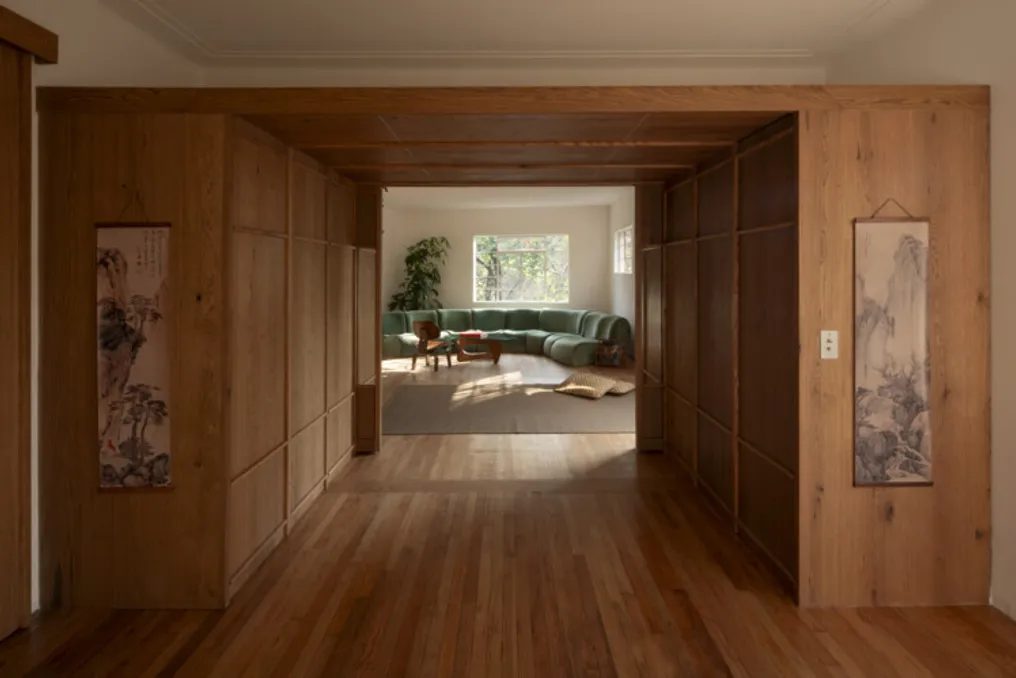
Plaza Popocatépetl serves as the immediate landscape and urban reference for the project, with its roundabout being a social and spatial landmark of the surroundings. The central vaulted structure, with its clear geometry and civic function, inspires the edge vault of the intervention. This creates a sense of refuge and spatial continuity, functioning as a connection point for daily communal spaces, such as the living room, kitchen, powder room, and access.
The curved path, echoing the old hippodrome, gradually guides the resident to the center of the vault, which becomes the visual and spatial focus of the project. The master bedroom connects to the living room through a closet positioned where there was previously a dividing wall. This large piece of furniture is strategically open, allowing the bedroom to integrate with the living room space and extend its views to the plaza.
The carpentry used in the kitchen, closet, and bathrooms has a unified language, as do the curved doors. Combined with white ceramic tiles, brushed steel elements, and locally molded granilite in a curved shape in the central corridor, the project uses a limited selection of noble materials. The goal is to promote coziness and maximize the entry of natural light, which now flows continuously through the integrated environments.
The intervention revitalizes the apartment by directing visual perspectives, hierarchizing the communal spaces, and using geometries that converse with the curvature and concentric logic of both the plaza and the old hippodrome. Plaza Popocatépetl transcends the role of mere background, integrating itself as a perceptual extension of the interior, strengthening the link between architecture, urban memory, and daily life.