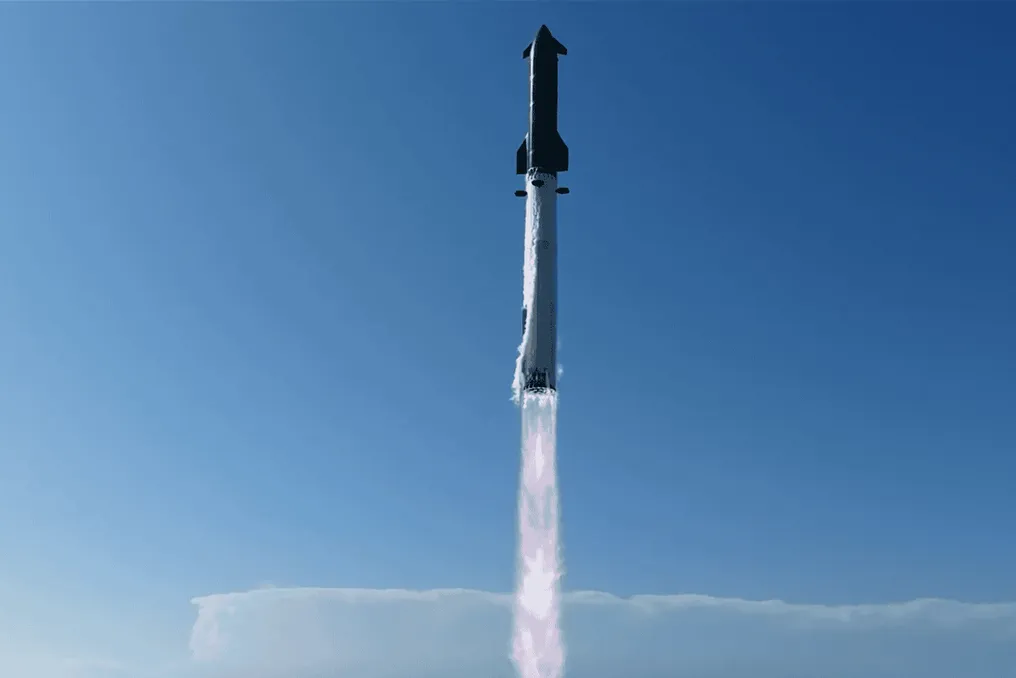
SpaceX is conducting the thirteenth launch of Starship, an event that can be watched live. The broadcast will be hosted by Executive Editor Bruno Capozzi and astronomer Marcelo Zurita, an OD columnist, starting at 7:30 PM Brasília time, immediately following Olhar Digital News with Marisa Silva.
Flight and Test Details
Elon Musk's company allowed a 90-minute window to initiate takeoff, and the total flight is expected to exceed one hour. The main objective is to monitor the system's operation in crucial phases, such as module separation, engine ignition, and vehicle return.
A major point of attention is the performance of the Super Heavy booster. In a mission conducted this May, this stage failed to return properly for a controlled landing, resulting in its fall into the ocean. SpaceX reported that it has implemented hardware and software corrections to address the issues detected in that flight.
Starlink Equipment Demonstration
In addition to testing the rocket, this operation will serve as a demonstration for new components of the Starlink network. 20 Starlink V3 satellites will be launched, following a suborbital trajectory and being destroyed upon atmospheric reentry. According to the company, the Starlink V3 models are larger and promise to substantially increase the capacity of the satellite internet network.
During the test, these satellites will also attempt to establish communication with the Starlink constellation using high-capacity lasers before reaching the atmosphere. Six of these units will be equipped with cameras to record images of Starship and its heat shield throughout the flight.
Starship Mission History
The flight history of Starship includes various milestones and challenges. Flight 1, in April 2023, ended with the explosion of Starship while still attached to Super Heavy, due to engine failures that activated the vehicle's self-destruct system.
In Flight 2, in November 2023, the spacecraft successfully separated from Super Heavy for the first time, but the subsequent booster exploded, leading to the loss of Starship before the flight concluded.
Flight 3, in March 2024, lasted approximately 50 minutes and was considered a significant advance, even though the craft was lost before the planned landing.
In June 2024, Starship achieved a controlled landing in the Indian Ocean, while Super Heavy landed in the Gulf of Mexico.
Flight 5, which occurred in October 2024, allowed SpaceX to capture Super Heavy on the launch tower for the first time, and Starship also performed a controlled reentry.
In November 2024, the booster completed a controlled landing, and the spacecraft managed to reignite an engine in space.
Subsequent flights recorded losses: Flight 7, in January 2025, resulted in the loss of Starship after an explosion during the test, and Flight 8, in March 2025, saw the upper stage lose stability about eight minutes after launch and be destroyed.
Flight 9, in May 2025, marked the first reuse of a Super Heavy, although failures prevented some planned experiments from taking place.
Mission Flight 10, in August 2025, achieved important goals, such as tests with satellite simulators, engine reignition in space, and controlled reentry.
Flight 11, in October 2025, successfully concluded the Starship V2 phase, including the controlled landing of Super Heavy, the craft's reentry, and new operational tests.
Finally, Flight 12, in May 2026, was the first test of the Starship V3 version, showing notable progress, such as launching satellite simulators and two modified Starlink satellites. However, the Super Heavy booster failed during the return attempt because the engines did not reignite correctly after separation.