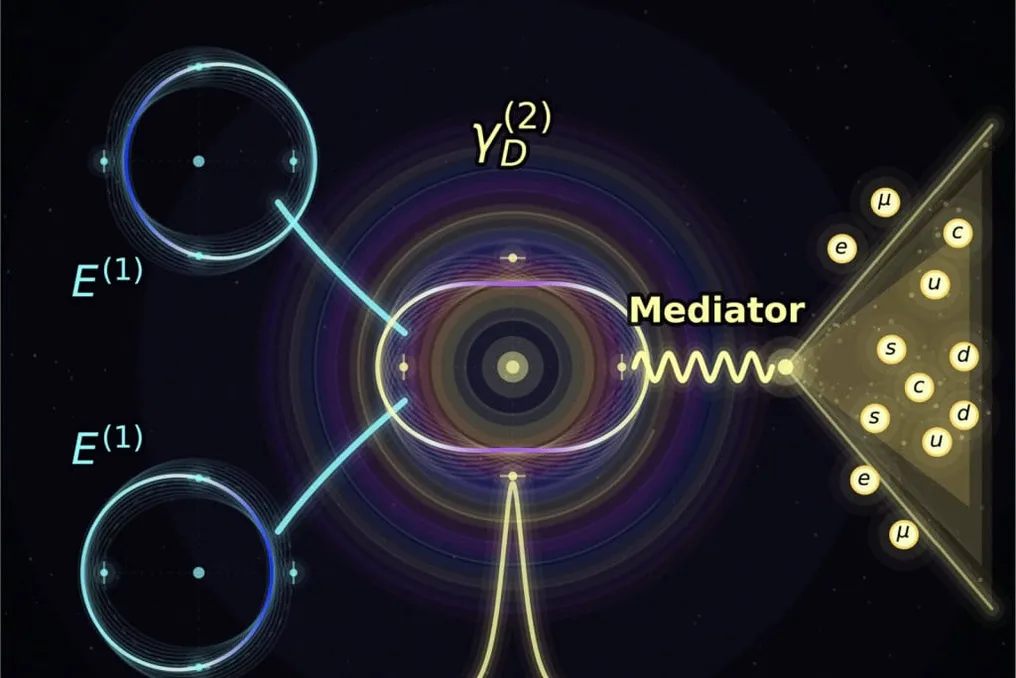
Researchers from the University of Sheffield (England) have developed a new theory suggesting that the mysterious substance holding galaxies together may be in harmony with a hidden fifth dimension. The goal of this research is to help explain one of the greatest mysteries of modern science—the true nature of dark matter.
Dark Matter: A Physics Problem
Dark matter has been studied by scientists for decades and inspires works of science fiction. For example, it appears as vortices capable of destroying planets in the film 'Star Trek,' or as 'dust' sustaining the multiverse in Philip Pullman's fantasy trilogy 'His Dark Materials.' Despite this, it remains one of the most unresolved problems in physics.
Although this substance has never been directly observed, scientists are confident in its existence due to its intense gravitational influence. It acts as an invisible 'cosmic glue,' ensuring the cohesion of galaxies, but its composition and properties remain unknown.
A New Theoretical Model
The hypothesis that this substance might exist in an additional and hidden dimension has been discussed in recent years. However, researchers from the University of Sheffield claim to have made a step forward with a new theoretical model. This study, published in the journal Physical Review D, offers an explanation for the behavior of dark matter and the difficulties in detecting it.
According to this model, dark matter exists in an extra dimension hidden near a force-carrying particle known as the dark photon. The theory posits that the specific geometry and shape of this dimension lead to the precise alignment of these particles' masses. This alignment generates a phenomenon called dark matter resonance, which researchers compare to the operation of a musical instrument vibrating strongly when reaching the correct note.
Geometry and Resonance
Dr. Yu-Dai Tsai, a senior researcher at Dorothy Hodgkin's Royal Society at the University of Sheffield, told Phys.org that dark matter resonance is already considered an important idea for understanding both its origin and detection methods. He noted: 'Dark matter resonance is already known as a powerful idea with the potential to change our understanding of how dark matter was produced in the early Universe and how we search for it today.'
According to the scientist, previous models treated this resonance merely as a pre-assumed hypothesis. Tsai added: 'But many previous models of resonant dark matter viewed the resonance as an assumption. This work provides a possible deeper origin for it: the resonance may stem directly from the geometry of hidden dimensions.'
Tsai also stated that this mechanism could explain why dark matter interacted much more intensely during fundamental periods of cosmic history, remaining practically undetectable today. He emphasized: 'This resonance can make dark matter interactions much stronger during critical epochs of cosmic history, such as in the early Universe. It is important that the model allows for these strong past interactions while explaining why dark matter seems so inert and difficult to detect today.'
Natural Mass Alignment
The researchers also point out that although resonant dark matter and extra dimensions were studied separately in previous works, these models required extremely precise tuning of particle masses to function. The new study suggests that this alignment is not a coincidence nor dependent on manual adjustment, but arises naturally from the mathematical structure of the hidden dimension itself.
Significance for Cosmology
For Tsai, understanding this mysterious substance would mark a significant breakthrough for science. He stated: 'Understanding dark matter would be a profound breakthrough in humanity's knowledge of the cosmos and what it is made of.'
He added that the new model opens up new avenues for future research. 'Our study offers physicists new clear goals in the search for dark matter, while simultaneously linking two of the greatest ideas in fundamental physics: the mystery of dark matter and the existence of hidden dimensions.'
Beyond the implications for understanding the Universe, the researchers note that the search for dark matter stimulates the development of technologies with practical applications. These include ultra-sensitive detectors, cryogenic systems, low-noise electronics, and quantum measurement technologies, which can contribute to progress in fields such as medicine, computing, and global communications.