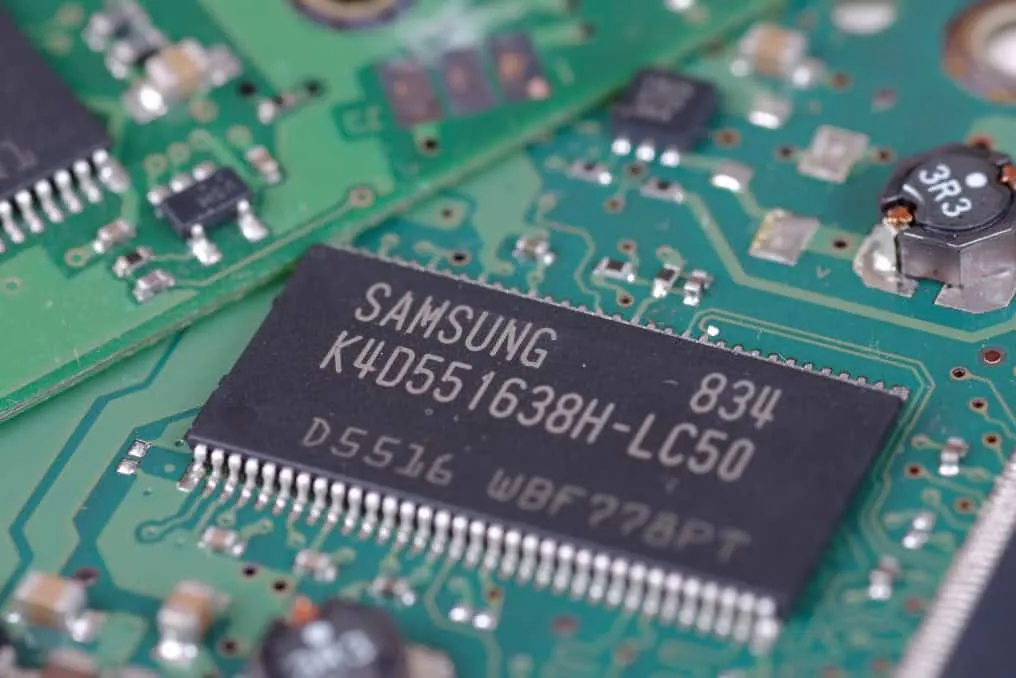
Samsung has become the focus of a commercial investigation in the United States following a formal complaint filed by Netlist. This case is directly related to memory chips that are essential in servers supporting much of the artificial intelligence services.
Scope of the Inquiry
According to Reuters, the analysis of the situation also extends to products marketed by Google, Nvidia, Broadcom, and Super Micro Computer, as these companies use the components in question.
USITC Proceedings
The United States International Trade Commission (USITC) has initiated proceedings to verify whether memory chips manufactured by Samsung infringe on patents registered by the American company Netlist. The complaint specifically focuses on DRAM (Dynamic Random Access Memory), which is crucial for the temporary storage of data processed by processors.
These components are vital for servers running AI applications in large data centers. Netlist requested that the USITC impose a block on the importation of the questioned chips and the products incorporating them, as well as prohibiting their sale in the American market.
History of Legal Disputes
This new case represents another development in a long legal dispute between the two corporations regarding high-performance memory technologies. In 2024, a jury in Texas ruled that Samsung should pay Netlist $118 million (equivalent to about R$ 601.8 million) for infringing patents related to data processing in memory. One year earlier, a previous decision established compensation of $303 million (approximately R$ 1.55 billion) in a similar lawsuit.
Currently, a USITC judge is responsible for examining the evidence and issuing a preliminary ruling, which can still be reviewed by the commission itself.
Impact on the AI Market
The investigation comes at a time of strong growth in demand for infrastructure dedicated to artificial intelligence. Technology companies are increasing their investments in data centers, which raises the need for memories produced by Samsung, SK Hynix, and Micron. Reuters points out that this movement has also driven up the prices of these components.
The USITC has up to 45 days to establish the case schedule. If it decides to restrict the importation or marketing of the items under scrutiny, this measure will take immediate effect and can only be reversed by the U.S. Trade Representative within a 60-day period.
Consequences for the Supply Chain
It is important to note that the opening of this case does not automatically imply patent infringement, but rather puts pressure on a strategic supply chain for the AI sector. While the commission evaluates the arguments presented by both Netlist and Samsung, manufacturers and other companies using these memories are closely monitoring the development of the case. The final outcome may influence not only the two involved companies but also a market increasingly dependent on servers and data centers to keep pace with the progress of artificial intelligence.