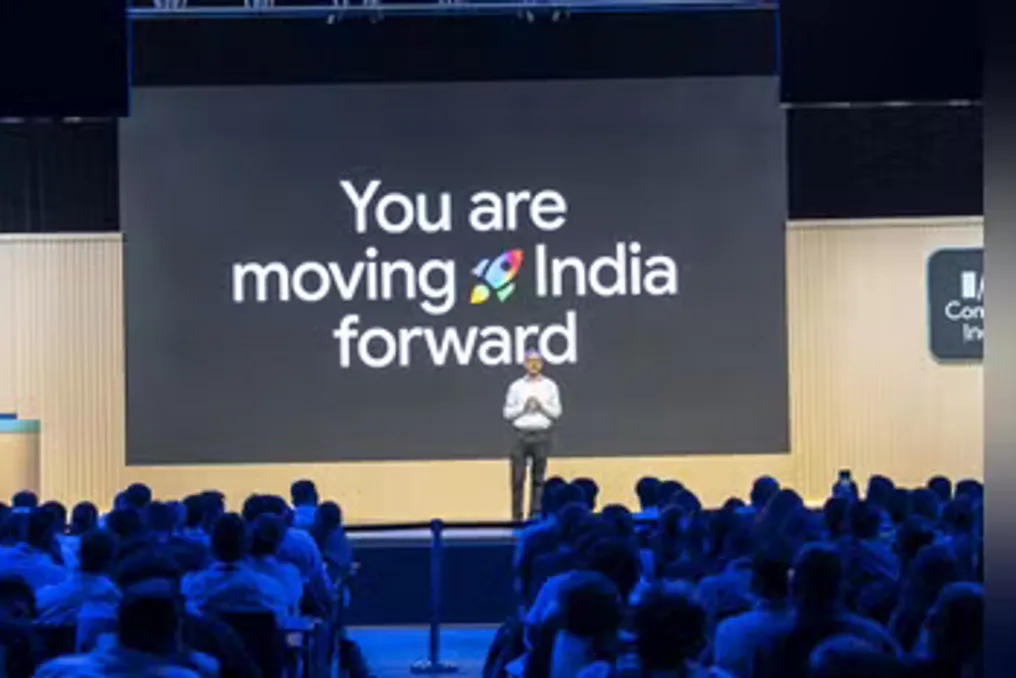
At the Google I/O Connect India 2026 event, the company unveiled a range of initiatives in corporate artificial intelligence (AI), cybersecurity, and education, while simultaneously bolstering AI infrastructure within the country for the business sector.
AI Development Strategy in India
Google aims to make India a testing ground for the next stage of artificial intelligence development. On Tuesday, the company announced new security protocols, options for local computing, and educational programs. These measures are intended to attract Indian enterprises, developers, and startups as AI systems evolve from simply answering questions to autonomously performing tasks.
Financial Contribution of the Ecosystem
During Google I/O Connect India 2026 in Bengaluru, it was noted that, according to third-party estimates, the Google Play and Android ecosystem generated revenue of 5.3 lakh crore rupees ($60 billion USD) for app publishers and the broader Indian economy in 2025, marking a 28% increase over 2024.
Leadership Priorities and Vision
Dr. Manish Gupta, Senior Director for India and Asia Pacific at Google DeepMind, emphasized that the key indicator of AI progress is not just the number of model parameters, but the positive transformation it enables. Gupta noted that India is actively integrating AI into all layers of the economy—from local merchants to national healthcare initiatives. He added that the company intends to accelerate this momentum by providing advanced AI capabilities, local computing power, and a commitment to security, expecting Indian innovators, builders, and educators to lead the nation's AI ambitions.
Educational Programs and Research
Google announced two programs aimed at expanding access to advanced AI skills in India to help train the next generation of researchers, developers, and educators. One program offers the Google DeepMind AI Research Foundations curriculum—a free 56-hour course that teaches participants how to build and fine-tune large language models and conduct cutting-edge AI research. Graduates can earn Google Cloud skill badges and professional certifications.
This course will be available through Google's Skills platform and will be expanded through a partnership with the industry body Nasscom and the Indian Institute of Science (IISc) in Bengaluru to cover institutions across the country. Separately, the social investor network AVPN will collaborate with local partners to provide this curriculum to students via the Google.org APAC AI Opportunity Fund.
Innovations in Medicine and Education
Google DeepMind also launched ATL Saathi—a Gemini-based assistant for teachers, developed in collaboration with the Atal Innovation Mission. This web tool will be deployed in 100 schools this year, with plans to reach 10,000 schools participating in the Atal Tinkering Labs program in the future. Furthermore, researchers from AIIMS Delhi are utilizing open-source MedGemma AI models to develop India-specific tools concerning leprosy and reproductive health. The resulting models will be made available to the Indian developer ecosystem. Separately, the company has expanded Gemini Live to support 25 Indian languages and dialects, including Sanskrit, Bodhi, and Maithili.
Data Localization and Sovereignty
The company stated that it is providing its Gemini 3.5 Flash model to Indian enterprises with the capability to process machine learning domestically, thereby strengthening its position on data sovereignty issues. Google also allows enterprises, including regulated industries and government bodies, to run Gemini on Google Distributed Cloud from data centers in India. This enables AI applications to function entirely within their own infrastructure without reliance on the public internet.
Competitive Advantages and Security
When asked what sets Google DeepMind apart from competitors such as OpenAI, Anthropic, Meta, and Microsoft in attracting Indian developers and businesses, Seshu Adjarapu, Senior Director of Applied AI at Google DeepMind, responded that the company's advantage lies in its comprehensive AI stack. Adjarapu stated: 'Nothing differentiates us more than our full-stack approach.' He clarified that Google creates components across the entire AI stack—from infrastructure, including TPUs (Tensor Processing Units), to foundational models, open models like Gemma, specialized models such as MedGemma, and enterprise AI tools. The breadth of Google's model portfolio, combined with products used by billions of people, allows the company to test and refine its AI models at massive scales before deploying them for enterprise clients.
Google is also extending access to Sec-Gemini v3, its AI-powered cybersecurity agent, for selected government and corporate testers, including Flipkart, aiming to address security challenges related to agentic AI. The company is also making CAPSEM—a secure execution environment for AI agents—open source and is working on industry standards for secure AI-driven transactions. Additionally, Google announced research partnerships with IIT Delhi and IIT Madras focused on agentic AI security and threat detection.
Recognition and Future Development
Google cited third-party studies demonstrating high adoption rates of its AI tools among Indian developers and announced the expansion of the Google Play Academy curriculum to 10,000 developers through partnerships with the governments of Rajasthan, Odisha, and Madhya Pradesh. At the Google I/O Connect India event, about 1,500 developers participated, and startups such as Adya.AI, VideoSDK, Sivi, Superjoin, Knit, PolicyBazaar, Emergent, and RedBus showcased applications built using Google's AI models.