Indian customs authorities supported the Ministry of Health in confronting Adani Group regarding the sale of nicotine pouches in airports, stating that duty-free shops benefit from tax exemptions but remain subject to domestic regulations.
Indian customs authorities supported the Ministry of Health in confronting Adani Group regarding the sale of nicotine pouches in airports, stating that duty-free shops benefit from tax exemptions but remain subject to domestic regulations.
Indian customs services joined forces with the Ministry of Health to combat Adani Group over the distribution of nicotine pouches in airports. They argue that duty-free shops only have tax advantages and are not exempt from complying with other regulations.
In March, health officials inspected Mumbai International Airport, owned by billionaire Gautam Adani, and found that the sale of nicotine pouches in duty-free shops violated the law. The Adani company is currently challenging this decision in the Bombay High Court.
The Customs Department stated in a document submitted to the Mumbai judges on June 22 that the concept of goods being 'outside customs territory' for tax purposes does not grant immunity from regulatory control. For its part, Adani argued that shops in the international departure zone are beyond the reach of domestic norms. In a filing dated July 13, which Reuters reviewed, the group insisted on the validity of its legal challenge because customs demanded an immediate halt to sales without prior warning.
The group also claimed that goods sold in duty-free shops to passengers departing the country are based on legal provisions stipulating that they are packaged in sealed bags and should not be used until crossing the Indian border.
However, customs authorities deemed this interpretation 'unfounded,' as passengers receiving duty-free goods can consume them freely. Nicotine pouches, one of the fastest-growing nicotine products globally, remain unapproved in India. Philip Morris reported a sharp rise in sales of its Zyn brand in the US, which doubled compared to 2023.
Adani operates eight airports in India and plans an $11 billion expansion, which includes investments in duty-free offerings. According to Reuters, since August, the Adani firm has imported Zyn and White Fox brands from Swedish Smokeless Solutions worth over $35,000.
The next hearing is scheduled for July 28. Neither party responded to Reuters' requests.
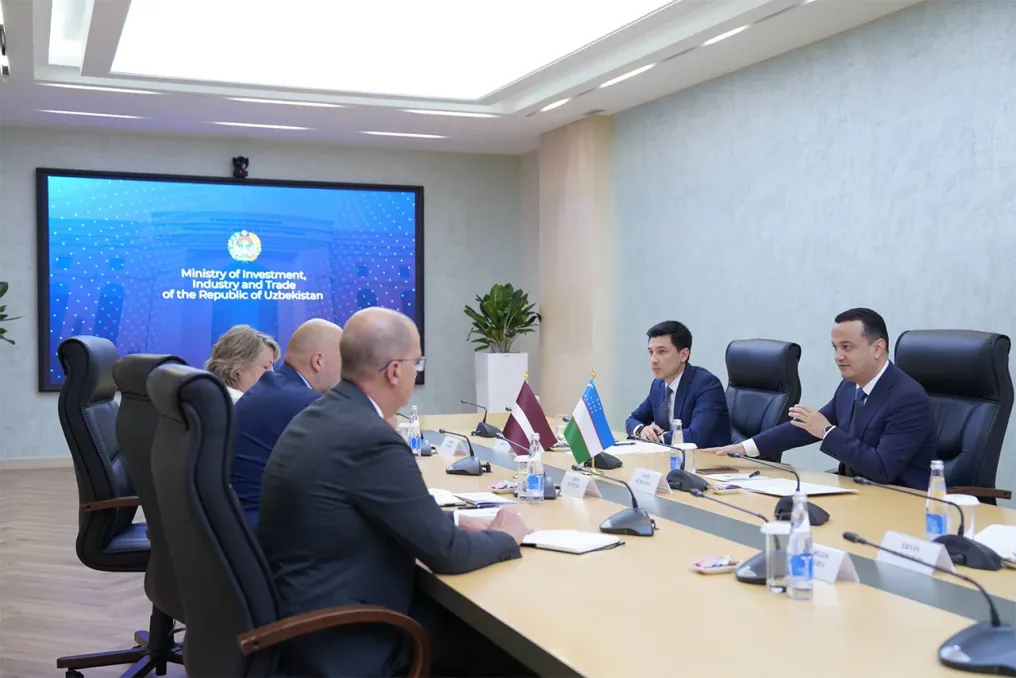
The Minister of Investment, Industry and Trade of Uzbekistan, Laziz Kudratov, met with the Ambassador of Latvia to Uzbekistan, Gerts Jaunzems, to discuss the further development of bilateral trade, economic, and investment interaction.
During the negotiations, the parties focused on implementing the agreements reached at the ninth meeting of the Intergovernmental Commission. Issues were discussed regarding the creation of the Business Council of Uzbekistan and Latvia, the opening of a trade house in Tashkent, as well as the results of the 'Made in Uzbekistan' exhibition, which took place in Riga with the participation of about 70 Uzbek companies.
Furthermore, the dialogue participants reviewed prospects for joint work in sectors such as pharmaceuticals, the agro-industrial sector, fertilizer production, packaging production, and fish processing.
An important aspect of the meeting was cooperation in the field of transport and logistics. The parties discussed opportunities to increase cargo transportation through the ports of Riga and Ventspils, improve air connections, and attract Latvian companies to implement new investment projects in Uzbekistan.
At the conclusion of the negotiations, both sides reaffirmed their commitment to implementing the agreed initiatives and strengthening partnership in the economic sphere.
According to the results of tests conducted by nPerf, Uzbekistan ranked third among countries with a comparable level of economic development based on fixed internet performance indicators for web browsing.
Tests conducted from January to May 2026 showed that Uzbekistan was third among fourteen countries whose GDP per capita ranged from $1,000 to $4,000 USD. In this ranking, Uzbekistan achieved a web browsing performance score of 54.8%.
This index assesses the speed and smoothness of loading five most visited websites in each country.
Only Kyrgyzstan, which scored 56.5%, and Cambodia, which scored 55.6%, were ahead of Uzbekistan. The difference in scores between Uzbekistan and the leader was only 1.7 percentage points, indicating a slight difference in user experience among the top three participants. In comparison, Myanmar, which took last place, lagged behind Kyrgyzstan by 22.5 percentage points.
Uzbekistan surpassed countries such as Tanzania, Togo, Benin, Egypt, Kenya, and Pakistan.
OTP Group is continuing the process of transforming Ipoteka Bank in Uzbekistan, turning it into a modern universal commercial bank. This was reported by Adam Szentpétery, Deputy Chief Executive Officer and Head of Strategy and Finance at OTP Group, in an interview with Daily News Hungary.
According to Szentpétery, the agreement to acquire Ipoteka Bank was signed in 2022, and integration and transformation work began in 2023. The main objective of the project is to transform the financial institution, which previously specialized mainly in mortgage lending, into a bank that provides a full range of services.
As part of this transformation, the bank is reviewing its business processes, expanding its range of banking services, updating IT systems, and improving customer service quality. Special attention is being paid to digitalization as one of the most important areas of development.
Szentpétery noted that the results of the transformations are already reflected in the bank's financial performance. He stated that Ipoteka Bank's profit reached approximately 100 million US dollars in 2024 and is expected to increase to about 140 million US dollars in 2025. Furthermore, he emphasized that Uzbekistan presents significant opportunities for foreign investors due to the development of its financial sector, infrastructure, technology, agriculture, and consumer services.
In Szentpétery's opinion, the most promising sectors for Hungarian companies are digitalization, food industry, agricultural technologies, water resource management, healthcare, and education. The main challenge of the project is cited as the simultaneous implementation of the bank's modernization, its digital transformation, and its integration into the OTP Group.
Speaking about operations in Uzbekistan, he characterized Tashkent as a highly developed city offering comfortable conditions for foreign specialists. He also highly praised the openness and friendliness of the country's residents. Daily News Hungary reported that OTP Group views the development of Ipoteka Bank as one of the key projects in the Uzbek market, which can contribute to strengthening Uzbek-Hungarian economic cooperation and attracting new investments.