The Public Investment Corporation (PIC) is experiencing a serious corporate governance crisis, exacerbated by ongoing internal power struggles, despite key recommendations from the Mpati Inquiry Commission.
Governance Issues and Allegations
The Association for Monitoring and Protecting Public Pensions (AMAGP) notes that PIC has long been in the news for negative reasons because two important politically significant requirements have not been implemented. This situation followed the PIC board of directors suspending the CEO, Patrick Dlamini, on preliminary charges of corruption, mismanagement, and abuse of power.
Unresolved Reforms
This chaos revealed that critical reforms proposed by the Mpati Commission in 2020 remain unresolved. This occurred even though PIC management had previously assured Parliament of the full implementation of all recommendations. The Mpati Commission was established in October 2018 to investigate allegations of misconduct at PIC, which handles investigations into corruption, management failures, and improper investment decisions in Africa's largest shareholder company.
Commission Recommendations
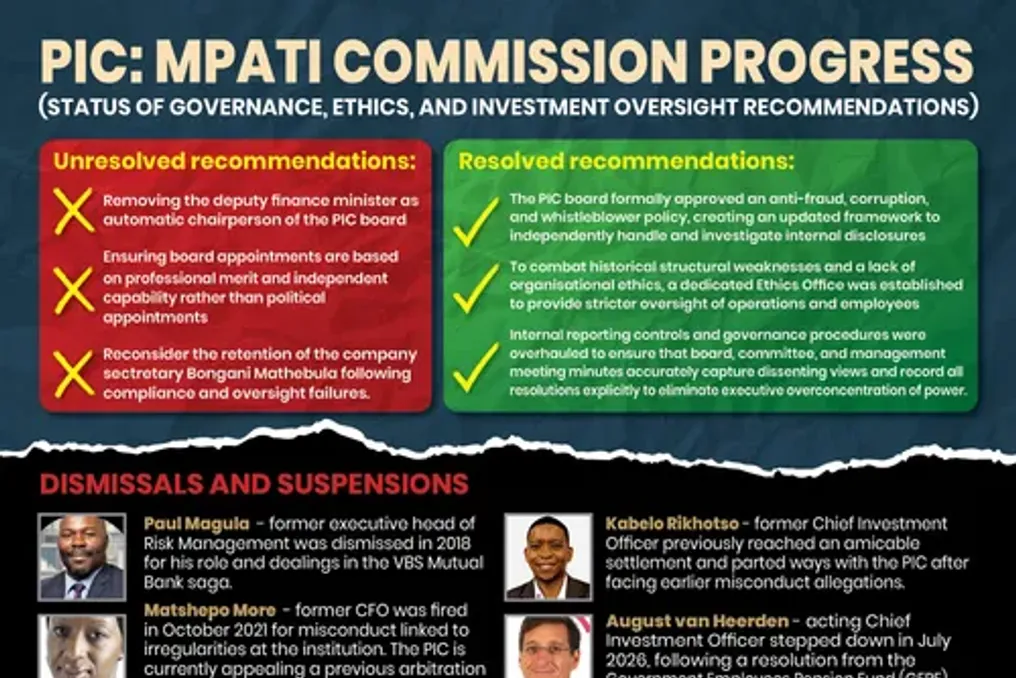
The Commission presented an important report containing 276 recommendations aimed at systemic corruption and governance issues. Specifically, the commission concluded that appointing a deputy minister as chairman of the board subjected PIC to serious political interference and institutional instability. The appointment of an independent, non-executive chairman with specialized expertise in finance, pension funds, and corporate governance was recommended. The report clearly stated that board member appointments should be based solely on professional merit and independent capability, not on political placement or patronage.
History of Personnel Changes
Furthermore, the commission instructed the PIC board of directors to officially review compliance, oversight, and governance structures concerning the reinstatement of company secretary Bongani Mathebula. After the report was published in 2018, a former risk management head was dismissed for his role and connections in the VBS Mutual Bank case. In October 2021, former CFO Matshepo More was also dismissed due to misconduct related to institutional irregularities. PIC is currently challenging a previous arbitration ruling that required its reinstatement.
Former Head of Legal and Compliance Ernest Nesane resigned before the completion of official disciplinary proceedings but was heavily involved in the VBS scandal. Kabelo Rikhotso, a former investment director, previously reached a settlement and left PIC following allegations of wrongdoing. Nevertheless, Nesane is currently facing legal action regarding his liability and recovery of funds.
Anti-Fraud Measures
Meanwhile, PIC has approved an updated anti-fraud and corruption system, ensuring independent investigation of internal whistleblowing from executive management. A specialized Ethics Office has also been established to monitor organizational ethics, manage consequences, and provide stricter oversight of daily operations and employee conduct.
Current Conflicts and Suspicions
Despite all the recommendations, PIC is now embroiled in serious internal disputes, culminating in the preliminary suspension of Dlamini and the removal of Acting Investment Director Augustus van Heerden. These disagreements coincide with increased public scrutiny of PIC's unlisted investment portfolio, where approximately 67 billion rand was invested in unlisted entities that have recorded significant financial losses.
At the heart of this board struggle lies a deeply contentious multi-million rand investment deal related to the Lanseria airport, which reportedly led to a 400% overvaluation error.
Expert and Regulator Comments
AMAGP Chairperson Zirk Gus stated that the current board conflict provides a clear picture of how the company is managed. He noted that it reinforces the view that PIC operates with questionable motives, jeopardizing institutional trust in the management of public pension funds. Gus called on the Standing Committee on Finance (SCOF) to demand full disclosure of hidden documents, adding that the first document for full disclosure should be GEPF's investment mandate for PIC, especially concerning unlisted investments.
He also emphasized that the commission recommended the board chairman be independent with a defined term and experience in the pension sector. Gus described the state-owned company's statement about fully implementing the recommendations as 'dishonest, which has eroded trust through its actions.' He concluded that removing political influence and controlling PIC and basing appointments on merit would be the first steps toward ensuring governance integrity.
Government and Union Reaction
Neither PIC nor Deputy Minister of Finance David Masondo, who chairs the PIC board, responded to requests for comment. Masondo's representative, Sifo Mofokeng, stated that the Deputy Minister would not respond to media inquiries while the Financial Sector Conduct Authority (FSCA) investigation is ongoing. The regulatory intervention by the FSCA under Section 135 of the Financial Sector Regulation Act follows serious concerns regarding governance, transparency, and leadership stability at PIC.
Finance Minister Enoch Godongwana insisted in a statement made Wednesday morning that PIC has completed the implementation of the Mpati Commission's recommendations. Godongwana added that although challenges persist, PIC has made significant progress in strengthening the Corporation's governance system and oversight processes.
Meanwhile, the Public Service Association (PSA), representing over 240,000 public servants, expressed deep concern over developments at PIC. PSA stated: 'While GEPF remains financially sound and well-funded as a pension fund, recurring governance issues at PIC inevitably undermine the confidence of public servants whose retirement savings are entrusted to this institution. The most immediate impact is the erosion of trust. Members need assurance that investment decisions are made solely in their best interests and free from political or improper influence.'