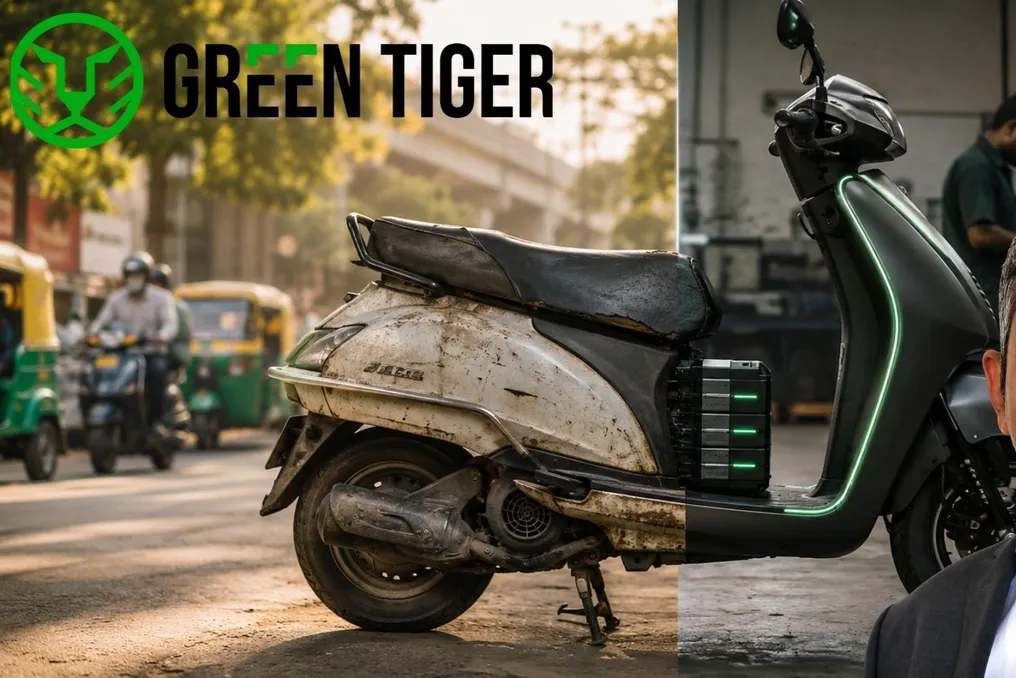
While many companies in India are creating new electric vehicles, they are competing for the same audience—affluent buyers willing to purchase a brand new electric scooter. Ashish Dokania decided to bypass this competitive struggle.
While many companies in India are creating new electric vehicles, they are competing for the same audience—affluent buyers willing to purchase a brand new electric scooter. Ashish Dokania decided to bypass this competitive struggle.
He noted that there are already between 250 and 300 million two-wheelers running on gasoline on Indian roads. These scooters function normally, and their owners do not plan to replace them. However, each one represents an air-polluting and fuel-consuming problem that no new EV showroom can solve.
Therefore, Dokania founded Green Tiger Mobility to modernize existing vehicles.
Dokania's background is not typical of an automotive company founder. He spent years in banking and infrastructure financing, notably leading the solar division of Shapoorji Pallonji and founding a specialized network company in the UK, Transtel Utilities. Among balance sheets and power grids, he stumbled upon an idea that most engineers overlooked: perhaps the fastest path to a cleaner India is not in building new machines, but in saving old ones.
Green Tiger Mobility Private Limited was officially registered on October 27, 2020, with Dokania and his wife, Swati Keshan Dokania, serving as founders. The company's headquarters are located in Bangalore. Their initial message was extremely simple and counterintuitive: bring your gasoline scooter, and we will convert it into an electric vehicle.
When a scooter is delivered to the Green Tiger retrofit center in Bommanahalli, it undergoes diagnostics across 130 parameters, after which the team selects one of three conversion options. The first option is a bimodal hybrid, allowing the driver to switch between gasoline and electric modes with the press of a button, thereby eliminating range anxiety that deters many Indians from EVs. The second option is a full electric conversion, powered by a battery that can be charged at home via a standard 5-amp socket. The third option is designed for couriers covering 100–150 km daily and includes a swappable battery system developed jointly with Indofast Energy—a joint venture of Indian Oil and Sun Mobility, and Battery Smart—ensuring that a discharged battery is always available for quick replacement.
Since necessary components were unavailable in India, Green Tiger developed its own battery management systems, vehicle control units, and telematics equipment from scratch. This intellectual property is now used by approximately 10 other EV manufacturers. According to the company, the retrofitted vehicles have collectively covered over 150,000 kilometers on Indian roads, a real measure of durability that many early-stage startups fail to achieve.
The reliability of Green Tiger goes far beyond a good presentation. The company holds six approved patents covering its retrofit technology and power electronics, and its solution has received approval from ARAI—the same regulatory body that certifies vehicles for Indian OEMs. In 2022, the company received the FICCI 'Most Promising Innovation' award, went through incubation at NSRCEL, the startup hub of IIM Bangalore, and its founder was included in the EMobilityPlus Top 100 list in electric mobility.
Regarding funding, Green Tiger has raised approximately $1.95 million in equity over five rounds, and government grants increased the total amount to about 210 million rupees. The initial round of angel and foreign investment in January 2022 amounted to 50 million rupees for technology development and permit acquisition. A subsequent round of 110 million rupees was conducted in 2023, in which Bajaj Motors, along with Faad Capital and Indus Capital, invested. The connection with Bajaj Motors is not limited to being on the shareholder list; Vikas Bajaj holds a seat on the Green Tiger board of directors as a nominee, indicating deeper involvement.
Since commencing full-scale operations in August 2024, the company has completed about 600 retrofits, employs a staff of 20–24 people, and reported revenue of 46 million rupees for the fiscal year 25, according to the company. Recognition reached the highest level: at the Bharat Mobility Expo in 2024, Prime Minister Narendra Modi specifically stopped at the Green Tiger booth to learn about the i-Hybrid retrofit technology.
India does not lack EV startups chasing the future. The problem lies in the absence of people addressing the past: hundreds of millions of two-wheelers that have already been purchased and sit in parking lots across the country. Dokania did not try to surpass this reality with innovation. He created a sustainable, patent-protected business, backed by regulatory approval and the support of the Bajaj Motors board, around an obvious yet overlooked thing that everyone else ignored.
Electrified vehicles have been available on the market for fifteen years and represent an advantageous alternative for those who travel long distances, although various myths about them still persist.
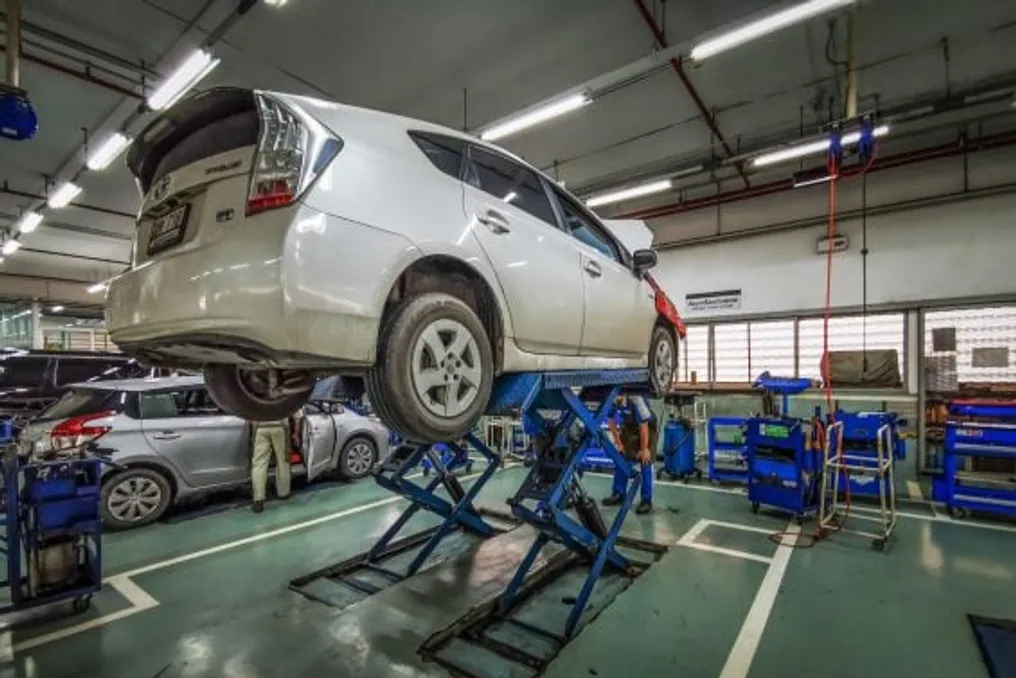
Hybrid cars have been part of the Brazilian reality for over a decade and are frequently found in the used car market. The first example of this type in the country was the Mercedes-Benz S400, launched in 2010, while the first widely circulated model was the Toyota Prius, in 2013. Over time, it has become possible to assess how these cars age and whether maintenance becomes complex with the passing of years. This article aims to clarify the main doubts about used hybrid cars.
There is a belief that hybrid car maintenance is more expensive due to the presence of two propulsion systems. However, in practice, this statement does not hold up, since the maintenance plan is quite similar to that of a purely combustion-powered vehicle.
Taking the Toyota Corolla Hybrid as an example, the only distinct procedure in its maintenance plan is the replacement of the battery air filter, which must be done every 30 thousand kilometers or three years. Additionally, every 40 thousand kilometers or four years, it is necessary to check the level of the battery coolant and transmission fluid, replacing them if necessary. The rest of the maintenance schedule follows the standard of the purely combustion version. In the case of the Corolla and the Corolla Cross, the hybrid engine does not use direct injection, eliminating the recommendation to use a gasoline tank after driving ten thousand kilometers using only ethanol.
In the case of the GWM Haval H6 plug-in hybrid, which has more powerful electric motors and a larger battery, the periodic review is also simplified. Extra services include changing the DHT gearbox oil and replacing the electric motor coolant, both scheduled to occur every five years or 60 thousand kilometers. In Honda and Ford hybrid models, the maintenance plan does not change compared to an equivalent combustion model. The Japanese brand, specifically, establishes a longer interval for transmission oil changes, suggesting every 150 thousand kilometers or six years.
Mechanic Ludovico Ballesteros, owner of Pitucha Centro Automotivo, was consulted. Based on his experience, he points out that vehicles with the highest number of reported failures tend to be the best-selling ones, for statistical reasons. He emphasizes that, so far, he does not identify a specific model that presents significantly more problems than others. The most considerable risk lies in cars that have not received adequate servicing or have undergone improper maintenance.
A hybrid car demands less effort from the combustion engine because it operates with the support of the electrical system and can remain off for long periods. Does this imply that oil and other parts can be delayed in replacement? For Ludovico Ballesteros, the maintenance plan must be strictly followed, also considering the factor of time. Although the engine suffers less wear from being stopped at times, the oil needs to be changed within the deadline, as time affects its durability.
Another crucial aspect for engine longevity is keeping it operating within the ideal temperature range. The specialist explains that the vehicle's electronic management ensures that the powertrain operates this way, even when the hybrid systems are inactive.
A frequent argument used to criticize used electric and hybrid cars is the high cost of the battery pack. Although the complete replacement of this component is indeed expensive, it is not a common event. Currently, the industry adopts a standard of offering eight years of warranty for this part, a period that exceeds the warranty offered for the rest of the vehicle. The mechanic also stated that he has not yet received hybrid cars in his workshop with battery problems.
He added that, in most cases that reach his workplace, the failure is not in the high-voltage battery, but rather in other components of the vehicle itself. In full hybrids, the battery is smaller and less stressed compared to a fully electric vehicle or a plug-in hybrid, as it is never discharged, being constantly recharged by the engine or the regeneration process.
Purchasing a used hybrid car can be compared to buying a combustion model. What determines whether the choice is correct or not is the general state of conservation and whether the maintenance has been performed correctly. The suggestion is to prioritize models that are more popular in the market, as this ensures more accessible maintenance. Because they are more economical, hybrids are sought after by taxi drivers and ride-share drivers.
During inspection, it is important to check for signs of severe wear on the rear seat and door trims, as these may indicate professional use. Finding a good used hybrid can result in significant savings on fuel costs.
boolean