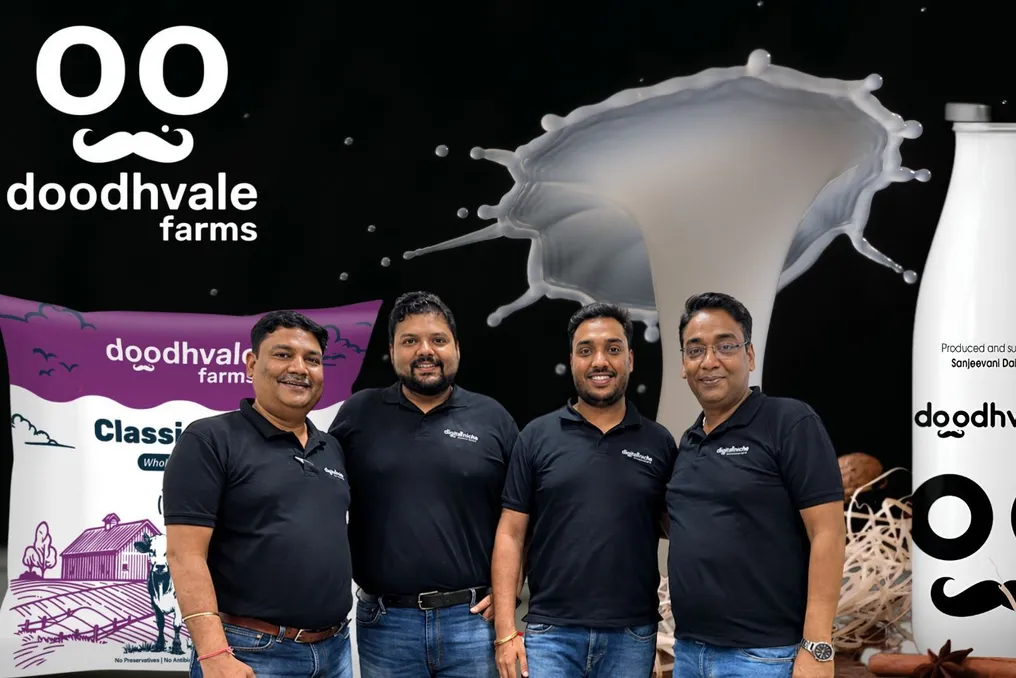
Despite India producing more milk than any other country in the world, many city dwellers do not trust the quality of milk in refrigerators. Scandals involving counterfeits, inconsistent quality, and a complex chain of intermediaries have made the phrase 'fresh from the farm' one of the least convincing in India's consumer goods industry. Doodhvale Farms addressed this problem by taking control of the entire supply chain—from farm to consumer's door—and refusing to hand over any stages of work to third parties.
Family Business in a Difficult Category
In 2019, Doodhvale Farms was founded by Sudhir Jain, Aman Jain, Ishu Jain, and Sanjay Jain. They chose one of the least attractive categories for venture capital—dairy products. This industry is characterized by low margins, high risk of spoilage, complex logistics, and almost impossible trust building. Instead of outsourcing production or sourcing raw materials, the company built a vertically integrated model, controlling all processes from farm to final delivery, with laboratory tests integrated at every stage, rather than added as a marketing gimmick.
Currently, the company delivers fresh milk, paneer, and high-protein products directly to homes in the Delhi-NCR, Chandigarh, Ambala, Karnal, and Meerut regions. Additionally, it ships non-perishable goods such as ghee and cold-pressed oils across the country.
Industry Financial Performance
Doodhvale's growth demonstrates stable profitability, something many prominent D2C brands cannot achieve. The company reports year-over-year growth and sustained EBITDA profitability for three consecutive years, which is rare in the D2C sector where the strategy of growth at any cost often prevails. According to the latest report, the company's D2C business nearly doubled in the last year, leading to an overall revenue increase of approximately 65%. Furthermore, the D2C share now accounts for almost 90% of total revenue. Value-added products, meaning everything except plain milk, constitute about 35% of sales, indicating that customers who came for reliable milk remain for the wider assortment.
Investment Support and Development Plans
These results attracted serious institutional support. In November 2024, Atomic Capital led a $3 million Series A round, and Singularity Early Opportunities Fund joined as a major co-investor alongside Bharat Founders Fund, Indigram Labs Foundation, and business angels, including Ramakant Sharma and Saurabh Jain from Livspace, Ankita Tandon from OYO, and Arjun Vaidya from V3 Ventures. In July 2026, Atomic Capital Fund I conducted an additional funding round of $1 million to expand market reach, deepen penetration in existing channels, and innovate products. Part of these funds will be directed towards artificial intelligence and technologies, including demand forecasting and delivery route optimization. This exemplifies a combination of a traditional industry with modern technological tools.
Business Expansion Strategy
Doodhvale is moving beyond positioning itself solely as a dairy company. The company is intentionally expanding into the area of protein deficiency in India, developing home-based, high-protein products alongside core items like atta and cold-pressed oils. Thus, it is transforming from a startup specializing only in dairy products into a trustworthy daily goods brand. The company plans to more than double its business within the next 12–18 months while entering new markets and strengthening its position in existing ones.
The Essence of the Company's Innovation
Doodhvale's true innovation lies not in a brilliant product or viral marketing. It resides in choosing to compete on the aspect that has historically been the weak point of the Indian dairy industry—trust. This trust is built through owning the entire supply chain, not through promises. In a market saturated with startups chasing flashy categories, Doodhvale's founders bet that the biggest opportunity lies in quietly fixing what people buy daily and earning stable rewards for doing so with quality.