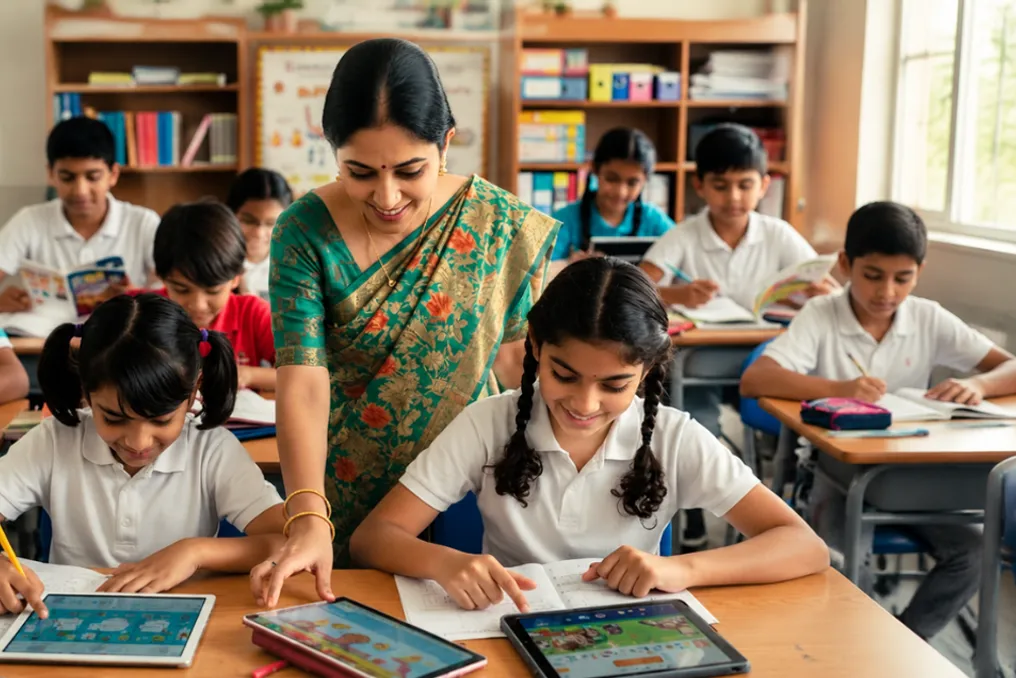
Many educators daily carry over work tasks from the previous day into school, including lesson plans, notebooks, and materials prepared after work. The day is spent explaining material, working with different student knowledge levels, and maintaining their engagement. After lessons, the work continues: preparing worksheets, developing assessments, and creating plans for the next day, and for many teachers, this cycle rarely stops.
Similar stories
Popular
Spark School AI Initiative
Alok Kumar Singh, an educator and data specialist, personally observed this daily burden and decided to alleviate it. He founded the Spark School AI platform, which aims to reduce this load by rethinking the process of lesson preparation and delivery by teachers.
Experience in Real Classrooms
Alok's journey in education began in classrooms where limited resources and unequal access shaped the approach to learning. Working as part of the Teach For India program, he interacted with young children, including students from communities affected by unrest in Gujarat. This experience gave him direct insight into how classrooms function without structured support for teachers.
During these sessions, it became clear that teachers put in significant effort, but much of their time was spent adapting educational content rather than teaching itself. Later, holding leadership positions in academia and working on curricula, he encountered the same problem in various school systems—content fragmentation, curriculum changes, and high administrative load.
Teachers' Need for Tools
The core idea behind Spark School AI is based on a simple yet powerful observation of teachers' daily work. Alok Singh emphasizes: 'Teachers don't need more content. They need tools that help them teach better.' He adds that the real gap in classrooms is not access to information or learning materials, but the amount of time teachers lose daily preparing this material, adapting it to different student levels, and managing routine classroom tasks.
This realization became the starting point for creating Spark School AI—a platform designed to relieve some of the daily preparation pressure on teachers and help them manage the multitude of small tasks that fill the school day.
Using AI Without Starting From Scratch
Spark School AI is a curriculum-aware learning platform designed specifically for the realities of Indian classrooms. It is closely integrated with major educational boards such as CBSE, ICSE, state boards, IB, and Cambridge, covering students from grades 1 to 12. Instead of starting every lesson from scratch, teachers can log into the system, select their board, grade, subject, and chapter, and generate structured, ready-to-use classroom material in just a few seconds.
After these selections, the platform compiles a learning kit that the teacher can use in class. This kit includes curriculum-aligned lesson plans, worksheets for different student levels, quizzes and assessments, ideas for STEM and science lab work, and exam preparation materials useful for JEE and NEET. Meanwhile, the teacher retains control over the lesson: they can change examples, add their own notes, adjust complexity, or adapt the material to the students in front of them. Thus, the platform provides a ready foundation to start working, instead of leaving the teacher to begin from a blank slate after a long workday.
Benefits for the Educator
For the teacher, this means fewer hours spent creating worksheets, formatting lesson plans, or recreating the same material repeatedly. Spark School AI handles these repetitive aspects of preparation, allowing the teacher's energy to be directed toward parts that require human attention. This freed-up time can be used in the classroom: for higher quality concept explanation, substituting a struggling student, changing the pace of the lesson, or simply for more active participation in the learning process. The goal is to make preparation less burdensome so that the act of teaching itself receives more focus.
A Tool Tailored for India
Many AI tools can answer questions or create content, but they do not always understand how a school lesson actually unfolds: from a textbook chapter to program requirements, then to examples, worksheets, review, and tests. Spark School AI was developed with this daily pedagogical process in mind. It closely follows Indian educational boards and grade requirements, providing teachers with material that aligns with their lesson, requiring less time for editing or reworking.
The platform also supports multiple languages, including Hindi, making it suitable for use in diverse regions and school settings. It is intended for both private and government schools, focusing on ensuring accessibility across varied learning environments. A key area of development is accessibility, including an offline-first approach designed to support schools with limited or unstable internet connections.
AI-Powered Planning Process
For teachers, Spark School AI consolidates the most time-consuming parts of their day: lesson planning, assessment preparation, and review organization. Instead of switching between multiple apps or tools for different tasks, teachers can work through a single dashboard designed to handle the entire lesson preparation cycle. The process usually begins with the teacher selecting the relevant grade, subject, and chapter. Based on this selection, the platform generates structured lesson plans along with supporting learning material. Teachers can then use the same system to create worksheets or quizzes for in-class assessment, followed by exam-oriented tools for review and test preparation. The platform also helps teachers track student progress over time, giving them a clearer picture of what has been absorbed and what requires further study. This replaces a fragmented preparation process spread across numerous tools with a more unified and organized system. Furthermore, the platform includes easy export functions to Google Workspace, as well as tools to optimize classroom planning and reduce administrative effort.
Changes in Classrooms
In pilot schools and early implementations, one consistent result has been a noticeable reduction in the time teachers spend on preparation. Alok notes that 'on average, teachers report saving nearly fifty percent of their weekly planning time when using the platform, especially for subjects that require frequent creation of worksheets, revisions, and differentiated content for different learning levels.'
The impact is also visible in the daily mental load on teachers. In many schools, especially where teachers have large classes or teach multiple subjects, lesson preparation often becomes repetitive and exhausting. The platform solves this by generating structured drafts upon which teachers can build their work, reducing the need to create material from scratch multiple times.
Dayawanti Punj Model School Director, Dr. Chitra Singh Bankawat, describes how this shift is changing lesson delivery: 'It helps teachers who don't always have enough time for detailed planning and who often teach directly from textbooks.' She adds: 'With structured support, their lesson delivery becomes more confident and organized.' Teachers in subject-heavy classes report similar changes in their daily routines. A biologist from Kota reported that it helped her move away from repetitive planning cycles and explore clearer ways of explaining concepts. Ms. Manisha Hada, a biology teacher, says: 'Before, I often repeated the same patterns when teaching. Now I can try different approaches using structured material and review tools.' For others, the most immediate change is simply the ease of access to learning materials. 'I don't have to search for old lessons or constantly recreate content. Everything is in one place,' shares Ms. Anita Nair, an educator from Maharashtra, describing the simplification of her workflow thanks to the platform.
Scaling the System
Founded in 2025, Spark School AI is currently operating in several cities, including Ahmedabad, Pune, Delhi NCR, Kota, Agra, and parts of the UAE. It is also participating in structured pilot programs in Uttar Pradesh government schools, covering 60 schools in Lucknow and Kanpur with teacher training support. The platform is incubated in institutions like iHub Gujarat and GTU Ventures, supporting its development and deployment structure. A mobile application is also being developed to support teachers needing on-the-go access, and offline functionality is being created for low-connectivity regions. The long-term plan includes expanding to approximately 400 schools within three years.
Accessibility for All Strata
One of the key design principles of Spark School AI is its pricing. For institutions, the platform cost is capped at approximately 499 rupees per student per year. This is done so that the system can be used by budget private schools, semi-urban institutions, and government schools without financial strain. Individual teachers have separate subscription plans available through the platform. The goal is to ensure access to structured learning tools outside of expensive private schools.
For teachers, the platform aims to eliminate some of the preparatory work that accompanies them home every day, allowing more attention to return to what happens in the classroom. A teacher's day often involves planning, teaching, grading, and progress reporting. Spark School AI seeks to reduce the first part of this burden—preparation—so that teachers have more space to focus on teaching and student comprehension. It also offers fresh ways to explain the same concept, which is useful when one method does not suit every child in the class.
Vision for the Future of Education
For Alok, the broader goal extends beyond software. He believes the education system needs tools built specifically for teachers. He asserts: 'Real change in education will not come from fixing small problems individually. It will come from solving the very structure of the classrooms. The teacher is at the center of this structure.'
He adds that when teachers receive support through the right systems, student learning naturally improves. For him, the essence is simple: technology must stand alongside the teacher, helping them prepare better and enter the classroom with more time and clarity. It doesn't change what teachers teach, but it changes how much time they spend preparing to teach.
In many classrooms, this difference is already noticeable—in reduced preparation hours, more structured lessons, and more stable class delivery. As India continues to expand its educational infrastructure, such tools become part of a wider discussion on how to support teachers at scale. At the heart of it all is a simple reality: when teachers have more time to prepare, they can enter the classroom with greater clarity. And for students, this can change their perception of the lesson, the degree of understanding, and the volume of support received.
As part of an event aimed at increasing the intellectual potential and enriching the knowledge and worldview of military service employees and workers, the regional stage of the 'Zakovat' intellectual competition took place in the Syrdarya region.
Competition Mechanism
The competition was organized in collaboration with the Syrdarya Regional Emergency Situations Department and the 'Zakovat' intellectual club. Teams from city and district emergency departments, as well as structural units of the system, participated.
Content and Atmosphere of the Competition
Participants were asked not only to test their knowledge but also to demonstrate skills in teamwork, quick thinking, and analysis. The teams answered complex and interesting questions concerning the history of Uzbekistan and the world, literature, science and technology, logic, national values, and general knowledge. Each stage took place in an atmosphere of heated discussions, clash of opinions, and healthy competition. Special attention was paid to questions requiring logical thinking and quick decision-making, which clearly demonstrated the participants' level of preparation.
Results and Awarding of Winners
According to the results of the competition, the team from the Yangiyer City Emergency Department took first place. The team from the Okoltin District Emergency Department received second place, and the team from the 'Sirdarya IES' Joint Stock Company Emergency Department won third place. To conclude the event, the winners and actively participating teams were recognized by the organizers with diplomas and commemorative gifts.
The dissertation submitted by Mirzabaev Timur Bisenbay oghli to obtain the degree of Doctor of Philosophy (PhD) in pedagogical sciences will be defended.
Dissertation Topic and Specialization
This dissertation was written on the topic 'Improving the teaching methodology of medicinal plants (at the example of higher pedagogical institutions)'. Mirzabaev Timur Bisenbay oghli worked on this issue under the specialization 13.00.02 – 'Theory and Methodology of Education and Upbringing (Biology)'.
Information about the Defense Event
The defense of the dissertation will take place at the meeting of the Scientific Council No. PhD.03/2025.27.12.B.04.09.M under the Karaqalpaq State University on July 30, 2026, at 11:00 AM. The defense will be held at the Karaqalpaq State University, located at 1 Abdirov Street, Nukus city, 230112.
An event was held at Navoi State University to award diplomas to graduates. In the 2025-2026 academic year, students completed their studies at Navoi State University, totaling 4889 individuals. Among them, 4662 graduated from 35 bachelor's programs, and 227 received a master's degree.
Significance and Achievements of the University
The Rector of the university, Mukhiddin Kalonov, noted that this higher educational institution holds its place not only in the region but also at the republic level. He emphasized that the institution, with a 43-year history, graduates specialists who enter the labor market as experienced professionals. The university has created all conditions for youth to receive high-quality education and upbringing.
Navoi State University has implemented systemic approaches to improving the quality of education, ensuring an inclusive environment, environmental responsibility, and social well-being. The university has ranked between 601–800 places in the Times Higher Education Impact Rankings 2026. This result reflects the effectiveness of reforms in the country's higher education sector, including improving the quality of teaching according to international standards, increasing the productivity of scientific research, expanding the academic and financial independence of educational institutions, and implementing sustainable development goals.
Social Role of Youth
A completely new system for working with youth is currently being formed in the country. The sense of social activity among young people, as well as their involvement in the fate of the Motherland and the people, is strengthening, which contributes to expanding participation in building the new state of Uzbekistan.
Graduates' Wishes
Shakhnoza Makhmudova shared her impressions, saying: 'The greatest happiness for a person is the achievements gained through knowledge. Today, having graduated from university and obtained a master's degree, I feel that this is one of the unforgettable moments for us graduates. Receiving my master's diploma from the hands of teachers brings me immense joy and pride from their wishes. My achievements and successes were greatly helped by the services of my professors. Thank you very much to them.'
Diplomas were awarded to students who completed their studies at the bachelor's and master's levels during the event. Photos of participants: Abdulvali Boriyev, S. Aslonov.