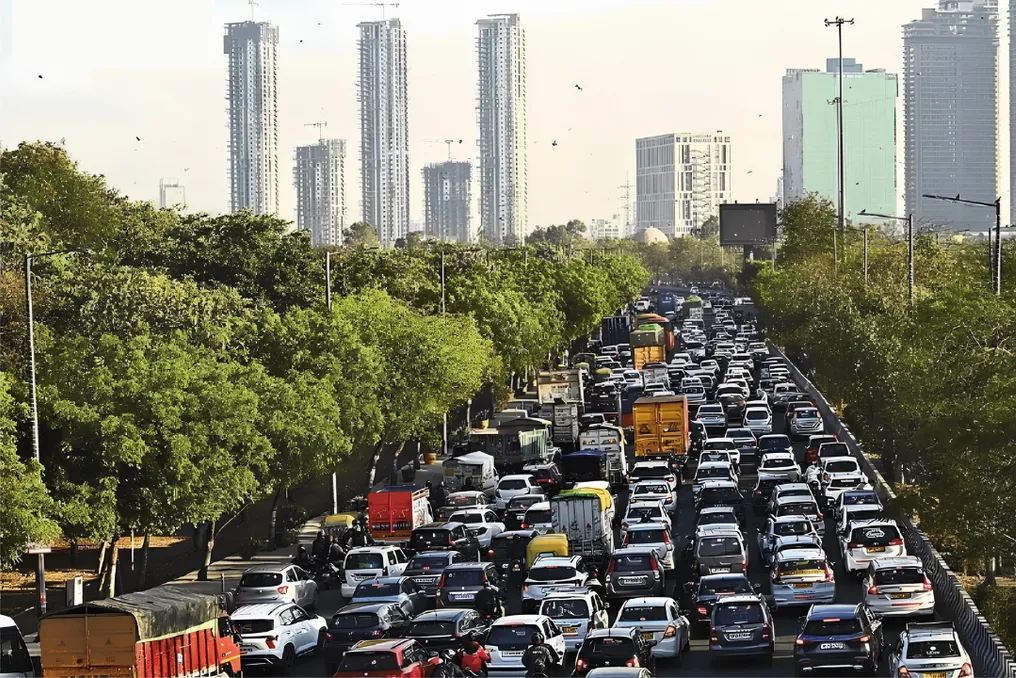
India's economic future will be determined by its cities, as they are the centers of concentration for capital, ideas, markets, and population, which other forms of settlement cannot provide. India's transition to a high-income country, Viksit Bharat, must rely on functioning and dynamic cities, similar to what has happened in other countries.
India's Competitive Advantage
Unlike East Asia, whose growth was based on manufacturing, India's competitive advantage lies in the service sector. Over the last two decades, the export of services, including IT, BPO, financial services, and over 2000 Global Capability Centers (GCCs), has provided exports and high-paying jobs for 2.3 million professionals. Today, service exports are comparable to goods exports. The success of these industries directly depends on the ability of cities to attract skilled talent and investors, provide reliable infrastructure, and ensure a quality of life that allows firms to compete globally.
Current Achievements and Challenges
The quality of life in cities like Bengaluru or Gurgaon is not just a municipal issue but a national economic indicator that influences the decision of India's most talented citizens to stay home or move to Singapore, Dubai, or London. India has made significant progress: the metro now operates with a length of about 1000 km in approximately 20 cities (compared to 229 km in fewer than five cities in 2013), and airports and highways have also improved. Coverage for tap water supply and sanitation has significantly expanded, becoming universal in urban areas with high public awareness, and digital governance has simplified access to urban services.
Nevertheless, existing gaps are large enough to jeopardize the entire growth plan.
The Need for Economic Planning
There is a serious lack of economic vision and planning in city development. Cities and their economies often remain at the discretion of architects and master plans, which fix the future based on a dynamically changing reality. Meanwhile, little effort is made to identify the strengths of cities—both current and potential—and use them to accelerate economic growth. Cities need economic plans, similar to those in Singapore, Dubai, New York, and London, that manage trillion-dollar economies.
Urban Environment Issues
Time lost in rush hour and air pollution pose serious challenges. Delhi constantly ranks among the world's most polluted capitals, where PM2.5 concentrations exceed WHO norms by 20 times. Although Mexico managed to reduce pollution levels through consistent coordinated policy, India has not yet made similar serious efforts. A similar situation exists with basic services: although the number of water connections has increased, almost no Indian city provides 24-hour water supply, forcing households to invest in pumps and purifiers. Furthermore, waste collection in many cities exceeds 90%, but this occurs without scientific recycling, creating mountains of old waste, such as in Gazipur (Delhi) and Deonar (Mumbai).
Financial and Infrastructural Barriers
Indian cities are designed primarily for transport, not for people; in many cities, most roads lack continuous and usable pedestrian walkways, even though walking constitutes one-third or more of all trips. In Europe and East Asia, pedestrian accessibility is considered basic infrastructure, whereas in India, it is a secondary aspect sacrificed when roads become overloaded. This problem stems from financial difficulties: India invests only about 0.6–1.5% of GDP annually in urban infrastructure, while rapidly urbanizing economies typically invest 3–5% during the fastest growth phases.
Municipal revenues are stagnant. The World Bank estimates that India will require about $840 billion for urban investments over 15 years, which amounts to approximately $55 billion annually. However, cities can fund themselves if they have freedom and flexibility.
Three Critical Reforms
An expert highlights three most important reforms:
- Economic Planning: This differs from simply drawing master plans. India mistakenly equates detailed regulation with strategic foresight. The government must think 50 years ahead, securing land, preserving transport corridors, and proactively building trunk infrastructure (railways, metro, water, sewage, electricity). Once these foundations are laid, the markets should determine the rest.
- Regulation: Regulation should stimulate supply, not restrict it. The housing affordability crisis is largely caused by internal factors. The floor space index should be relaxed to allow for additional area and revenue. Rigid Floor Area Ratio (FAR) rules, outdated land conversion regulations, and slow project approvals make development more expensive. Solutions include liberalizing FAR where infrastructure permits, densification around metro stations, legalizing mixed-use, and digitizing building permits.
- City Finance and Governance: No city can provide world-class infrastructure with village-level finances and borrowing powers. Municipalities need stronger property tax systems, deeper municipal bond markets, and predictable transfers from states. It is also crucial to grant mayors and commissioners authority for planning, execution, and evaluation so that citizens know whom to hold accountable.
Urbanization Prospects
By 2050, nearly 900 million Indians will live in cities—a number exceeding the combined population of the US and Western Europe. Cities already generate about 60% of India's GDP, and this figure is expected to rise to 70% within a decade. Therefore, the discussion must go beyond viewing cities as administrative units requiring periodic maintenance. Cities are productive assets generating jobs, innovation, exports, and tax revenue. Investing in cities is not social welfare; it is one of the highest-yield investments. India's success in achieving Viksit Bharat will depend on the quality of its cities.