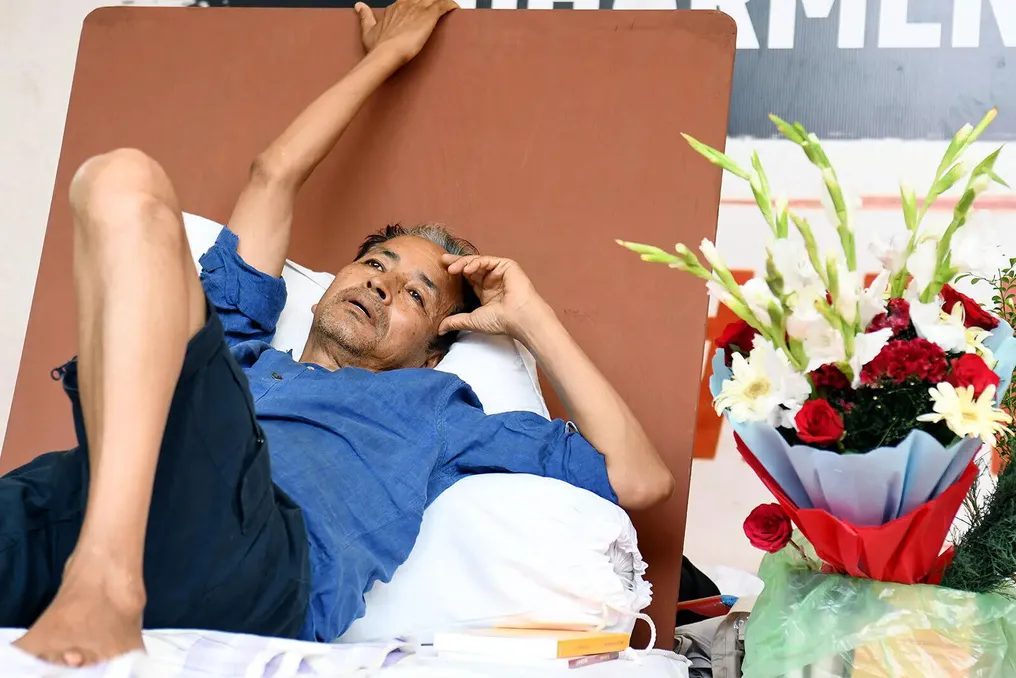
The Delhi High Court on Thursday demanded that both the Central Government and the state government, both led by the Bharatiya Janata Party (BJP), ensure regular monitoring of Sonam Wangchuk's deteriorating health. He is in his nineteenth day of an indefinite fast, which he began to protest alleged irregularities in the NEET medical examination.
Court's Stance and Medical Concerns
Considering the petition regarding the activist's declining health, the court emphasized that 'life is precious' and asked both administrations to provide medical assistance to the Ladakh resident if necessary. The bench, comprising Chief Justice Devendra Kumar Upadhyay and Judge Tejas Karia, questioned Solicitor General Tushar Mehta about the health monitoring mechanism. Mehta informed the court that Wangchuk undergoes daily medical check-ups, and his health parameters are regularly reported.
Activist's Health Condition
Doctors warn that Wangchuk may soon enter a potentially 'critical' phase related to organ damage. It is reported that since the start of the fast, Wangchuk has lost over 9 kilograms. Dr. Satish Lambha provided an update on the activist's condition, noting that he remains conscious and is currently medically stable, but doctors are closely monitoring for signs of potential deterioration.
Lambha stated that after nineteen days of fasting, the total weight loss exceeded 9 kilograms. His blood sugar level was 80 mg/dL, and his pulse was 72 beats per minute. Blood pressure while lying down was 105/61 mmHg, and while sitting, it was 101/65 mmHg. Hydration level is assessed as satisfactory, and he maintains mental clarity. His current weight is 56.9 kg.
Medical Stages and Protest
Explaining the medical issues, Dr. Lambha added that the second stage is associated with elevated uric acid levels, indicating muscle breakdown and catabolism, which caused the rise in blood uric acid. They are now facing a potential third stage, which could cause concern due to organ involvement; this requires a 'wait and watch' approach. Doctors maintain round-the-clock vigilance.
A few days before the court ruling, Wangchuk stated that he was 'not well, but not that bad.' In a video clip published on X, he called on people to join a planned march to Parliament on July 20th instead of asking him to end his fast. He noted that many senior leaders had met with him; some showed affection, others insisted, and some even approached the court requesting forced feeding.
Wangchuk stressed two points. Firstly, he asked what would change even if he stopped fasting and what signal that would send. He added that the only signal the government would receive is the lack of need for accountability. Secondly, he assured that his condition was not such that he would die in 24 days. He underwent numerous medical tests, and the results for a person fasting for 18 days were quite normal. He also had an ECG, which showed good results. Therefore, he can continue for a few more days. He acknowledged weakness and muscle mass loss but stated that his heart and major systems are still functioning well.
Instead of simply asking him to stop fasting, he appealed to everyone to take a small step: to come out in large groups on July 20th to send a clear message to the government. Meanwhile, Abhijit Dipke, founder of the Cockroach Janata Party, claimed that Wangchuk was losing muscle mass and experiencing 'unbearable pain,' adding that the activist had lost 8.5 kg since the start of the fast.