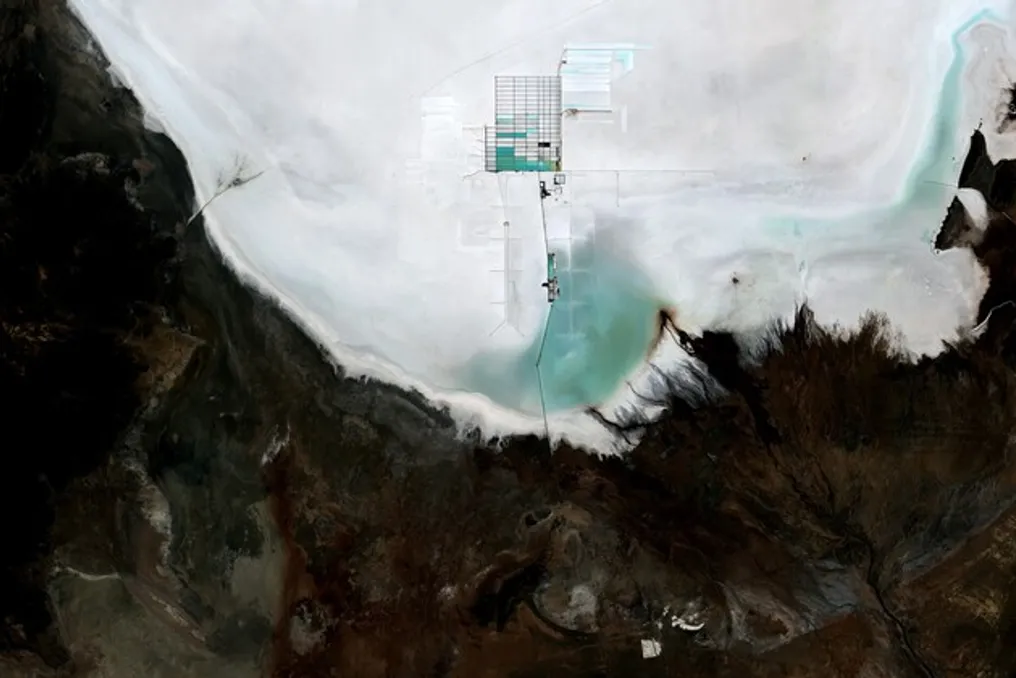
Every architectural project uses materials that, in their origin, are extracted from distant locations, such as sand, stone, or lithium. These inputs arrive at their destination after a complex logistical process involving transport and customs clearance, which completely obscures their original provenance. Although architecture treats these materials as readily available, it is at the moment of extraction that the construction process truly begins.
Global trade in sand and minerals
The world trade in construction sand operates on a scale comparable to the illicit markets for wood, gold, and fish combined, utilizing violent networks that endanger the lives of journalists and activists. In one example from Tuscany, a single mountain produced more marble recently than in the previous two thousand years, exploited by a workforce whose history of resistance has been widely ignored.
In salt flats across three South American countries and in the copper belt of Central Africa, minerals destined for a more sustainable future are removed from lands inhabited by indigenous communities for generations, and in some cases, mined by children. Although each transaction is presented as common trade, it also represents a territorial transaction whose terms were defined far from the site of material removal.
The political dimension of raw materials
The link connecting sand, stone, and critical minerals is not just the distance traveled, but who resided at the extraction site and the minimal decision-making power this population held over the transaction. Examples include a riverside community in Cambodia, a quarry town in the Apuan Alps, and an indigenous family witnessing the drying up of a valley in Argentina. None of these groups participated in signing the contract that determined the fate of their lands.
Understanding a marble facade or a battery pack merely by its finish implies accepting a depoliticized narrative, ignoring that all phases of the process involve who controls the land and who is forced to abandon it.
The sand industry worldwide
Globally, annual sand consumption reaches fifty billion tons, classifying it as the planet's largest extractive industry, with a projected growth of up to 45% by 2060. However, civil construction requires angular and coarse sand transported by rivers and coasts, unlike desert sand, which is not suitable for binding concrete. This need forces the industry to extract the material from other locations, creating a contradiction between abundance and scarcity.
A specialist from the Federal Police in Brazil, focusing on extractive industries, estimates that the global illegal trade in sand moves between two hundred and thirty-five billion dollars annually, surpassing the sum of illegal wood extraction, gold mining, and fishing. Despite this, sand receives little scrutiny because it is viewed as a common resource, and legal and black market material are indistinguishable on the construction site. In India, illegal sand mining has become the largest organized crime activity, resulting in hundreds of deaths, and in 2019, a journalist was murdered for exposing corruption linked to this practice.
Geopolitics and environmental impact
The dynamic between suppliers and consumers carries a strong political charge. In Southeast Asia, there was a dispute between Singapore, the importer, and Malaysia, which restricted exports. The demand for maritime landfills in Singapore led to illegal sand dredging in Cambodia and Indonesia, causing the territorial expansion of one country to occur at the expense of another's decline.
In the Mekong River basin, sand extraction is intense in Cambodia and Vietnam, driven by real estate growth, affecting the six riparian nations that have little decision-making power over a trade shaped by geopolitical rivalry and domestic demand. Singapore's reclaimed coast is, therefore, transferred geology, built from the margin of another country.
An independent ecologist studying the Mekong Delta points out that legislation classifies sand merely as a common material, ignoring its structural role in maintaining territory. Continuous extraction can force the redrawing of the delta map due to coastal erosion and riverbank deformation.
In extraction areas, populations suffer from forced displacement due to bank erosion and housing collapse. Meanwhile, financial profits concentrate in distant urban centers. Furthermore, sand mining reduces the water table, forcing destitute farmers to migrate to cities that depend precisely on the extraction that displaced them, perpetuating a vicious cycle.
Marble and the history of exploitation
More marble has been taken from Carrara in recent decades than in the previous two thousand years, with annual production reaching about four million tons. The Apuan Alps host more than 650 distinct quarries, exceeding the number of active quarries throughout the entire United States, a much larger country than Carrara.
The workforce involved in this extraction has its own political history. In the late 19th century, Carrara was a hub of anarchism in Italy, especially among quarry workers, many of whom were ex-convicts or fugitives. They revolted against working conditions, organizing under anarchist principles (the Lunigiana revolt). The Italian state severely repressed the uprising, leading many workers to emigrate to the United States, where they found employment in marble and granite quarries in Vermont.
This connection persisted: two Carrara companies, R.E.D. Graniti and Mazzucchelli Marmi, currently operate the Danby quarry in Vermont, the world's largest underground marble quarry. The marble does not stay in Carrara, and the former extractors never had lasting rights over what they took. Large blocks are exported, where cheaper labor manufactures luxury cladding and furniture. Thus, the city lost much of its artisanal industry.
China has become a major buyer of raw blocks, absorbing more than half of certain exports, while the United States remains the main market for finished slabs and pieces. A material formed by the compression of a mountain range travels twice through global supply chains before reaching a kitchen, proving that the value of marble resides not only in the stone but in the geography it crosses.
The extraction process generates dust that contaminates regional aquifers, rendering water unusable for consumption, and eroded slopes that cause geological instability, increasing the risk of landslides and floods. Such dangers have already caused major displacements, such as a flood in 2014 that required the rescue of four hundred people. Anna Marson, former regional secretary of Tuscany, proposed a stricter environmental regulation plan in 2014 but faced an intense campaign of opposition from quarry owners.
Critical minerals and the energy transition
While sand and stone represent ancient forms of extraction, the minerals driving the energy transition mark a more recent and ideologically complex chapter. To meet zero-emission targets, global lithium production must increase more than fivefold by 2030, demanding over one hundred billion dollars in new investments. This forces us to question what the acceptable cost is for the mineral that promises to reduce global emissions.
Argentina, Bolivia, and Chile hold more than half of the known lithium resources, concentrated in high-altitude salt flats. Chile possesses about a quarter of global reserves, much of it in the Atacama Salt Flat, ancestral territory of the Lickanantay people. Extraction involves pumping millennia-old underground brine into evaporation tanks, consuming between 450,000 and 650,000 liters of water per ton of lithium carbonate. In Atacama, miners are accused of depleting up to 65% of the region's vital water sources.
An indigenous activist, who grew up near the oldest lithium mine in Argentina, in the Salar del Hombre Muerto, reported how this depletion affects a family: a river that sustained llamas, goats, and sheep was diverted and dried up due to lithium production, leaving a valley that, according to him, 'was once beautiful' and today 'there are no animals because everything is dry.' Researchers from the University of Chile confirm this degradation through satellite analysis.