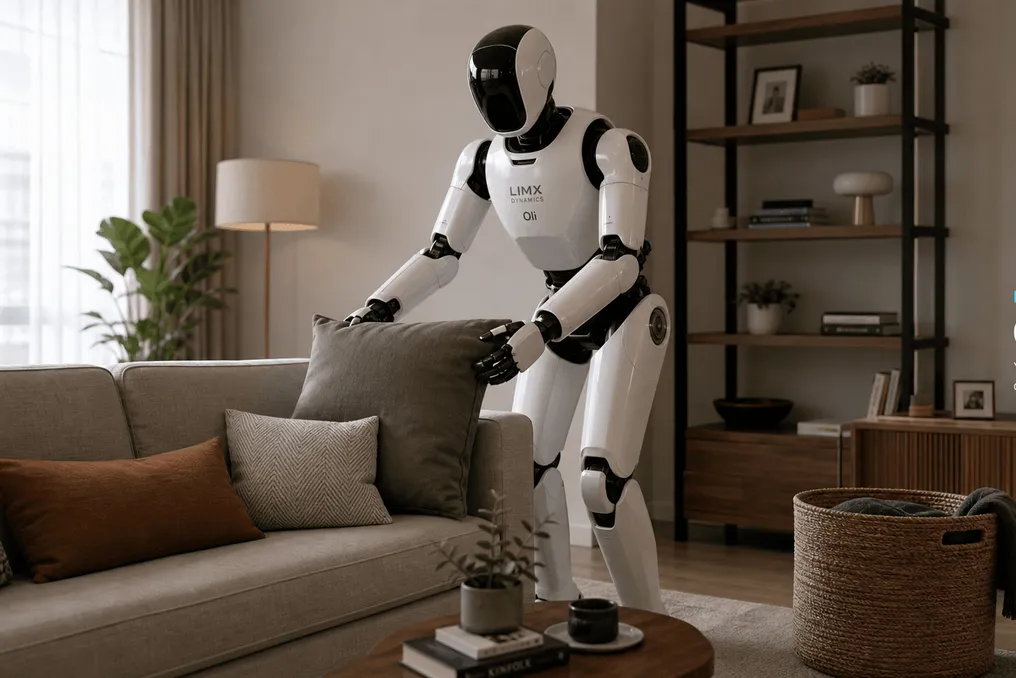
LimX Dynamics has demonstrated how the full-sized humanoid robot Oli is capable of independently performing prolonged household chores in a real living space without requiring remote control or editing.
Demonstration of Autonomous Tasks
The robot, featuring 31 degrees of freedom, continuously performed a series of household duties in one uninterrupted cycle, including folding clothes, organizing items, stacking boxes, collecting trash, and delivering water. This achieved level of long-term autonomous manipulation places LimX second in the world, alongside the company Figure.
COSA 0.5 System Concept
The breakthrough is attributed to LimX's COSA 0.5 brain architecture, which consciously rejects the commonly accepted industry model for brain function. Founder Zhang Wei asserts that equating a large model with brain functions is erroneous. He compares a pure large model to Stephen Hawking lying in bed: extremely intelligent but completely incapable of movement. In Zhang Wei's view, the brain is a system that organizes cognitive abilities, skills, and motor control into a single architecture operating on a real physical body.
Multi-Level System Architecture
The COSA system implements a three-stage architecture, S2-S1-S0, functioning across different time scales. The S2 Cognitive level acts like the prefrontal cortex, utilizing an LLM/VLM agent for scene understanding, memory, world modeling, reasoning, and human interaction. This level determines which actions need to be performed. The S1 Skills level provides a set of trained capabilities, including Vision-Language-Action (VLA) models for generating full-body motion. At the S0 Motion Control level, it works with a 10-million-parameter Whole Body Trajectory (WBT) policy at a frequency of 1000 Hz directly on the device, translating arbitrary target movements from higher levels into balanced, coordinated joint commands.
Company Advantages and Strategy
These layers interact through intentionally narrow interfaces: intent is passed down, and the robot's state is passed up asynchronously, without blocking operation. This architecture allows for stable iteration, something approaches based on a single model cannot achieve. Each layer can be updated, replaced, or fine-tuned independently without affecting the others. In the Oli demonstration, reinforcement learning was used on the real robot, where experts remotely corrected errors, while S0 maintained balance autonomously. Collected data was used to train reward models, and RL continued to iterate on the real robot, making the system stronger with each use, rather than stopping after initial training.
The home demonstration also confirmed LimX's strategic focus on out-of-factory applications. While most embodied AI companies focus on industrial deployment, LimX CEO Zhang Wei is orienting humanoids toward commercial service, hospitality, entertainment, and domestic care markets, where value is created through physical interaction similar to human interaction. The possibility opened up by COSA 0.5 makes this strategy increasingly plausible, demonstrating that a system designed for consumer applications can achieve world-class performance in autonomous manipulation.