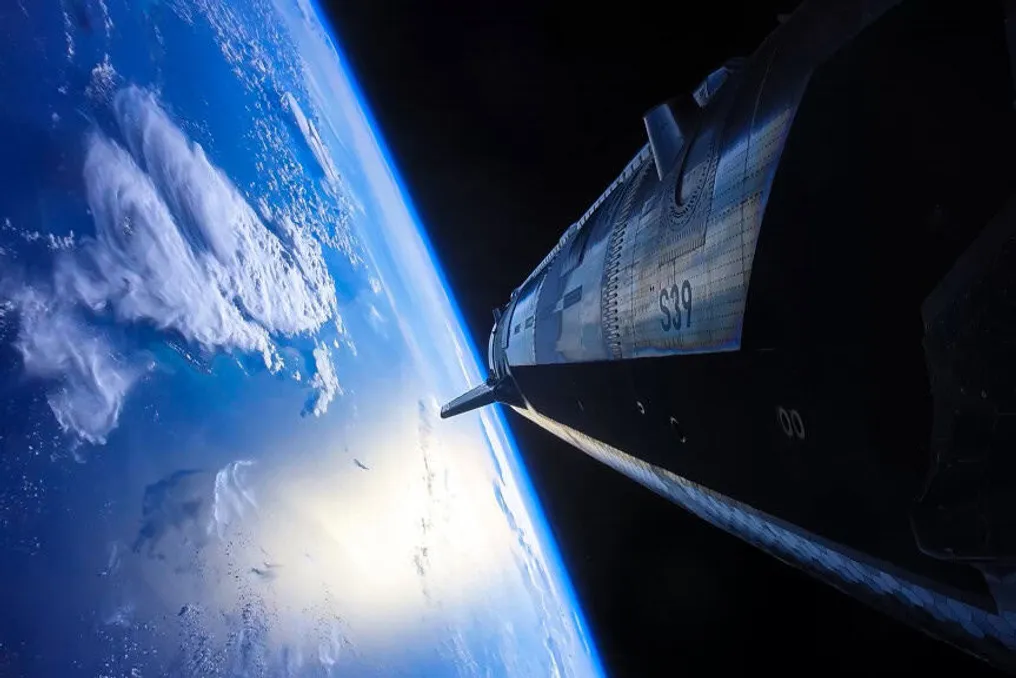
SpaceX has received authorization from the U.S. Federal Aviation Administration (FAA) to conduct another test with Starship, following a detailed investigation into the failure that occurred in the Super Heavy booster during the flight in May.
Changes after the investigation
This new launch will be the second of the V3 version of the rocket and will also mark the introduction of the first Starlink V3 satellites, which are essential for expanding the company's space internet network. The event is scheduled for next Thursday, the 16th, with an expected time between 7:45 PM and 9:15 PM, Brasília time.
The project revision was motivated by the failure observed during the 12th flight. In May, the Super Heavy was supposed to simulate a landing in the Gulf of Mexico, but the engines failed to reignite properly after stage separation. According to SpaceX, small discrepancies in engine ignition caused an unwanted 90-degree rotation in the booster.
Technical improvements implemented
After meticulous analysis, the company adjusted the ignition sequence and implemented corrections aimed at greater reliability in reignition. The FAA also identified other contributing factors, such as thermal effects on propulsion system components during the rocket's ascent and inadequate settings in the engine alarm system.
The announced modifications include adjustments to the engine ignition system, enhancements to booster reignition reliability, changes to alert and mission abort protocols, as well as modifications to both hardware and operational procedures.
Highlighting the Starlink V3 satellites
In addition to validating the corrections made to the Super Heavy, the next flight aims to place 20 Starlink V3 satellites into orbit. These satellites are larger and more powerful than previous models. SpaceX reported that they will use high-capacity lasers to connect to the main Starlink constellation and will disintegrate in the atmosphere approximately twenty minutes after launch.
Six of these satellites will be equipped with cameras intended to capture images of the external surface of the Starship, providing crucial data for engineers to analyze the vehicle's behavior throughout the flight.
Starship strategy and future
SpaceX's approach remains firmly anchored in the philosophy of 'fly, fail, correct.' Each launch serves as a source of valuable information to refine the design and bring the company closer to its goal of operating a completely reusable system.
The current expectation is to confirm whether the changes applied after the May test resolved the problem faced by the Super Heavy. Positive performance in this flight will strengthen the company's plans to expand Starlink and prepare for future missions to the Moon and subsequently Mars.
Historical summary of flights
The flight history includes: Flight 1 in April 2023, where Starship exploded attached to Super Heavy due to engine failures; Flight 2 in November 2023, which allowed initial separation but resulted in the booster exploding and the loss of Starship; Flight 3 in March 2024, which achieved a significant advance in about 50 minutes despite being lost before the planned landing; Flight 4 in June 2024, with controlled landing of Starship in the Indian Ocean and Super Heavy in the Gulf of Mexico; Flight 5 in October 2024, where SpaceX captured the Super Heavy on the launch tower and Starship performed a controlled reentry; Flight 6 in November 2024, with controlled booster landing and in-space engine reignition; Flight 7 in January 2025, which ended with the loss of Starship after an explosion; Flight 8 in March 2025, where the upper stage lost stability eight minutes after launch and was destroyed; Flight 9 in May 2025, which marked the first reuse of Super Heavy but had partial experiments compromised by failures; Flight 10 in August 2025, meeting goals such as satellite simulator tests, in-space engine reignition, and controlled reentry; Flight 11 in October 2025, successfully concluding the V2 phase, including controlled landing of Super Heavy and spacecraft reentry; and Flight 12 in May 2026, the first V3 version test, which showed notable advances but suffered a Super Heavy failure upon attempting return because the engines did not reignite correctly after separation.