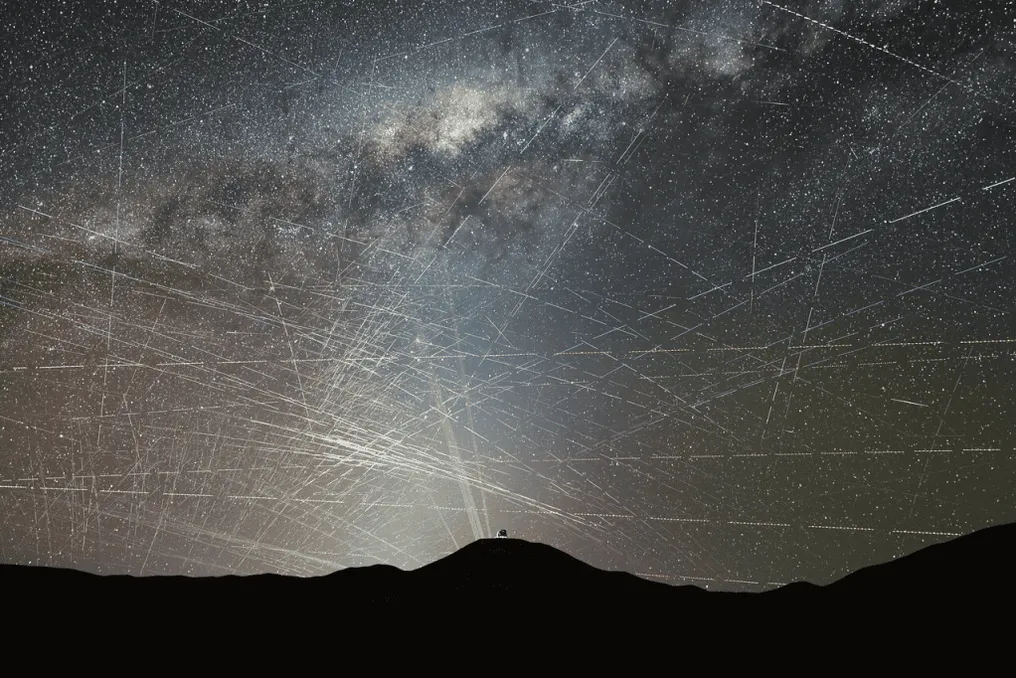
The Starlink constellation recorded a record volume of maneuvers aimed at avoiding collisions, exceeding 355 thousand in just one year. This data indicates the growing level of competition in Earth's orbit.
The Starlink constellation recorded a record volume of maneuvers aimed at avoiding collisions, exceeding 355 thousand in just one year. This data indicates the growing level of competition in Earth's orbit.
Data provided by SpaceX to the Federal Communications Commission (FCC) has alerted specialists to the progressive increase in the danger of space accidents, according to Space.com. There has been a notable growth in preventive maneuvers: between December 2025 and May 2026, 207,152 maneuvers were performed, compared to 148,696 in the previous semester. In total, over 355 thousand deviations have been surpassed, a figure more than three times that registered in 2024. On average, each satellite performed more than 40 maneuvers during this period.
This movement reflects the rapid expansion of the Starlink constellation, which increased from approximately 6 thousand to over 10 thousand satellites in two years. Simultaneously, the total number of active spacecraft in orbit grew from about 10 thousand to 16 thousand.
The satellites operate at altitudes ranging between 480 and 550 kilometers and automatically change their route when the probability of collision exceeds three in ten million. The figures released by SpaceX detail this scenario: over 355 thousand annual maneuvers, an average of over 40 deviations per satellite, the constellation expanding from 6 thousand to over 10 thousand units, and the increase from 10 thousand to 16 thousand operational spacecraft.
Despite the system being automated, the increase in space traffic makes the operation increasingly complex. Hugh Lewis, Professor of Astronautics at the University of Birmingham, predicts that the challenge will continue to grow, stating that a situation is approaching where a collision involving an operational satellite will occur, and this will not be due to failures in prevention attempts, but despite them. The researcher clarifies that each deviation reduces the risk of collision to about one in a million; however, when hundreds of thousands of maneuvers are part of the routine, this probability becomes significant in the overall operations.
Tommaso Sgobba, director of the International Association for the Advancement of Space Safety, considers this scenario predictable, as the greater the number of satellites in the same orbital region, the greater the potential crossings. He adds that fluctuations caused by space weather complicate the precise prediction of trajectories, forcing operators to perform preventive deviations that might not be strictly necessary. For this reason, experts advocate that new mega-constellation projects must present regulatory bodies with estimates of the number of maneuvers before receiving launch authorization, given that this planning will become crucial alongside the technology itself.
A new advance in the competition for satellite internet services occurred early Thursday morning with the launch of 29 satellites belonging to the Amazon Leo project. These satellites were placed into low orbit using an Atlas V rocket, bringing Amazon's operation closer to offering an initial service.
The launch, conducted in Florida, demonstrates Amazon's accelerated pace in this market, which is currently dominated by Starlink, according to Space.com. The 29 new satellites were deployed into low Earth orbit and their confirmation was received about 70 minutes after liftoff, according to ULA. The vehicle used was the Atlas V in the 551 configuration, considered the most powerful in its line.
This version of the rocket carried a payload of approximately 18 tons, setting a previous record for the mission itself. With this shipment, Amazon Leo now has about 400 satellites positioned in space, resulting from 15 launches so far.
The goal of Amazon Leo is to establish a global network composed of approximately 3,200 satellites in low Earth orbit, aiming to compete directly with Starlink, which already operates over 10,000 satellites worldwide. According to The Verge, Amazon already has enough satellites to start a limited service in certain regions, with initial coverage focused on specific latitudes. This scenario recalls the early stages of Starlink, when its service was restricted and unstable for few users.
Initially, the service performance is expected to vary depending on the location. Expected parameters include speeds between 50 Mbps and 150 Mbps, latency ranging between 20 ms and 40 ms, as well as a connection that may be unstable in areas with poor coverage, with progressive improvements as new satellites are launched.
Despite constant progress, Amazon still faces obstacles in maintaining the planned speed for its constellation. Part of this delay is related to the launch schedule, which was affected by setbacks in the development of the New Glenn rocket, manufactured by Blue Origin. This factor has reduced the deployment frequency, while SpaceX maintains a considerable advantage due to the consolidation of its network.
Nevertheless, the recent advance signals an acceleration. It is predicted that the commercial service will begin to take shape by mid-2026, as more satellites are incorporated and coverage becomes more uniform globally.