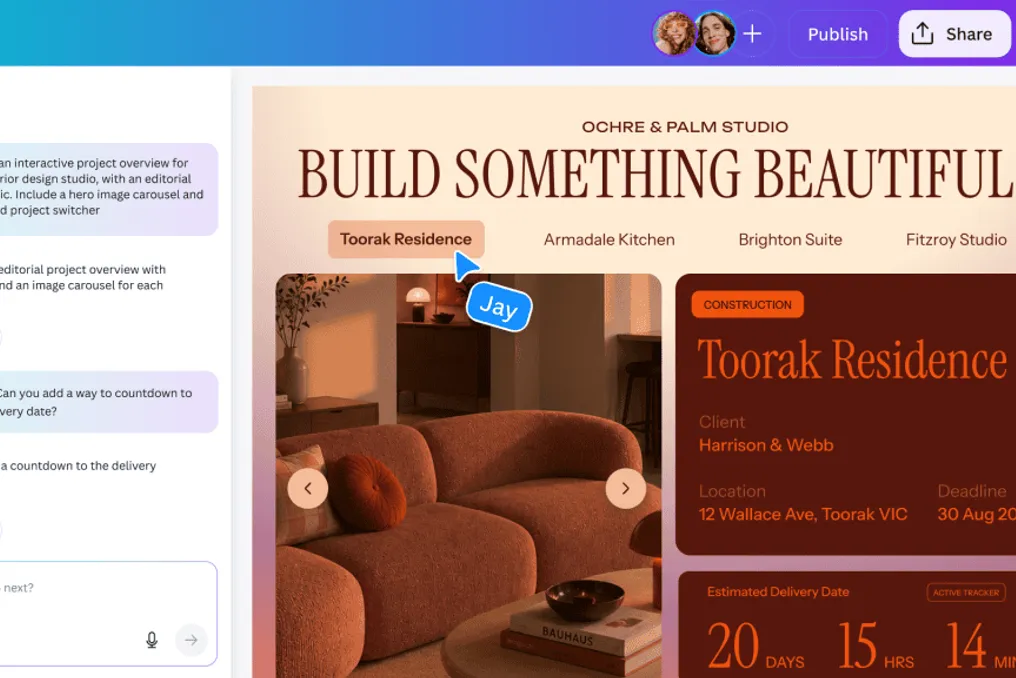
Canva announced the worldwide launch of Canva Code 2.0, an update to its interactive experience creation tool that utilizes artificial intelligence (AI). This technology, previously a research preview presented at the Canva Create 2026 event, is now officially integrated into the platform's Visual Suite as a native design format.
No-code development
With Code 2.0, users gain the ability to develop websites, applications, games, and other digital materials without needing to write any code. The company makes this feature available to all users, promoting the concept of 'vibe coding,' which involves generating applications through natural language commands assisted by AI.
Focus on design and market
By launching this functionality, Canva enters competition in the 'vibe coding' tools market, a segment that the company itself estimates has the potential to reach US$22 billion (equivalent to BRL 112 billion) by 2030. Unlike other platforms focused on traditional software development, Canva designed Code 2.0 with a design-centric perspective. The goal is to ensure that generated projects maintain the visual identity of brands, companies, and creators, and do not appear merely as AI-generated content.
The company notes that the advancement of AI-based programming tools has considerably increased the number of non-developer users. Data provided by Canva indicates that 63% of users of AI programming tools are not developers. However, the company points to a 'trust paradox' in the sector: despite it being easy to create functional prototypes using text commands, the results are often generic and offer little room for customization without technical knowledge.
Advanced editor features
To solve this issue, Code 2.0 combines AI models with Canva's already well-known visual editor, used by over 265 million users globally each month. Among the innovations is a fully interactive canvas that allows for the visual editing of projects. Users can manipulate elements such as colors, fonts, and text, dragging images from the Canva library, all without needing to restart the project or send new commands to the AI.
Another important feature is the ability to import HTML files. This allows users to upload code created manually or by other AI assistants and transform it into fully editable projects within the Canva environment. Furthermore, the tool supports conversational editing focused on specific parts of the screen, allowing the user to select components and request adjustments via text, even using images as references to guide visual modifications. The platform also offers options to publish projects on a custom domain or via secure corporate login (SSO), and information collected in forms and interactive experiences can be automatically integrated into Canva Sheets.
Results and impact in Brazil
Canva communicated that since the beginning of the technology's testing period last year, Canva Code has been used in the creation and publication of more than six million websites worldwide. The tool's infrastructure was specifically optimized to serve Brazilian marketing teams, small and medium-sized enterprises, and educators.
The results presented by the company show a 75% reduction in the average time spent generating code, which dropped to approximately 45 seconds. Additionally, the time lapse between drafting the first sketch and publishing an interactive experience decreased by about 30%.
Democratization of access
Alberto Ceresa, Canva's Country Manager in Brazil, stated that the new tool aims to reduce both the technical and financial barriers that professionals and companies face during the digitalization process. He emphasized that Brazil has many entrepreneurs and creatives looking to accelerate their businesses but often run into technical and budgetary obstacles when digitizing their products. According to Ceresa, Canva Code 2.0 democratizes access, replicating what static design achieved ten years ago, but now with interactive development.
Ceresa concluded that the platform will empower Brazilian companies, marketing professionals, and educators to create landing pages, portfolios, and educational games that not only function but also faithfully reflect their brand identity, combining cutting-edge AI technology with the intuitive editor that the Brazilian public already knows and trusts.
Global availability
Canva Code 2.0 is globally accessible, including support in Brazilian Portuguese. Access can be made directly from the platform's homepage by selecting the new design type, or through the 'Elements' tab, which allows incorporating interactive code components into existing presentations, documents, and whiteboards.