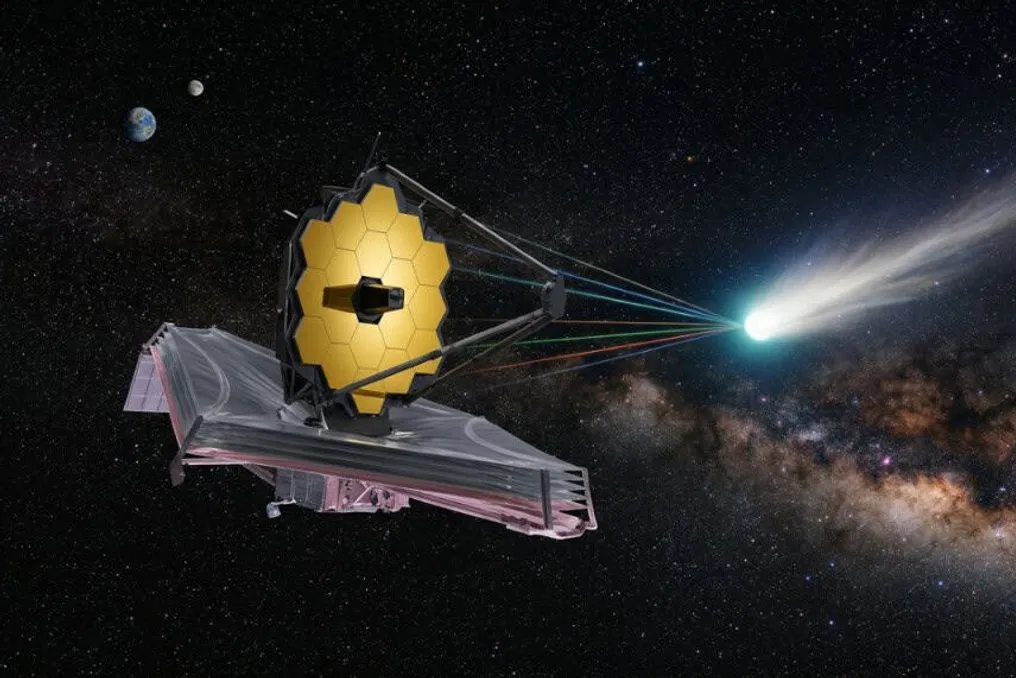
The James Webb Space Telescope has revealed the existence of a new giant planet located outside our Solar System. This celestial body, named Beta Pictoris d, was previously hidden in one of the most investigated planetary systems in our galaxy.
Identification through chemical signature
According to NASA, the discovery was not based solely on visual images, but rather on the identification of the 'chemical signature' present in the planet's atmosphere.
Details of the Beta Pictoris system
The Beta Pictoris system, located 63 light-years from Earth, was already known to possess two giant planets: Beta Pictoris b and Beta Pictoris c. With this new confirmation, astronomers have established the existence of a third member, Beta Pictoris d.
The investigation was conducted by Aidan Gibbs, a postdoctoral researcher affiliated with the University of California, San Diego, and the results were published in the journal Astrophysical Journal Letters. Gibbs commented that this finding adds an element to an already notable planetary system, suggesting that Beta Pictoris serves as a natural laboratory for studying the formation and evolution of planetary systems over time.
How the discovery was made
It is relevant to note that the team's primary objective was not to find a new planet. The researchers were analyzing the planet Beta Pictoris b using the James Webb's NIRSpec instrument when they detected an unusual signal in the collected data. The observed pattern pointed to the presence of carbon monoxide, a characteristic indicator of giant planet atmospheres.
Characteristics and composition of the planet
Spectral analysis allowed scientists to confirm that the object in question was indeed a planet, ruling out hypotheses of it being a distant star or another type of space body. Furthermore, this methodology allowed for determining aspects of its composition and movement. The main estimates for Beta Pictoris d include:
- Mass greater than twice that of Jupiter;
- Being the smallest of the three known giant planets in the system;
- Having an orbit located approximately 30 astronomical units from the star;
- Having a distance comparable to the region inhabited by Neptune in the Solar System.
Subsequently, observations made with the MIRI instrument, also belonging to Webb, identified water vapor and methane in the planet's atmosphere, which strengthened the confirmation of its nature. Jean-Baptiste Ruffio, a scientist at the University of California, San Diego, highlighted the value of this technique, stating that it allows not only identifying a planet but immediately beginning to study its temperature, chemistry, and movement.
Implications for astronomy
Beta Pictoris d remained hidden for several years due to its location within one of the brightest debris disks ever observed. The dust surrounding the star acts as a barrier, complicating the distinction between planets and other celestial structures.
The technique employed by Webb allows for the search for specific atmospheric chemical signatures, even in more complex environmental scenarios. This discovery not only contributes to a deeper understanding of the Beta Pictoris system but also demonstrates that spectroscopy can open new avenues for locating distant worlds that escape traditional observation methods. Researchers plan to continue analyzing the James Webb data to obtain more information about the trajectory, atmospheric composition, and temperature of Beta Pictoris d. The telescope operates as an international mission coordinated by NASA in collaboration with the European Space Agency (ESA) and the Canadian Space Agency (CSA).