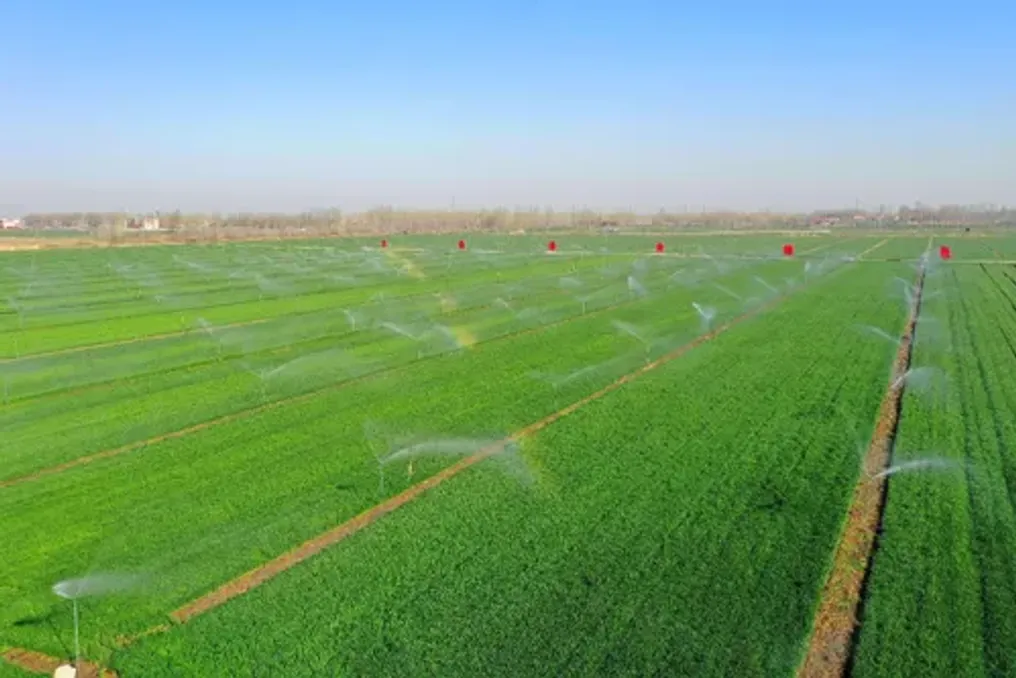
Agricultural lands in Shandong province, eastern China, are undergoing a technological revolution that is changing irrigation methods, crop management, and cultivation practices, despite the persistence of traditional agricultural rhythms.
Addressing Water Resource Issues
In Hupizhangsi village, a farmers' cooperative, Director Ye Zitao noted that previously irrigation was a serious logistical problem, as several households had to use a single well, and waiting for watering could take three or four days. Now, thanks to the construction of a pipeline network that supplies water from the Yellow River directly to the fields, the system operates without delays or competition for water.
Ninzhen District, located at the end of the Dezhou Yellow River irrigation system, long faced water scarcity and over-exploitation of groundwater. To solve these issues, a major water resource improvement project was launched, which included dredging 114 kilometers of key waterways, constructing or upgrading 14 sluice gates and pumping stations, building 12 reservoirs, and increasing the region's river water reserve by 5 million cubic meters, significantly boosting irrigation capacity.
Precision Resource Management
In addition to securing water, efficient use of it has become critical. Farmer Wang Yuchi from the Shiqi planting cooperative in Ninzhen now uses a smartphone to monitor soil moisture and water consumption data in real time. This has allowed a shift from traditional flood irrigation to drip irrigation and integrated water and fertilizer management, ensuring more precise resource utilization.
In the unmanned farm in Jiaociao commune, Zoupin, a farming complex equipped with an autonomous combine supported by BeiDou and TianTong satellites, as well as remote sensing technologies, automatically harvests wheat. This transition from fighting for water to precision water management reflects a broader transformation in Shandong.
Combating Soil Salinization
In Uchuan village, Kenli County, Duning, 107 hectares of wheat fields became lush after this land was heavily salinized four years ago, having an average salt concentration of 16 parts per thousand. The transformation was achieved using a locally developed 'closed double subsurface drainage system' technology. The method involves vertically installing plastic barriers to prevent saline water intrusion and laying two underground drainage pipes: the upper layer flushes salt from the soil, while the lower layer blocks the rise of saline groundwater. Experts claim that this solution can prevent re-salinization for 50 years after a single application.
Within one to two years of implementation, the technology reduced soil salinity from 16 to 3 parts per thousand, restored the pH to nearly neutral levels, and corn yield reached 600 kilograms per mu, turning barren land into productive land.
Drones and Smart Farming
Technology is also changing daily farm management. In Linshu, Linyi, plant protection drones fly low over crops, evenly spraying water and nutrients onto wheat seedlings. Yu Lei, a 45-year-old grain farmer from Diantou commune, noted that previously fertilization and irrigation were based mainly on experience, whereas now he can see temperature, humidity, and crop condition in real time by pressing a button on his phone, making precision management easier and more effective.
This transformation is driven by the district's 'smart agriculture' monitoring system. Since last year, 200 monitoring stations have been installed in Linshu across the district to collect data on soil moisture, temperature, humidity, and other key indicators. This data is uploaded to the 'smart agriculture' big data platform, which provides farmers and support service providers with accurate decision-making tools. Agricultural machinery operator Wang Lei, working with a crop protection drone, emphasized that the mobile platform allows him to control the drone's flight paths, soil data, and crop growth, making precise fertilization and scientific irrigation the standard.
Automation and Robotics
Similar scenes are observed in the unmanned 'smart' farm in Wali village, Anjiazhuan commune, Tai'an, Shandong. Technician Wang Xinwen uses a tablet to control a robotic machine for pesticide spraying. He explained that after setting the route, the machine moves autonomously, and the screen displays soil moisture levels and insect damage on leaves, allowing easy adjustment of the spray angle.
According to Professor Chen Guocun from Shandong Agricultural University, the robot uses centimeter-level navigation based on the BeiDou satellite system, and the digital control platform processes images in real time. The robot achieves 95% targeting accuracy when applying pesticides and reduces chemical use by 40%, covering over 13 hectares per day, which is ten times more efficient than manual labor. Chen added that renting such robots can reduce operational costs by 60% per hectare and labor costs by 40%, with the cost of one unit being about 20,000 yuan, and the goal is to develop affordable and reliable smart equipment for ordinary farmers.