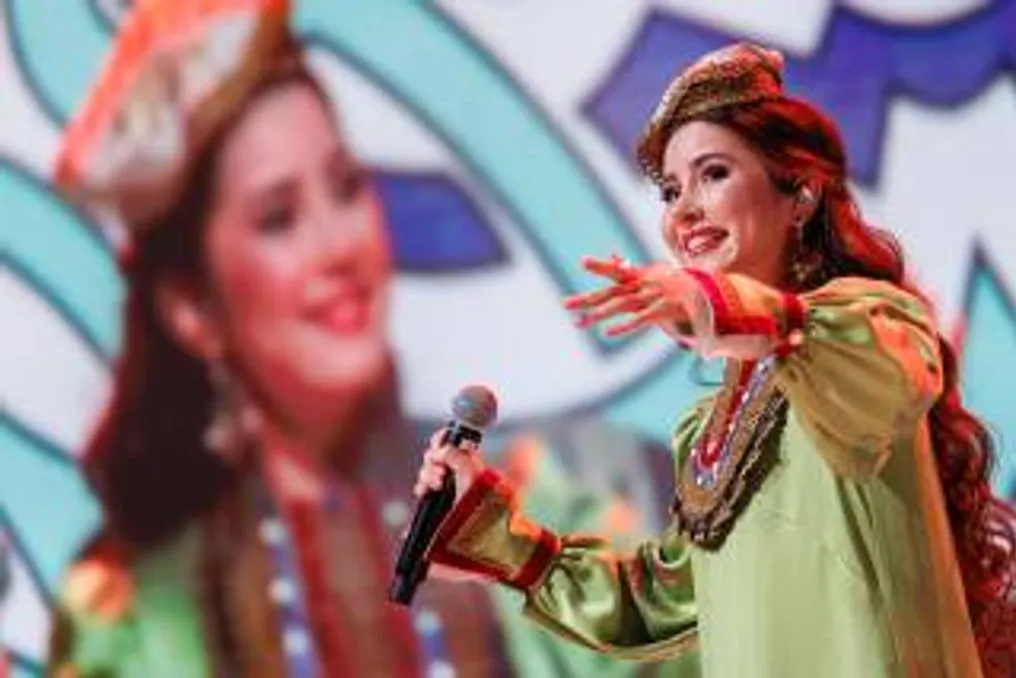
Saida Mukhametzyanova, an artist working in the Republic of Tatarstan, shared in an interview how her album, consisting of folk songs, managed to surpass federal stars and reach a high level. She also spoke about her participation in the 'Ovoz' music project in Uzbekistan and how her song became popular on the Apple Music platform.
Musical Path and Traditions
The artist emphasized that her main goal has always been the wide promotion of Tatar song and culture worldwide. She reported that she plans to complete a second album dedicated to Tatar folk songs and release it on all music platforms this year. Her first album, released about three years ago, contained ten Tatar folk songs, and shortly after its release, it entered the charts of one of the most popular Russian music platforms, holding the fifth position and surpassing many famous performers.
Mukhametzyanova insists on the importance of preserving roots, asserting that folk art is what maintains this connection. She believes these works are not just simple three-note songs but deep canvases that should not be simplified for modern listeners. Although many regional artists release mini-albums of five compositions, she prefers to adhere to the traditional format to present rare Tatar folk songs to the general public, thereby contributing to the global dissemination of this invaluable musical heritage.
Globalization and Language Preservation
She noted that in today's rapidly changing world, the issue of preserving the native language remains extremely relevant. Mukhametzyanova stated that some Tatar artists allow the use of foreign languages under the pretext of striving for modernity. Meanwhile, while traveling, she observed the achievements of Central Asian countries that actively develop and promote their native languages. She questioned why other countries succeed in this area while they themselves cannot.
In these countries, in her observation, state languages are used everywhere—on banners, in advertisements, on road signs, and television is broadcast predominantly in the national language. The people sincerely care about their culture, and trends in social networks are formed in the national language, while national styles are widely used in fashion. In Uzbekistan, Kyrgyzstan, and Kazakhstan, films are shot in national languages across various genres, and in Kyrgyzstan, viewers prefer local films over foreign ones.
Participation in the 'Ovoz' Project
Speaking about her participation in the 'Ovoz' music project in Uzbekistan, she explained that she learned about the competition through social media, and her mother advised her to apply. She decided to give it a try since she saw no reason to refuse. The organizers asked her to perform a song in the Tatar language, which matched her desire. The initial difficulties began on the day of the performance, as the film crews were almost formed. She arrived in Uzbekistan early in the morning, having slept only three hours, because she was supposed to be on set by 11 am.
Arriving at the competition alone, she went through preparation with stylists who did her makeup and styled her hair. For the stage appearance, she wore her simple red blouse and decorated it with national elements—an izh and a kalpak. She chose the song 'Gulzhamal' for the Uzbek audience, recognizing it as one of the most difficult, requiring a wide vocal range. She promised herself that she would definitely perform this song, despite the lack of rehearsals, having only prepared for microphone setup before going on stage.
Her main goal was to join Sevara Nazarxon's ensemble. When she was told that there were no open spots in the jury, and the Ministry of Culture of Uzbekistan's team was already full, she was disappointed. However, being among the last participants, she went on stage, and her fears vanished: immediately four judges approached her, and Sevara Nazarxon herself was the first. She realized that if a person sets a clear goal, they will surely achieve it.
Working with Sevara Nazarxon
Later, she was asked why she didn't choose the Ministry of Culture of Uzbekistan. She explained that, firstly, there were no open spots, and secondly, she came to Uzbekistan specifically to work with Sevara Nazarxon. Collaborating with her proved challenging, as Sevara Nazarxon is a very demanding mentor. Every meeting turned into an intellectual discussion where she was encouraged to think independently, seek new solutions, improvise, and present the song in a completely new way.
She recalls sending her many voice messages, and Sevara Nazarxon would reply: 'This version is not suitable' or 'too simple,' often using the phrase: 'Improvise!'. During the project, she was allocated an hour and a half for each participant, which served as a great creative school for her. Participation in the project significantly helped her future career.
Similarities Between Tatar and Uzbek Cultures
When asked about the similarities between Uzbek and Tatar art, she noted that their culture and language are very close, although not one hundred percent. She believes that although their performing arts may differ, they are similar in spirit, content, and reflection of the people's experiences. She admitted that before traveling to Uzbekistan, she did not know about the existence of maqam, but after hearing it, she wanted to perform it in the 'Ovoz' project. However, realizing that two or three lessons were insufficient to master this genre, she revised her attitude towards it.
Her favorite songs are 'Unutma meni' performed by Kumush Razzokova and 'Khaol' by Ravshan Namozov. She also listens to Ozodbek Nazarbekov and hopes to perform one of his compositions someday, as they embody national spirit, sincerity, and deep meaning. She finds narrow music very close to her and appreciates the respect for art shown by the audience in Uzbekistan. She expressed a desire to collaborate with Uzbek artists in the future, creating duets and new projects, believing that this will strengthen friendly ties between the peoples.
Career Outside Music
Besides her singing career, she is a theater and film actress, as well as a well-known blogger. Mukhametzyanova performs as a soloist at the Kazan Philharmonic, where various creative projects, including productions, are implemented. For example, in the play 'Kok Roмол', she plays the main character named Maisara.
Many know her as a film actress. She established good relations with the author and singer Zulfat Khakim. At the request of the Ministry of Culture of Russia, when filming of the movie 'Sokov Kakku' was announced, Zulfat Khakim contacted her and offered her to participate in the casting for the role of Kashifa. The casting was conducted by a producer from Moscow. The film takes place during World War II. Initially, she played in a theatrical style, but the director asked her to act more naturally, like in real life. After several trials, she received the role, entering the world of cinema.
Currently, she is actively developing her social networks, believing that in the modern world, a person needs to know how to properly present themselves online and talk about their creative plans. Advising young people who strive for success, she emphasizes the need to set very high goals. She advises young performers participating in the 'Ovoz' project to always sing in their native language, regardless of the country of participation, because an artist's individuality is revealed in their culture and language. Furthermore, she recommends constantly working on vocals, studying modern trends, and improving stage presence. Knowing foreign languages and participating in international festivals also provides valuable experience, but the most important thing is to believe in oneself and never give up on a dream.