Scientists used ground-based radio telescopes to detect the presence of erythrose—a sugar found, for example, in raspberries—in the molecular cloud G+0.693-0.027 located in the Milky Way. This finding marks the first registered case of a sugar discovery in the interstellar medium, confirming the hypothesis that such complex prebiotic molecules can form and be preserved in space, from where they may enter the composition of small celestial bodies.
The Significance of Sugars for Life
Sugars are critically important molecules for sustaining life because they participate in metabolic processes, act as structural components, and are part of the bases of DNA and RNA nucleic acids. Research into how simple sugars appeared on early Earth is necessary to understand the origin of life on our planet and its potential existence beyond Earth. It is already known that several sugars, including ribose and fructose, have been found in meteorite samples and on the surface of the asteroid Bennu, which, combined with laboratory results, allows for the suggestion that these complex compounds form in the interstellar medium.
Previous Discoveries and Challenges
To date, only glycolaldehyde—a simple diose classified as a hydroxyaldehyde close to sugars, rather than a true sugar—has been identified in interstellar clouds and comet cores. Difficulties in obtaining rotational spectra of sugars in the gas phase under laboratory conditions were recently overcome by using laser ultrafast evaporation, which allowed for the acquisition of the necessary data for analyzing ribose, 2-deoxyribose, and erythrose.
Details of the Erythrose Study
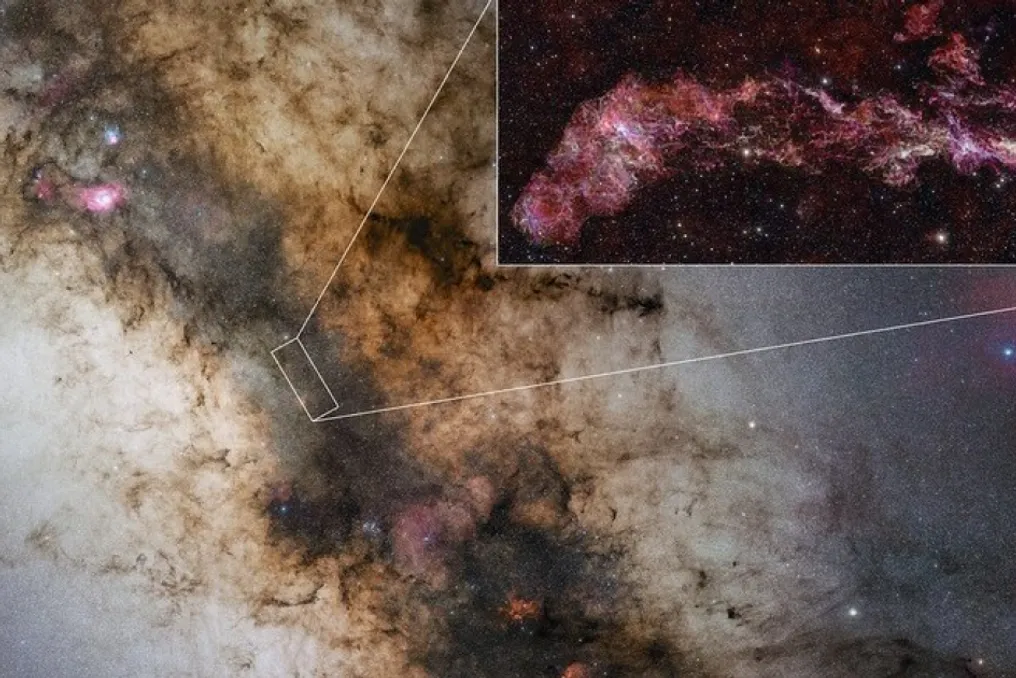
A group of astronomers led by Isaskun Jimenez-Serrano from the Spanish Astrobiology Center announced the discovery of erythrose in the interstellar medium. The scientists studied the molecular cloud G+0.693-0.027, which is located in the Galactic Central Molecular Zone, approximately 28 thousand light-years from the Sun. Observations were conducted between 2021 and 2024 using the 40-meter radio telescope of the Yepes Observatory and the 30-meter IRAM radio telescope. The cloud G+0.693-0.027 has long attracted the attention of astrochemists due to the presence of many complex molecules significant for living organisms.
Characteristics of the Discovered Sugar
Erythrose belongs to the ketoses, has four carbon atoms, and is present in raspberry berries as well as in cosmetic products. It has become the largest acyclic and the second chiral molecule identified in the interstellar medium. Its column density is 8.7 × 10^23 particles per square centimeter, which is similar to the value of glycolaldehyde also found in the cloud. Furthermore, researchers did not find traces of glyceraldehyde and dihydroxyacetone (three-carbon sugars), indicating that erythrose occurs 8–17 times more frequently than these compounds, which is unusual. Glycerin, which could serve as a precursor to erythrose, was also not found.
Proposed Formation Mechanism
Researchers believe that erythrose in G+0.693-0.027 may have formed as a result of a chemical reaction between glycolaldehyde radicals and ethylene glycol—both substances are present in the cloud in sufficiently high concentrations. This reaction possibly occurs on the solid surface of amorphous water ice covering dust particles in the interstellar medium, at temperatures characteristic of dust toward the center of the Milky Way (around 20–30 Kelvin).
Conclusions on Cosmic Origin
The discovery of erythrose serves as direct evidence that complex chiral and prebiotic molecules are capable of arising and being preserved in the interstellar medium. In the context of the Solar System, sugars could have formed in the protostellar nebula, after which they entered the composition of small bodies that subsequently bombarded the young Earth. Moreover, ketoses like erythrose can transform into treose and erythrose in an aqueous environment, potentially leading to the appearance of the TRK molecule—a possible precursor to RNA.
Other Astronomical Findings
It is also worth noting that astronomers have identified a promising candidate for an old, low-mass hypervelocity star leaving the Milky Way for the first time. It is hypothesized that the star DESI-HVS1 was previously part of a binary system that was ejected almost thirteen million years ago as a result of a close encounter with the supermassive black hole at the center of the Milky Way.