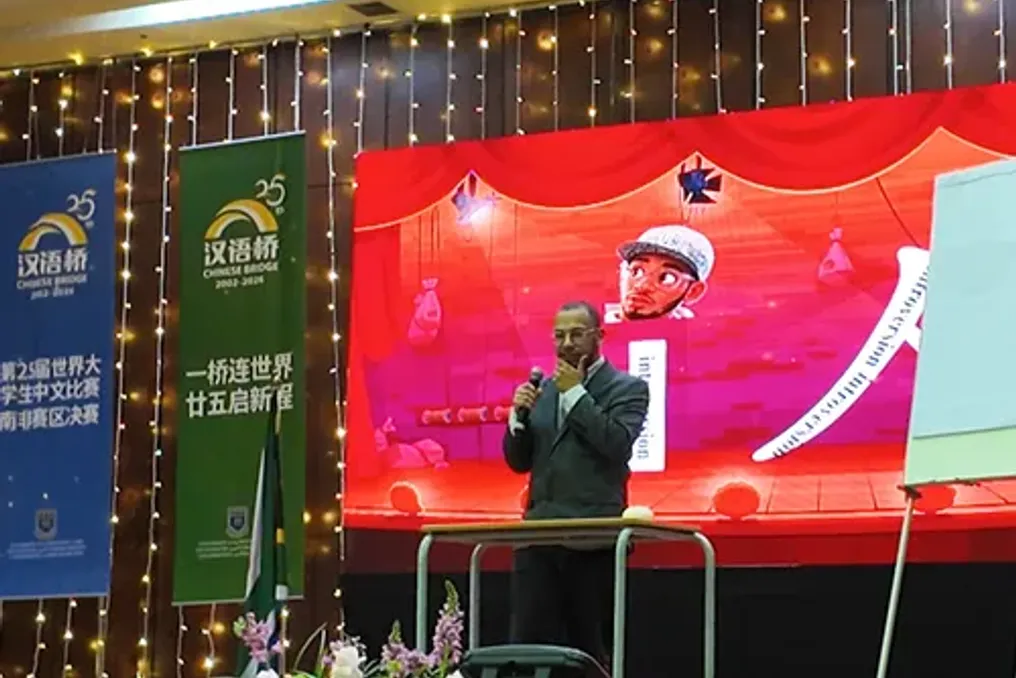
The National Final of the 'Chinese Bridge' Chinese language competition was held in Cape Town on its 25th anniversary, organized with the support of Longyuan South Africa Renewables and jointly with the Confucius Institute at the University of the Western Cape. Young South African participant Zhou Lihan delivered a brilliant performance, earning thunderous applause from the audience.
Cultural Exchange Between Countries
Language is viewed as a foundation for civilizational interaction, and human connections form the basis of cross-border friendship. This year marks the 25th anniversary of the launch of the 'Chinese Bridge' competition, the Year of Cultural and International Exchange between China and Africa, and the 10th anniversary of the integration of the Chinese language into the national education system of South Africa. The successful organization of the competition is a vivid demonstration of a decade of fruitful cultural exchange between China and South Africa and a practical example of building a China-Africa Community with a shared future.
For 25 years, the 'Chinese Bridge' has served as a link between China and the world through language, while the study of Chinese has taken root in South Africa over the past decade, exerting a soft, supportive influence. At the competition, South African youth demonstrated confidence, sincere attachment to Chinese culture, and a firm recognition of the friendship between China and South Africa, embodying the rich results of bilateral cultural exchange and heralding a bright future for cooperation.
A Decade of Development and Language Popularization
The 2025 'Chinese Bridge' competition in South Africa set a new record for scale, gathering young learners from seven Confucius Institutes across South Africa and attracting over 500 participants, including competitors, mentors, and their families. Moving away from the examination formats of traditional language competitions, participants delivered speeches based on real life and possessing a broad, forward-looking perspective. Many participants referenced the course of China-South Africa cooperation, their personal learning experiences, and social observations to share their views on Chinese culture, China's development, and bilateral friendship.
Some participants delved into the subtleties of traditional Chinese culture, revealing the essence of Chinese civilization through material carriers of culture, such as the meanings of Chinese characters, traditional festivals, and unique cuisine, tracing the origins of writing and interpreting folk rituals and culinary customs. Others compared the daily customs and educational philosophies of China and South Africa, discovering the comprehensive and humble essence of Chinese culture amidst the similarities and differences between civilizations. Additional participants focused on low-carbon development and South Africa's energy transition needs, presenting China's clean energy practices and achievements in building the Green Silk Road, offering multifaceted and concrete interpretations of Chinese culture.
Personal Experiences and Corporate Contributions
Zhou Lihan shared that participating in the competition allowed him to learn more about Chinese history and folklore, as well as meet like-minded peers. Speaking on the 'Chinese Bridge' stage, he admitted to feeling a mix of nervousness and excitement. The competition was not only a test of his years of studying Chinese but also an immersion into the charm of Chinese culture. In the future, he expressed a desire: 'My dream is to step onto Chinese soil, travel across the country, and experience vibrant Chinese culture beyond textbooks. I also hope to become a small ambassador for cultural exchange between China and South Africa.'
During the demonstration of Chinese cultural talents, young South Africans harmoniously combined traditional Chinese art forms, calligraphy, Dunhuang dance, Chinese martial arts, traditional instrumental music, and ink, with elements of indigenous African culture, creating works of art that blend Eastern charm and African characteristics, vividly illustrating the diverse appeal of intercultural exchange and mutual learning. During the Q&A session with judges, participants provided clear, objective, and profound answers to open questions concerning civilizational differences, mutually beneficial cooperation, and the responsibility of youth, demonstrating a solid understanding of the Chinese vision of 'one family under heaven' and the philosophy of win-win partnership.
Participant Sarah Jane Holmes, whose Chinese name is He Xiya, noted: 'I am deeply grateful to Longyuan South Africa Renewables for sponsoring the Chinese Bridge competition year after year. This long-standing support has provided us, South African students, with an exceptional platform to showcase our Chinese language skills and study Chinese culture.' In her view, corporate support breaks down barriers to cultural exchange, allowing more young South Africans to engage with the Chinese language and connect with Chinese culture, thereby strengthening grassroots friendly ties between the two nations.
Yang Kuo, an employee of Longyuan South Africa Renewables, participated in judging and exchange events throughout the event, personally observing the enthusiasm of South African youth for the Chinese language and culture. Yang Kuo stated: 'At this competition, I witnessed a vibrant exchange between Chinese and South African civilizations. I also deeply understood the sense of responsibility of Longyuan South Africa Renewables within the Belt and Road Initiative—taking root in local communities, stimulating cooperation through industrial development, and uniting people through cultural interaction.'
Strategic Partnership and Development
Friendship between nations stems from the affinity of their peoples, and affinity arises from genuine mutual understanding. Despite vast oceans and landmasses, China and South Africa have long traditions of friendly relations, being strategic partners marked by political trust, economic complementarity, and cultural connection. Ten years ago, the Chinese language was officially incorporated into the national education system of South Africa, marking a new phase of standardized, institutionalized, and regular cultural exchange between China and South Africa. Over the last decade, Chinese language teaching has steadily expanded across South Africa, and subtle traditional Chinese culture has gained widespread popularity through various platforms, including Confucius Institute instruction, the flagship 'Chinese Bridge' competition, and youth exchange visits. The popularization of the Chinese language has contributed to deeper mutual understanding, alignment of values, and strengthening harmony between the peoples.
More and more young South Africans, by studying Chinese, are beginning to appreciate the inclusive spirit of Chinese civilization, witnessing China's achievements in the new era of development, internalizing the core principles of wide consultation, joint contribution, and common benefit within the Belt and Road Initiative, and becoming a vital force promoting friendly cooperation between China and South Africa. After ten years of consistent long-term efforts, the Chinese language in South Africa has gone far beyond being a foreign language subject, becoming a key medium for youth communication, civilizational dialogue, as well as economic and trade relations, firmly rooted and thriving in the national education system of South Africa.
Investment and Energy Cooperation
Cultural exchange lays a solid foundation for cooperation, while industrial investment nourishes the soil of friendship. As a major Chinese energy enterprise with over a decade of local presence, Longyuan South Africa Renewables has deeply integrated into local development, realizing the vision of win-win cooperation between China and South Africa through pragmatic actions. Their De Aar wind farm is the first benchmark wind energy project in Africa developed, invested in, built, and operated by a Chinese state-owned energy enterprise, and one of the largest operational wind farms in South Africa today. This project represents a landmark achievement in energy cooperation between China and South Africa under the Belt and Road Initiative.
Since commissioning in 2017, the De Aar wind farm has provided stable clean energy generation, producing approximately 760 million kilowatt-hours of electricity annually, enough to meet the annual electricity demand of 300,000 local households. The project effectively reduces the load on South Africa's power supply, optimizes the local energy balance, and provides reliable support for the country's energy transition and low-carbon development. Throughout its operation, Longyuan South Africa Renewables adheres to a localization strategy, strictly complies with local laws and regulations, actively fulfills the requirements of South Africa's Black Economic Empowerment policy, constantly optimizes its staffing structure, and steadily increases the proportion of local staff, black employees, and female managers. Through regular professional training and systematic career paths, the company offers stable employment and opportunities for advancement to local youth, nurturing a cohort of highly qualified local technicians for wind farm operation and maintenance.
The career path of Desmond, a local employee, is an example of mutually beneficial talent development between China and South Africa. Through Longyuan South Africa Renewables' systematic training programs, he advanced from a frontline worker to a professional engineer for wind turbine operation and inspection. Possessing strong technical knowledge, he excels in his role and achieves career growth, personally benefiting from the cooperation between China and South Africa. Desmond noted: 'I am grateful to Longyuan South Africa Renewables for investing in the training of South African personnel and providing me with a job. I have acquired professional skills in wind turbine operation and maintenance, which allows me to contribute to the transition of my hometown towards low-carbon development.'
Language serves as a bridge crossing mountains and seas; human connections lay the foundation for a shared future of friendship. Today, the comprehensive strategic partnership between China and South Africa continues to deepen, the high-quality development of the Belt and Road Initiative steadily advances, and cultural exchange and cooperation between China and Africa are continuously improved, providing a broad platform for youth exchanges, industrial cooperation, and mutual learning between civilizations. Going forward, Longyuan South Africa Renewables will