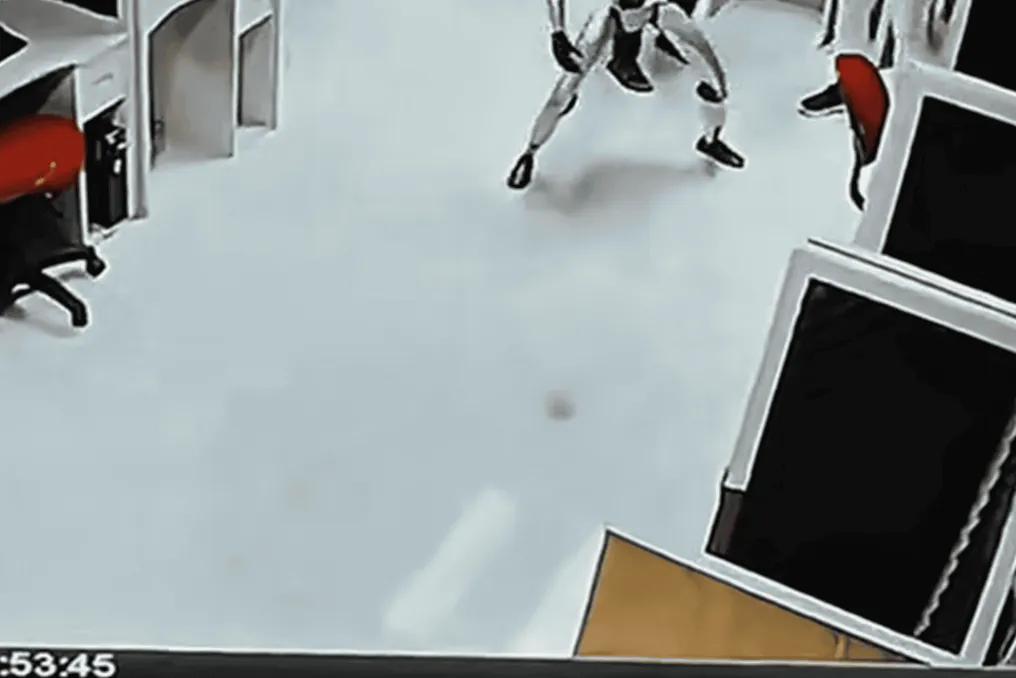
A video that reached over one hundred million views on social media, showing a humanoid robot seemingly attacking individuals in an office in Indonesia, does not represent an artificial intelligence (AI) rebellion. According to the equipment's responsible parties, the images capture a mere 'misunderstanding' resulting from the execution of a previously programmed routine.
Details of the Viral Footage
The footage was made available on TikTok on July 5th by the profile Joko Prabuwesi, the name given to the humanoid robot, and quickly spread across the internet, leading many users to believe that the device had lost control. In the scenes, several people are seen trying to restrain the robot while it performs movements similar to martial arts techniques. However, the team in charge of the humanoid assures that all the action was part of a demonstration sequence.
The robot's administrators explained that when the equipment was first turned on, it automatically initiated a martial arts routine that had been configured previously. This sequence was mistakenly interpreted as an attack, recorded, and subsequently posted on social media.
Robot Programming and Applications
The responsible parties emphasized that all movements performed by the robot were planned in advance and are part of a display designed to demonstrate the device's agility, speed, and reaction capability. This humanoid is a G1 model, developed by the Chinese company Unitree, and has the ability to execute complex maneuvers, including martial arts performances. The cost per unit of this robot is about US$ 33 thousand (equivalent to R$ 168 thousand).
Following the video's massive impact, the robot participated in a television program in Indonesia. Before this TV appearance, it posted a video on TikTok apologizing to the employee who was supposedly 'attacked.' During its TV appearance, the humanoid performed a dance and simulated a fight.
Influencer Robot Strategy
Mera Robotics, the Polish company responsible for programming these devices, indicated that the vast attention on social media aligns with the promotion strategy of so-called 'social robot projects.' In this business model, clients acquire the robots and receive support from the company to program them and turn them into digital influencers. Owners create scenarios aimed at generating 'organic visibility' on social platforms.
A spokesperson for Mera Robotics stated: 'A local client or partner can acquire a robot and then work with us on software integration, programming, personality development, content strategy, training, and continuous technical support. The robot itself is just the hardware—the character, interactions, and operating system require a separate development and production process.'
Success of Other Global Humanoids
In addition to the robot active in Indonesia, the company maintains three other humanoids in various countries: Edward Warchocki, in Poland; Amir, in Dubai; and Hudson, in the United States. All these robots maintain their own profiles on social media and accumulate thousands of followers. A large part of these robots is used in public events, demonstrations, and marketing campaigns.
Earlier this year, Edward Warchocki also went viral after being filmed chasing wild boars through the streets of Warsaw, Poland. As reported by the BBC, the video exceeded 14 million views on Instagram and showed the humanoid 'scaring' the animals moving through the city. The British broadcaster's report also highlighted that Poland registered more than 100 incidents of wild boars against people in the previous year.