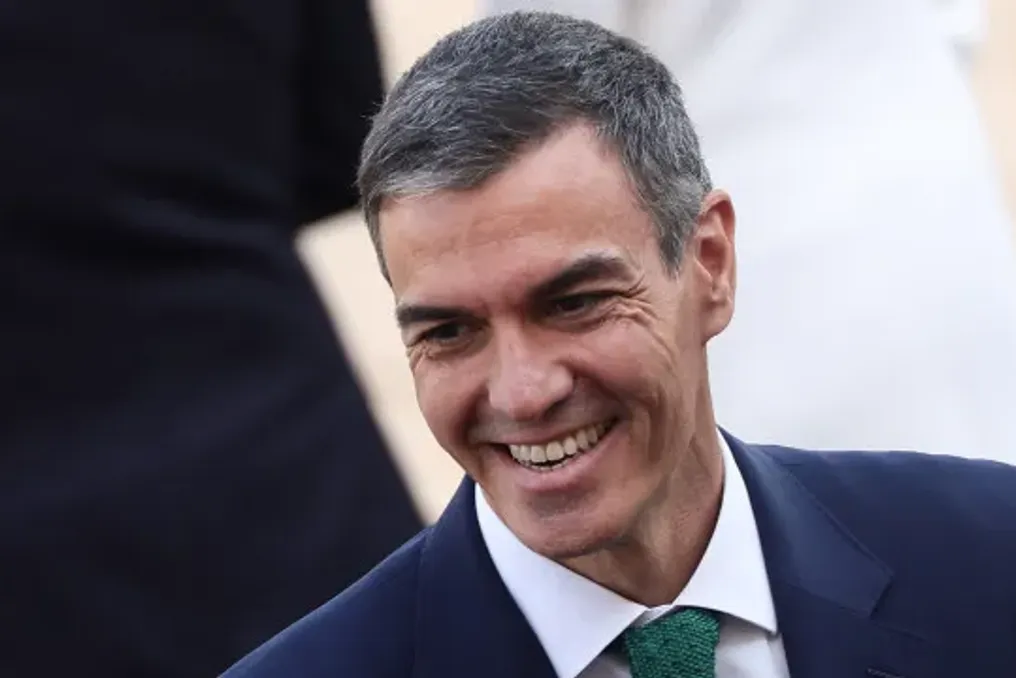
Pedro Sánchez made statements in La Línea de la Concepción, a Spanish city bordering Gibraltar, shortly after witnessing the removal of one of the last sections of the barrier that had completely isolated the two sides since 1909.
Pedro Sánchez made statements in La Línea de la Concepción, a Spanish city bordering Gibraltar, shortly after witnessing the removal of one of the last sections of the barrier that had completely isolated the two sides since 1909.
The closure of the barrier, known as 'la verja,' along with the elimination of dual passport controls at border crossings, was finalized at midnight on Tuesday (23:00 in Lisbon). This outcome resulted from an agreement negotiated between the United Kingdom and the European Union, involving Spain.
This agreement was negotiated in light of Brexit, the UK's withdrawal from the EU, which was ratified in a referendum held in 2016, and its implementation concludes this process. In a statement to journalists and local authorities, Sánchez described the day as a moment of 'good history' for Gibraltar and La Línea, as 'the last wall of continental Europe falls.'
Although Spain and the United Kingdom maintain a dispute over the sovereignty of Gibraltar, this represents the first agreement between the two nations regarding the territory in three centuries. Sánchez, who did not set foot on Gibraltarian territory that day but witnessed the removal of the barrier near the border line, thanked various British governments for their dialogue efforts and highlighted the role of the current Prime Minister, Keir Starmer, in concluding this understanding.
He stated: 'Today we open a new era of shared prosperity in the Campo de Gibraltar,' referring to the southern region of Spain where the British enclave is located. Sánchez continued, asserting that this is a phase of coexistence and common future for populations that have never lived in isolation, and that now they can 'look each other in the eye and move forward hand in hand.'
The agreement, which stipulates the free movement of people and goods between Gibraltar and Spain, as well as the opening of the British enclave's airport to civil aviation, was considered to be of 'mutual benefit.' The most evident example of this is the 15,000 individuals who work in the English territory but reside on the Spanish side, representing half of Gibraltar's workforce, whose economy also depends on land supply from Spain.
These 15,000 workers, who cross the border daily, mostly on foot, no longer face long queues to work or live under the uncertainty of the barrier closing, as occurred during certain historical periods. Pedro Sánchez commented that 'someone said that borders are the scars of history. A scar speaks of a wound that existed but ended up closing, while a wall is the conscious decision to keep a wound open'—referring to 'la verja' that affected thousands of workers and families for decades.
The Spanish Prime Minister emphasized that 'there was obviously a solution' and that only 'political will' was needed, arguing that politics reaches its highest dignity when it solves problems with courage, rather than just managing them. At this symbolic event of the 'demolition of the Gibraltar barrier,' present on the British side were the UK Ambassador to Spain, Alexander Wykeham Ellis, and the enclave's executive chief, Fabian Picardo.
With the treaty in force from today, controls at the land crossing between Gibraltar and La Línea have been abolished, and procedures will now be carried out by both Spain and Gibraltarian authorities at the airport and, in some cases, at the English colony's port. According to the pact, Schengen area rules will be applied to allow entry into Gibraltar.
Additionally, the treaty defines new terms for police cooperation between both sides and includes measures of 'fiscal convergence,' with specific provisions for tobacco, aiming for a customs union. The document also provides for a status and other provisions for workers who cross the border.