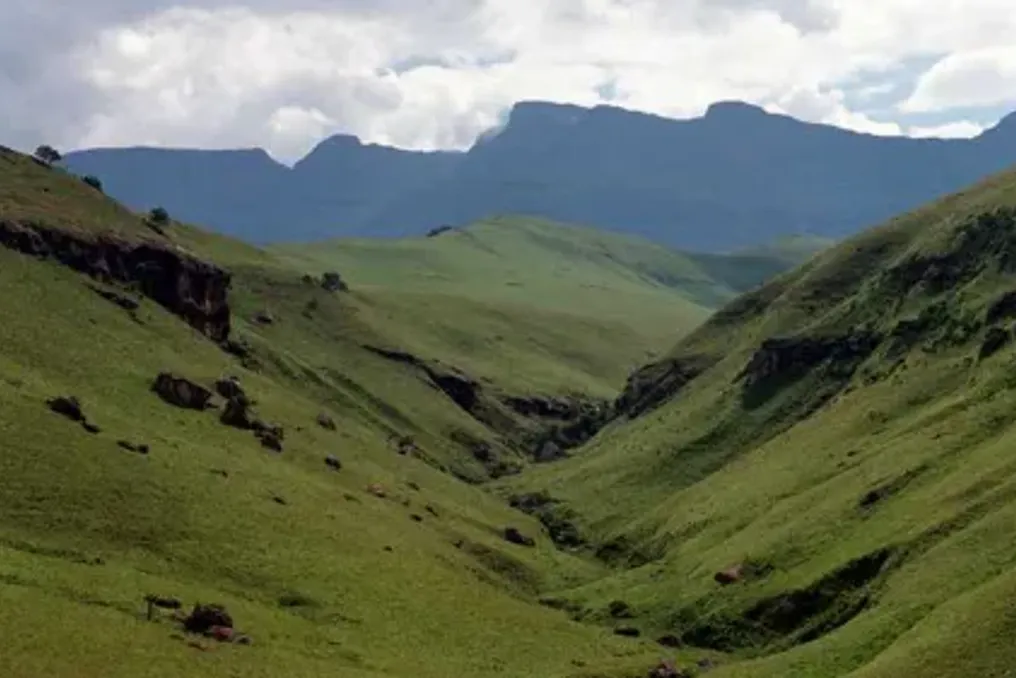
The Minister of Economic Development, Tourism and Environmental Affairs of KwaZulu-Natal, Musa Zondi, confirmed that the Drakensberg cable car project remains relevant, and R2.5 million has been allocated for auxiliary research for this project.
The Minister of Economic Development, Tourism and Environmental Affairs of KwaZulu-Natal, Musa Zondi, confirmed that the Drakensberg cable car project remains relevant, and R2.5 million has been allocated for auxiliary research for this project.
This project, which has existed for almost a decade, was approved by the KwaZulu-Natal Cabinet after an economic and technical feasibility study in 2017. However, its implementation also required approval from the Free State and Lesotho provinces. According to the 2017 study, the ambitious project was viewed as a catalyst intended to unlock the tourism potential of the uKhahlamba–Drakensberg region, aiming to attract at least 300,000 cable car visitors annually.
During the budget presentation to EDTEA departments this week, Minister Zondi confirmed that the project is in the implementation phase. He emphasized that tourism is one of the key drivers for economic growth and job creation in KwaZulu-Natal, and the province continues to position this sector as a strategic pillar of development. Specifically, R2.5 million has been allocated to accelerate auxiliary research for the cable car in the uThukela area.
In addition, other projects have also received funding. In Zululand, R4 million was allocated for the reconstruction and realization of the Queen Tokazi Lodge, R2 million for the Somkhanda reserve, and R1.5 million in uMkhanyakude for the modernization of the Hilltop camp.
The Minister noted that the province continues to benefit from hosting international and domestic events, including Africa’s Travel Indaba, the Comrades Marathon, and numerous business conferences, generating an economic impact exceeding R195 million. In 2026, Africa’s Travel Indaba provided an estimated economic impact of R835 million, attracted approximately 10,000 delegates, achieved 97% hotel occupancy, and supported over 1,100 jobs in the tourism value chain. As KwaZulu-Natal guaranteed the rights to host the indaba until 2030, the province is well-positioned to strengthen its status as a leading destination for tourism and business events while expanding opportunities for local communities and businesses.
The Indian state of Andhra Pradesh is implementing a policy-driven strategy to foster a statewide startup ecosystem, moving away from solely attracting large industries. This approach focuses on cultivating entrepreneurs to ensure sustainable, long-term economic expansion.
Andhra Pradesh is transitioning from an industrial policy centered on drawing in corporations to an entrepreneurship-first model. Key initiatives supporting this shift include the One Family One Entrepreneur mission, with a goal set to nurture 20,000 startups by 2029.
Instead of concentrating development in a single metropolitan area, the state is establishing innovation centers across various regions. These hubs range from the AI initiatives in Visakhapatnam and the Quantum Valley Tech Park in Amaravati to local co-working spaces and startup support centers at the district level.
By integrating advanced technological infrastructure, providing incentives for startups, ensuring access to necessary capital, and focusing on transforming investment pledges into active projects, Andhra Pradesh intends to establish itself as a primary center for deep-tech entrepreneurship and sustained job creation.
In corporate news, the IT services firm Wipro reported that its net profit remained unchanged during the first quarter of FY27. Despite this stability in profit, the company managed to increase its revenue by 10.5%. Specifically, the net profit for the initial quarter was Rs 3,352 crore, slightly higher than the Rs 3,330 crore recorded in the corresponding period last year. Revenue for the quarter reached Rs 24,479 crore, up from Rs 22,135 crore reported a year prior.
Globally, Artificial Intelligence continues to be a dominant force in technological progress. Nvidia is intensifying its focus on physical AI. During a visit to Japan, CEO Jensen Huang introduced Cosmos 3 Edge, a novel AI world model designed to assist vision AI agents and robots in comprehending and navigating actual environments.
Simultaneously, regulatory bodies are increasing their scrutiny of AI advancements. In Europe, Google is encountering renewed pressure from EU regulators. These regulators have specified that, pursuant to the Digital Markets Act, Google must enhance the accessibility of certain services to competitors, including search engines and AI firms such as OpenAI, aiming to curb the market dominance of Big Tech and promote a fairer digital environment.
In the realm of consumer goods, Swara Baby Products has been identified as India's largest contract diaper manufacturer, with close associations to FirstCry, as revealed in its IPO filing. Swara produces diapers for numerous clients, including FirstCry’s Babyhug, Piramal Pharma’s Little’s, Himalaya, and over twenty other customers, in addition to marketing its own Cuddles brand.
Brainbees Solutions, the parent company of FirstCry, acquired a majority share in Swara back in 2020 and currently holds 76.59% ownership, according to the company’s DRHP. This trend of contract manufacturing is gaining momentum as direct-to-consumer (D2C) brands and private labels increasingly outsource production to achieve greater efficiency, contrasting with global leaders like Pampers, Huggies, and MamyPoko which manufacture internally.
The inflow of funds into foreign currency non-resident deposits (FCNR(B)) was significantly less than market forecasts. This impacted the rupee's exchange rate, which weakened by more than 1% against the dollar this week.
After a 0.36% rise in June, driven by measures announced by the Reserve Bank of India (RBI), including a special period for FCNR(B) deposits, the Indian currency faced pressure in July. The cause was the sharp increase in global crude oil prices following the resumption of military actions between the US and Iran. On Thursday, the rupee performed worst among most Asian currencies, continuing its decline for the fourth consecutive week and reaching 96.35 per dollar, which is nearly a two-month low compared to the previous close of 96.27 per dollar.
Dilip Parmar, Senior Analyst at HDFC Securities, noted that the rupee was losing ground as recent support from the RBI waned, as well as due to sluggish interest in FCNR schemes amid rising global bond yields. Barclays also commented on the disappointing FCNR(B) flows in its report, stating that the positive effect of RBI measures to strengthen India's balance of payments and, consequently, the rupee, is beginning to fade, although they believe it is too early to judge their failure.
Finance Minister Nirmala Sitharaman and RBI Governor Sanjay Malhotra held separate meetings with bankers during the week to assess the situation. Sitharaman instructed public sector bank heads to intensify outreach to Non-Resident Indians (NRIs) and introduce new deposit products to maximize fund attraction. Banks, in turn, reported receiving an encouraging response from the Indian diaspora.
Barclays does not expect a repeat of the large inflows seen in 2013, given higher rates in the US and less attractive rupee yields. They forecast that the reasonable base case for FCNR inflows in the coming months will be between $25 and $30 billion, with potential upside risks. Unlike in 2013, one key obstacle for the FCNR(B) scheme is the narrowing of spreads. A BofA Securities report highlighted that the interest rate differential between Indian banks' one-year FCNR(B) deposits and the yield on 12-month US Treasury bills has narrowed from 2.9% in 2013 to 1.4% currently. Nevertheless, BofA expects total inflows of $60 to $70 billion, believing that the inflow momentum will pick up in the coming days.
Madan Sabnavis, Chief Economist at Bank of Baroda, noted that in 2013, most funds arrived in the last month. He added that banks continue to adjust deposit rates based on market feedback, and the mobilization process is still ongoing. Gaura Sen Gupta, Chief Economist at IDFC First Bank, pointed out that creditors are still finalizing contract terms and arranging dollar financing for structured deals, which is slowing down mobilization pace. She suggested that, unlike the previous instance where 60-80% of flows occurred in the last month, there will be growth in August and September.
Expectations of strong mobilization were built on the RBI fully covering hedging costs, exemption from reserve requirements and liquidity ratios, as well as the precedent of the 2013 scheme and the potential for yield enhancement through structured instruments. However, Barclays pointed to the mismatch between deposit tenure and lock-in period as another structural constraint. While FCNR(B) deposits are typically attracted for three to five years, depositors can withdraw funds after one year of lock-in, depending on individual bank policies. Conversely, the RBI swap cannot be terminated before maturity, exposing banks to residual mismatch risk in case of early depositor withdrawal.