Members of the band Teenage Fanclub have long since stopped being teenagers; the youngest member, keyboardist Euros Childs, reached 51 years old, and frontman Norman Blake celebrated his sixtieth birthday in October 2025. Nevertheless, the band's sound has not changed since its formation in 1989.
Musical Style and Releases
The recent work by the Scottish band Nothing Lasts Forever, released in 2023, demonstrates that they have maintained their style: mature alternative rock, which some call 'dad rock'. This style is characterized by a contrast between a dense wall of distorted guitar sounds and the tenderness of melodies complemented by acoustic layers, a cozy sound, and vocal harmonies reminiscent of the American folk-rock scene of the 1970s. Although Blake is the nominal leader, all members participated in writing compositions and singing vocals.
Grand Prix and Simtek S951
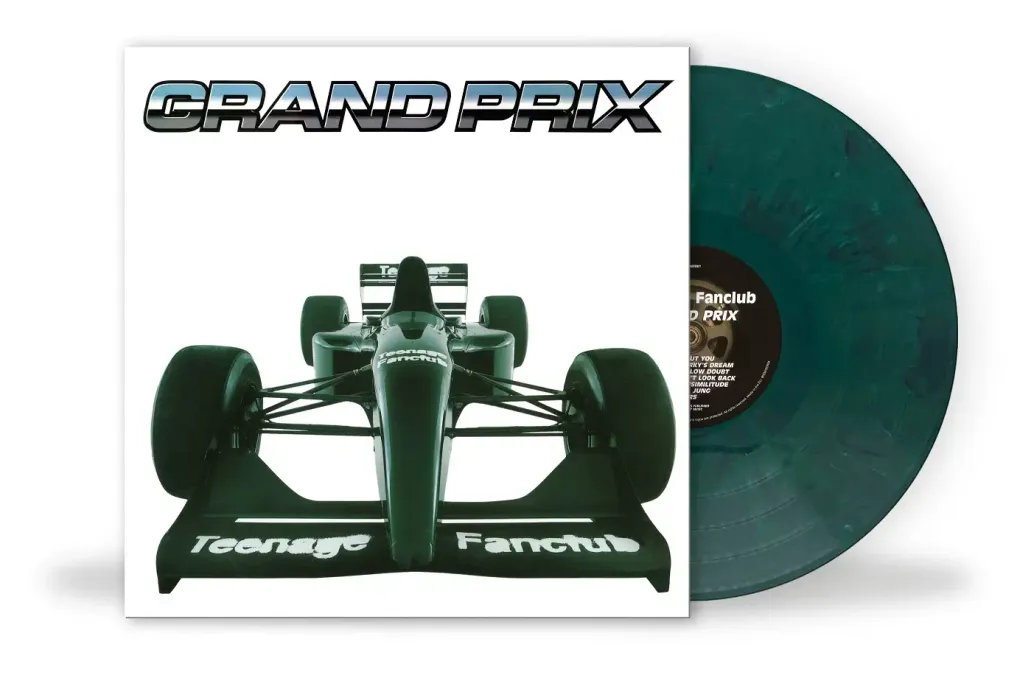
Although the article was originally posted on a car-focused website, here is Teenage Fanclub for those who do not know them. The album Grand Prix, released in May 1995, is considered by many to be the band's creative peak, possibly alongside Bandwagonesque from 1991. However, for motorsport enthusiasts, the influence begins even before the disc is put on the player. The album cover features a large, almost abstract shot of the nose of an F1 car, while the back shows a side view of the rear with an emphasis on the wheel. This car is the Simtek S951, a model used by the British team during the tragic 1995 season.
Irony and Simtek Aesthetics
One of the greatest ironies in the history of motorsport and music arises: it is highly likely that Simtek achieved its greatest success not on the race tracks, but on the shelves of global music stores. In the 90s, Simtek could not be ignored, and not because of its performance, which was, to put it mildly, weak, but because of its appearance. In an era when the Formula 1 grid was still dominated by the conservative color palette of cigarette brands, Simtek decided to fully embrace pop culture: the car was painted in a deep, almost magnetic purple hue mixed with turquoise and black details. This palette became defining for that decade. And to complete the image of the MTV Generation era, MTV itself was the main sponsor of the team, placing its logo on the side and nose of the car. The S951 looked like a full-sized toy, like an arcade racer from Virtua Racing or from a Weezer or Blur clip on MTV.
The Tragic History of Simtek
However, Simtek's story is inextricably linked to more serious, even tragic events. Founded by engineer Nick Wirth, the team debuted in 1994 and was overshadowed by the fatal accident involving Roland Ratzenberger at Imola. In 1995, trying to recover with the promising Jos Verstappen (Max's father) and Domenico Schiattarella, the team showed glimpses of speed in its beautiful purple car. Verstappen managed to finish sixth in the Argentinian Grand Prix before the gearbox failed.
But lack of funding inevitably caught up with the team. After only five rounds of the 1995 season, immediately after the Monaco Grand Prix, Simtek closed its doors and declared bankruptcy. Teenage Fanclub released the album during this period of the team's collapse, and the S951 on the cover represented not just a tribute to motorsport, but a kind of frozen portrait of an era—the embodiment of the speed, youth, aesthetics, and transience of the 90s.
Origin and Development of Simtek
Despite its turbulent fate, Simtek did not arise overnight. It was born in an office in the engineer's house. Simtek stands for Simulation Technology—an advanced engineering consulting company founded in 1989 by young aerodynamics genius Nick Wirth and Max Mosley, who would later become president of the FIA. Wirth was one of the pioneers in using Computational Fluid Dynamics (CFD), while most teams relied solely on huge and expensive wind tunnels. The use of computers for aerodynamic modeling allowed Simtek to start literally in a small room in Wirth's own house, where the only employee was engineer Darren Davis. However, the business grew quickly, and Simtek acquired its own headquarters in the Banbury industrial area, Oxfordshire, where they began using a wind tunnel to test calculations.
In 1990, Simtek secretly secured a contract from BMW to develop an F1 car for a possible debut by the Bavarian brand. The S192 project was shelved when BMW decided to move into the German Touring Car Championship (DTM), but the chassis was sold and used by the unsuccessful team Andrea Moda in 1992. In the same year, after becoming FIA president, Mosley sold his stake in Simtek to Wirth.
First Steps in Formula 1
In early 1993, Simtek took on the design of the chassis for the new Spanish team Bravo F1. However, this project collapsed due to the sudden death of Jean-François Mosnier, an entrepreneur and chief investor in the operation. Tired of seeing his projects fail, Nick Wirth made a bold decision in August 1993: Simtek would enter Formula 1 in the 1994 season under its own banner. To lend weight and credibility to the business, world champion Sir Jack Brabham became a shareholder of Simtek Grand Prix, and his son David Brabham was named the team's first driver until the end of that year. Charlie Moody, a former manager of Leyton House, was brought in to manage the pits.
The search for a second position for Simtek in 1994 vividly illustrates the constant financial maneuvering in the paddock. The team needed talent, but even more so, sponsorship money. Experienced Andrea de Cesaris and the young and promising Brazilian Gil de Ferran actively discussed participation, but negotiations did not advance. Jean-Marc Gounon was also considered, but his contractual obligations at the beginning of the year prevented an agreement. Thus, the spot went to a 33-year-old newcomer who managed to attract sponsorship capital for the first races—Austrian Roland Ratzenberger.
The debut season with the S194 model, equipped with a Cosworth V8 HB engine, was marked by the greatest tragedy. At the fateful San Marino Grand Prix in Imola—on the same weekend as Ayrton Senna's death—the world of motorsport witnessed the horrific crash of Ratzenberger in Saturday qualifying. The Simtek front wing detached at over 300 km/h at the Villeneuve corner, causing the Austrian to lose control. Roland did not survive.
Season Continuation and End
Emotionally and financially shaken, the team showed incredible resilience to continue participating in the championship. Andrea Montermini took the seat, but soon suffered another serious accident in the next round in Spain. Ultimately, Jean-Marc Gounon eventually occupied the cockpit for the remainder of the season. Simtek finished the year in a difficult state but remained in the game. For 1995, Nick Wirth presented the S951—the car that became the cover of Teenage Fanclub. This was a much cleaner and more refined project than its predecessor. In addition to the Cosworth ED V8 engine, Simtek entered into a vital agreement to use an active transmission and hydraulic system from Benetton (which won in '94 with Schumacher).
On the track, Max Verstappen's father began working miracles in the beautiful purple MTV car. At the 1995 Argentinian Grand Prix, Jos achieved an incredible 14th place in qualifying and finished sixth—making the points at the time and causing problems for much larger teams, until a Benetton-made clutch failure ended his race.
Despite the bursts of speed, financial reality proved to be the toughest enemy. Wirth was counting on sponsorship from the second driver Domenico Schiattarella and a prospective Japanese investor connected to test driver Hideki Noda, whose money never materialized. After the 1995 Monaco Grand Prix—the fifth round of the year—with accumulated debt exceeding $6 million and no funds even to send cars to the Canadian Grand Prix, Simtek announced bankruptcy and finally closed in June 1995, with remaining assets being auctioned off to pay debts.
Nick Wirth's dream of revolutionizing F1 with computers turned into scrap metal and a footnote in racing annals. But Teenage Fanclub ensured that the S951 would never die. Released in the same May that Simtek ran its last race on the streets of Monte Carlo, Grand Prix immortalized this purple nose with the MTV logo. Every time someone plays such sunny classics as 'Sparky’s Dream' or 'Neil Jung', this misunderstood technological machine, bright colors, and tragic fate race forward again, but now set to the perfect soundtrack of one of the best albums of the 90s, even if many do not know the history of this Formula 1 car on the cover.