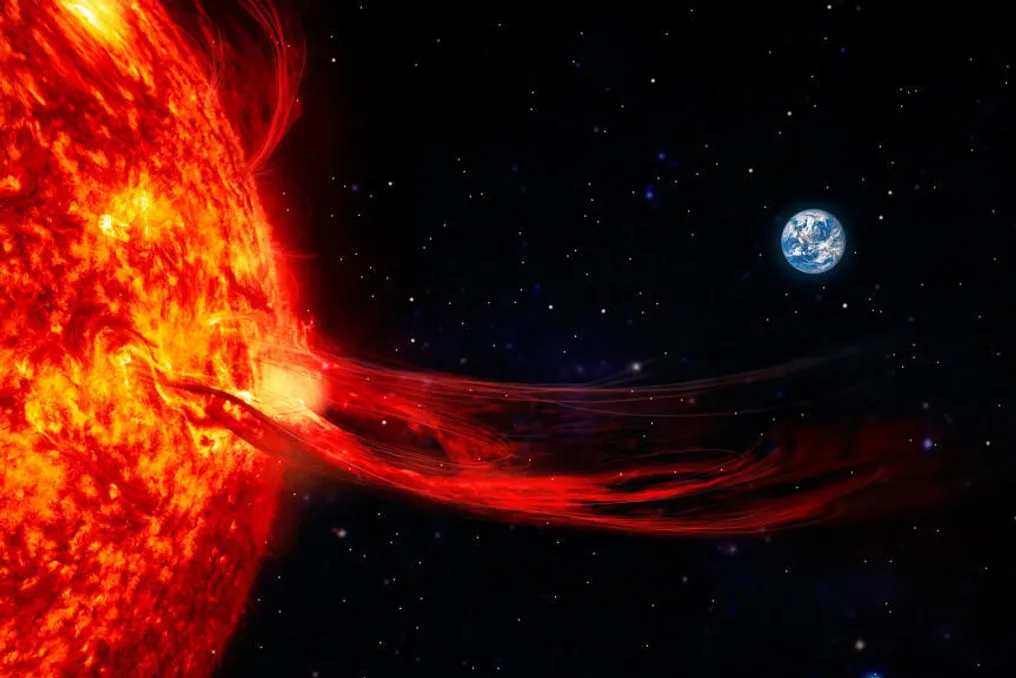
Researchers from NASA and the University of Lancaster have discovered evidence indicating that the impacts of the most severe solar storms have been underestimated. A study published in the journal Nature this Wednesday (15) raises questions about the existence of a maximum limit to the Earth's magnetic field response.
Analysis of space data
The investigation focused on analyzing data from electric currents in the upper atmosphere and solar winds to determine how the planet reacts to major space events. The scientists concluded that any observed stabilization in the effects could be a statistical artifact of the measurements, rather than a sign of natural protection against extreme phenomena.
Study leadership and findings
The work was conducted by Nithin Sivadas, a researcher at NASA's Goddard Space Flight Center, in collaboration with Maria Walach from the University of Lancaster. The analysis points out that unusual solar storms have the potential to generate more intense consequences for navigation systems, satellites, and communications.
Questioning the terrestrial barrier
For many years, the scientific community believed that the influence of solar storms would have a saturation point. This belief was based on the observation that certain atmospheric electric currents seemed to cease increasing even when the solar wind became stronger. The new study proposes that this apparent saturation might be a result of the data collection methodology.
Much of the measurements of extreme events comes from probes located at Lagrange point 1, an area about 1.6 million kilometers from Earth toward the Sun. The researchers argue that the disparity between the strength of the solar wind measured at this point and what actually reaches the planet can distort the data. By aggregating these data in large volumes, more extreme values end up appearing less intense, creating the illusion of a limit to the Earth's response.
Confirmation of direct relationship
To test this hypothesis, the team examined over one million records of solar wind captured by NASA spacecraft in orbit near Earth. The findings demonstrated a direct correlation between the intensity of the solar wind and the increase in electric currents in the upper layer of the atmosphere. According to the authors, this conclusion fundamentally changes how risk scenarios for extreme space events should be assessed.
If there is no maximum limit to the planetary response, very powerful solar storms could cause technological damage greater than currently predicted. Geomagnetic storms are temporary variations in the magnetic field and plasma around the Earth. In severe cases, they can affect satellites, disrupt GPS and communication signals, cause failures in power grids, and increase radiation exposure for pilots and astronauts.
Challenges in event prediction
Despite being rare events, the researchers emphasize that the low frequency of these occurrences makes accurate large-scale predictions difficult. The team concludes that only new records will allow for a clearer understanding of Earth's behavior in the face of an exceptional solar storm.