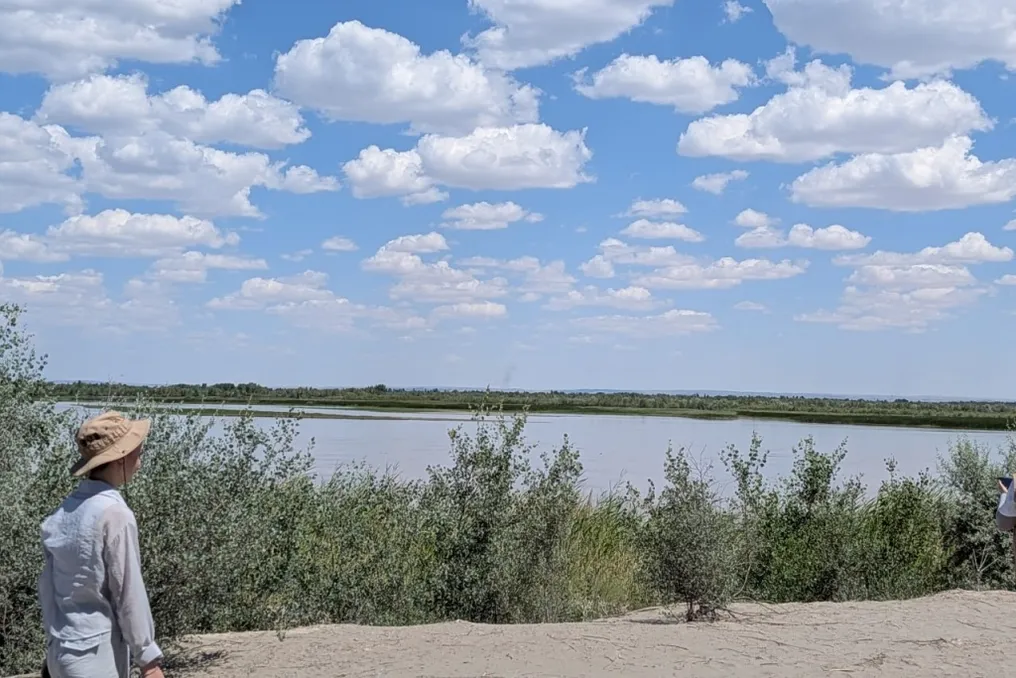
A three-day media expedition traveled from Dengizkul in Bukhara region, through the Amudarya's taghial forests and Khorezm National Park, to Sudochye near the former shore of the Aral Sea. This trip demonstrated that water is necessary not only for the needs of cities and fields.
Route and Goals of the Expedition
The expedition, organized as part of the Aral Sea Wetlands project, was implemented with the participation of the National Committee on Ecology and Climate Change of Uzbekistan, the United Nations Development Programme, and the Global Environment Facility. The route covered Bukhara and Khorezm regions, as well as Karakalpakstan, passing through Dengizkul, the Kyzylkum Reserve, the Lower Amudarya Biosphere Reserve, and Lake Sudochye.
The main topics of discussion included biodiversity conservation, land degradation, the state of protected areas, and finding sustainable sources of income for the local population. Special emphasis was placed not on the complete 'return of the Aral Sea' to its former boundaries, but on maintaining the viability of existing ecosystems: lakes, wetlands, taghials, pastures, and bird migration routes.
Scientific Approach to Water Resources
Experts emphasized that this is not just about the minimum volume of water that should be left in the river, but about a scientifically based irrigation regime. This regime must ensure the inflow of water to the right place, at the right time, and in the necessary quantity to support lake life, renew taghial forests, and preserve habitats for fish and birds.
Professor Malika Ikramova, head of the 'Integrated Water Resource Use' laboratory at the Research Institute of Irrigation and Water Problems, noted that due to limited water resources, competition between industries is increasing. She added that despite the existence of a Water Code that addresses sustainable management, the next step should be the development of additional regulatory documents.
Dengizkul Lake as a Migration Stopover
The first stop was Dengizkul Lake in the Alat district of Bukhara region. Amidst desert vegetation such as saxaul, kandim, solyanka, and tamarisk, a blue lake appeared. Despite its apparent stillness, it represents a complex and fragile system dependent on collector-drainage waters, the quality of which is characterized by high mineralization.
Khalilulla Sherimbetov, an environmental protection expert, pointed out the international significance of Dengizkul: the lake is located on a migratory route and is listed in the Ramsar Convention. Dozens of bird species, including pelicans, swans, and herons, many of which are listed in the Red Book, winter here and stopover.
Specialists note that during certain periods, Dengizkul concentrates about 40% of the wetland birds wintering in Uzbekistan. These birds require not only water but also a food base, safe resting places, and reed beds. 34 plant species grow around the lake, three of which are endemic.
Amudarya Taghial Forests
Next, the route led to the Kyzylkum State Reserve, where the sands of Kyzylkum contrast with the floodplain of the Amudarya and the taghial forests. The reserve director, Mirzagali Kilishev, explained that the taghial ecosystems formed due to proximity to the river. Turanga, willow, loch, and reeds grow in these forests, reaching heights of 20–40 meters.
The taghial forest critically depends on natural floods and soil moisture for its renewal. If water inflow stops, young trees die, and the forest begins to degrade. Mirzagali Kilishev emphasized that the forest does not consume water from the Amudarya; rather, it protects the river from excessive evaporation and retains life in the floodplain.
In the Khorezm National Natural Park, which is a new protected area, taghial resources of the ancient Amudarya delta are preserved. The Bukhara deer, Turkmen caracal, and various bird species inhabit this area. The inspector explained how the turanga adapts to hot sand: its roots can reach 25 meters deep, absorbing clean water from a depth of 15 meters.