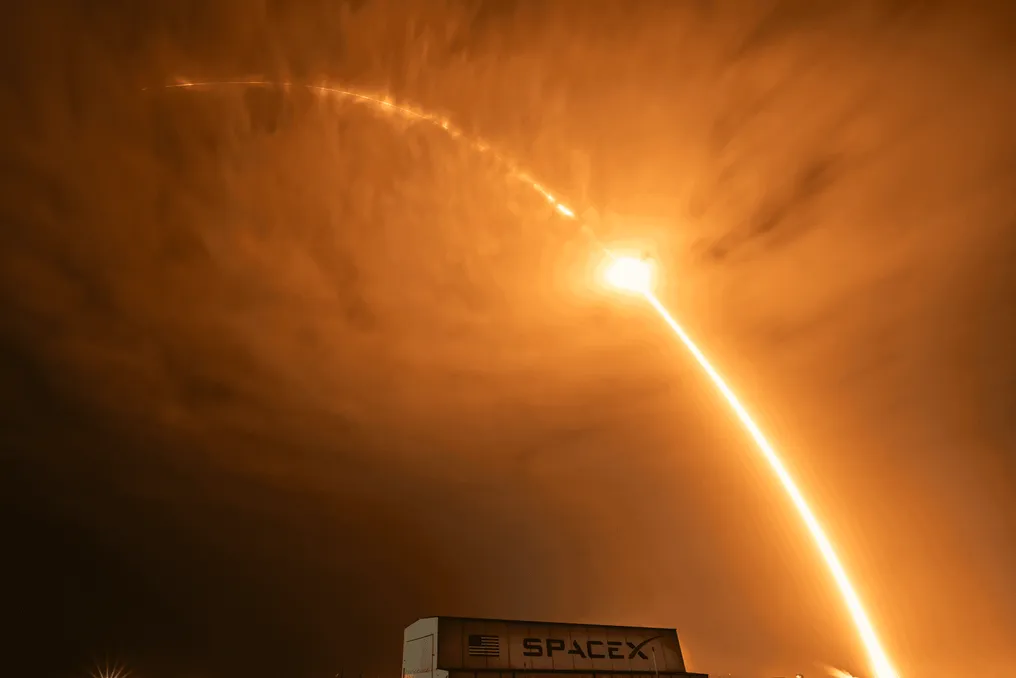
SpaceX launched 29 Starlink satellites into low Earth orbit on Tuesday, the 14th, at 6:10 AM Brasília time. The Falcon 9 rocket departed from Launch Complex 40, located at the Cape Canaveral Space Force Station in Florida, United States.
Mission and Reusability Details
This event marked the 28th mission for the first stage of the rocket used in the launch. This booster had already been used in several missions, including Ax-2, Euclid, Ax-3, CRS-30, SES Astra 1P, and NG-21, as well as 22 other flights destined for the Starlink constellation.
After stage separation, the first stage returned to the surface and successfully landed on the autonomous maritime platform named A Shortfall of Gravitas, located in the Atlantic Ocean.
Expansion of the Starlink Constellation
Currently, SpaceX maintains over 10,000 operational Starlink satellites in orbit and has permission to deploy approximately another 4,000. Since the beginning of the project, more than 12,000 satellites have been sent into space, although some have ceased operation.
The fleet growth continues at an accelerated pace. In the first half of 2026 alone, the company managed to place 1,589 Starlink satellites into low Earth orbit, a number higher than the 1,489 launched in the same period of 2025. In the previous year, the company reached its annual record by launching 3,180 satellites.
Next Steps with Starship
The Starship vehicle has already received authorization for new flights. The U.S. Federal Aviation Administration (FAA) granted SpaceX permission to conduct another test following the investigation into the failure that occurred in the Super Heavy booster during the flight in May.
According to SpaceX, this next mission will be the second launch of the V3 version of the rocket and will also feature the first Starlink V3 satellites, which will play a crucial role in expanding the company's space internet network. This launch is scheduled for next Thursday, the 16th, between 7:45 PM and 9:15 PM Brasília time.