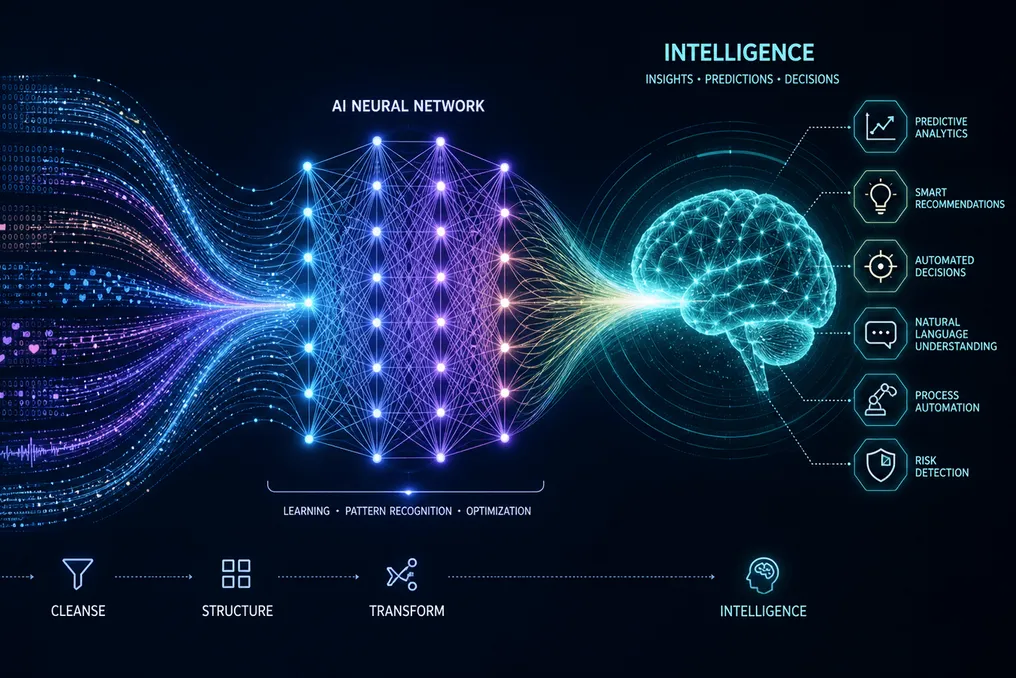
As the race for computational power matures, the industry's focus is shifting to data as the primary source of artificial intelligence intelligence. This includes issues of monetizing data assets, managing security, and changing the paradigm of AI-driven scientific research.
Shifting Focus in AI Development
At the China Internet Conference in 2026, the industry's attention moved away from the number of computing cards in data centers to a deeper question: where does intelligence come from? The answer increasingly points to data as the key fuel driving the AI revolution.
Data Monetization Challenges
The most pressing issue remains the monetization of data assets. Despite favorable national policies establishing a tripartite system for data ownership, usage, and operation rights, enterprises face a dual dilemma: concerns about registering data as assets and the inability to monetize them effectively. Guo Mai Internet board member Zheng Aijun presented examples, including a state fishery group, where platform data was successfully valued at 16.65 million yuan and converted into capital using market and cost methods. She proposed Model 1371—a structured seven-step process for transforming raw data into tradable assets, covering core business identification, asset inventory, compliance verification, asset recognition, and supply and demand matching.
Evolution of Data Security Management
As AI changes the threat landscape, data security management is evolving. The implementation of large models fundamentally alters data security boundaries. Traditional perimeter-based classification methods cannot cope with the complexity of risks in the AI era. The merging of training data creates interconnected data across different security levels, making internal knowledge attribution almost impossible. New attack vectors are emerging, such as prompt injection, jailbreak attacks, and data poisoning. Vice President of 360 Digital Security Group Zhao Yu described three levels of intervention: eliminating vulnerabilities at the engineering level in AI frameworks and tools; cleaning, labeling, and anonymizing data at the data level for training and inference; and auditing at the application level with human oversight to prevent privilege escalation.
Organizational Transformation for AI
The required organizational restructuring for AI adoption is profound. Many companies operate with siloed business and IT departments, where no one is responsible for data quality or governance. Zhao advocates for the creation of specialized data governance committees and data engineer roles to ensure high-quality data supply at the organizational structure level, which is a prerequisite for any significant AI deployment.
Future Predictions for AI
Looking ahead to 2035, experts predict a fundamental shift in AI from individual to collective intelligence through the symbiosis of humans and machines. Zhang Dong, a member of the National Committee on Intellectual Production, predicts that AI will change scientific research workflows through the dry experiment paradigm, followed by the wet experiment paradigm, where AI performs computational modeling before humans conduct targeted physical experiments, significantly increasing R&D efficiency. The ultimate transformation requires moving from human-understandable data formats to AI-understandable formats, as data governance will fundamentally reorient towards machine consumption rather than human comprehension.