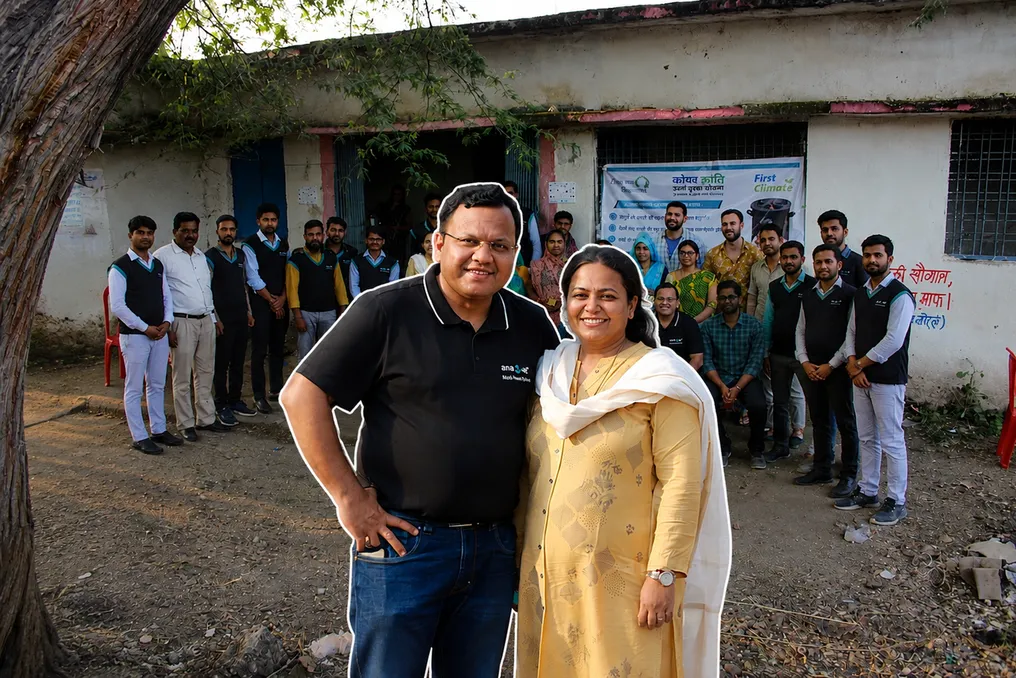
For a long time, companies faced serious difficulties launching products in small towns of Bihar, verifying addresses in rural Odisha, or conducting surveys in remote villages of Chhattisgarh. Despite the rapid development of India's digital economy, reaching people on the ground remained a complex task. Although brands, governments, and NGOs could interact online, they often hit the barrier of physical last-mile access.
Similar stories
Popular
The Emergence of Anaxee Digital Runners
This gap inspired Govind Agrawal and Arti Agrawal to create Anaxee Digital Runners. The company, based in Madhya Pradesh, has become one of the largest networks of field workers on the last mile in India. Today, over 40,000 local young people work as Digital Runners, helping businesses and organizations reach communities across the country.
Govind, co-founder and CEO, notes that 'Anaxee was inspired by the huge information asymmetry and lack of trust existing in rural India.' He adds that while digital connectivity improved, brands, governments, and social organizations still struggled with physically reaching people in Tier-2, Tier-3, and rural markets. The goal was to solve this last-mile problem by creating a platform that provides access to any point in India through a reliable local network.
Evolution from Biometrics to Human Network
Initially, Anaxee did not start with the Digital Runner model. Its first project was biometric technology. Govind recalls that the early days of Anaxee Technologies were challenging because they were ahead of their time. A vein recognition technology—a biometric identification method scanning the unique pattern of veins under a person's skin—was developed and even received a US patent. However, scaling proved impossible due to the 2008 global financial crisis.
Instead of shutting down, the founders changed direction. They abandoned hardware and focused on building a distributed network of locals who could perform tasks on the ground using smartphones. Around 2016, this idea transformed into the Digital Runner model, which was based on two trends: the growing spread of smartphones and the large number of youth in small towns seeking flexible work near home.
Functions of a Digital Runner
Govind compares the Digital Runner to taxi platforms. He defines it as a 'Local Resident' or 'Son of the Soil'—a tech-savvy person living in a village or town who acts as an on-demand partner. Similar to Uber drivers, Runners use their smartphones to visit locations near their homes and perform tasks such as data collection, merchant outreach, conducting surveys, supporting brand go-to-market strategies, and assisting in large-scale outreach programs.
Tasks are received through the Anaxee Partner App, which has exceeded one million downloads on Google Play. Runners accept tasks within a five-to-ten-kilometer radius of their homes. Work can be diverse: address verification, store registration, household survey, or field data collection. After completing a task, they upload confirmation via the app. Payment is made after verification by the Anaxee quality assurance team.
Technological Foundation and Scaling
Finding thousands of reliable people to support the network was another challenge. Govind explains that the breakthrough came from studying the Indian Aadhaar ecosystem. He noted that there were already nearly four hundred trained Aadhaar operators across India. This allowed them to realize that instead of building a field force from scratch, they could leverage an existing network. This knowledge enabled them to start operations in 26 states almost immediately.
Managing tens of thousands of field workers across India requires more than just manpower. Govind explains that Anaxee operates on a cloud platform consisting of mobile applications, web dashboards, and APIs. Digital Runners receive assignments on their smartphones, execute them in the field, and transmit data in real-time. Clients can track progress through dashboards, view photos, monitor locations, and analyze reports.
Every task goes through multiple verification stages. 'Every activity is recorded using GPS coordinates, timestamps, and photo evidence. Data undergoes multiple quality checks before approval. Digital Runners are paid only after successful verification. We also use automated calls and AI-based tools for verification, alongside human quality control processes.'
Growth to a National Network
Before scaling, Anaxee had to prove the viability of its model. Instead of investing heavily in offices, transport, and permanent on-site staff, the company chose a lean approach. It relied on digital infrastructure and local partnerships rather than creating a traditional field workforce.
The initial pilot focused on developing the technological platform, attracting local partners, testing task distribution workflows, and verifying quality assurance processes, according to Govind. By building the system on the existing digital ecosystem rather than physical infrastructure, they were able to expand much faster and at significantly lower costs.
As demand grew, the company continued to invest in its mobile platform, cloud infrastructure, training systems, quality assurance, and payment mechanisms. Standardizing workflows and operating procedures allowed for efficient management of task distribution, verification, payments, and reporting for clients, even as the network expanded across India.
Company Achievements and Vision
Today, Anaxee has created one of the largest distributed field networks in India, which includes: over 40,000 Digital Runners, operations in 540 districts, coverage of over 11,000 postal codes, and nearly 1.2 lakh villages. The Anaxee Partner App has over a million downloads. The platform supported retail expansion, merchant acquisition, government surveys, agricultural campaigns, medical initiatives, and climate change projects. During the pandemic, it conducted a vaccination awareness campaign called Project Suraksha. Recently, Digital Runners have also begun supporting the monitoring of carbon projects and conservation initiatives under the Anaxee Climate Center.
In 2021, the company received the National Startup Award from the Ministry of Commerce and Industry. However, for Govind, the true achievement lies elsewhere. His vision has always been to eliminate geographical barriers. Whether the company is launching a product, the government is implementing a welfare program, or an organization is trying to reach remote communities, he wants them to know that reliable local execution is possible anywhere in India.
Success Stories of Network Participants
Nipendra Kumar from Ballia district in Uttar Pradesh previously worked as an executive collector and then a bank correspondent. Seeking more flexible work, he joined Anaxee. He shared that after joining Anaxee, he earned about 50,000 rupees in just four months by performing market verification and order checks for brands like TTK Prestige. This experience helped him build confidence and communication skills without having to relocate for work.
For Ankita Kumar from Barabanki, the platform became a way to support his preparation for the UPSC exam. Discovering Anaxee through Facebook, he joined Project Suraksha and went door-to-door spreading information about COVID-19 vaccination. The flexible schedule allowed him to work in the mornings and study the rest of the day, while also helping cover book expenses during exam preparation.
Arjun Yadav, a medical student from the village of Bakhtiyarpur, balanced tasks with college studies and earned about 50,000 rupees over seven to eight months. Later, he introduced ten more people from his community to the platform, creating earning opportunities for others. Govind emphasizes that these stories demonstrate how the platform serves as a bridge, enabling local youth to become 'Sons of the Soil' who contribute to the local economy while achieving personal and professional success.
Future Goals of Anaxee
Govind and Arti aim for Anaxee to do more than just expand its network. Their goal is to change how organizations operate in rural India. Govind states that they intend to become the preferred platform for last-mile execution and intelligence gathering for organizations working across India. He summarizes his vision: 'We want to be the default partner for any brand or organization wishing to reach the last mile of India.'
The Uzbekistan Migration Agency, together with the US Embassy, held discussions aimed at developing legal employment programs for Uzbek citizens in the United States. During the meeting, the main focus was on the agricultural sector, the process of preparing potential workers, and issues related to the completion of necessary documentation.
Negotiations and Meeting Goals
Bekhzod Musaev, head of the Uzbekistan Migration Agency, met with Jonathan Henick, the US Ambassador Extraordinary and Plenipotentiary to Uzbekistan. The central topic of the discussion was increasing opportunities for Uzbek citizens to find employment in the USA.
Requirements for Migrants
Representatives of Uzbekistan informed the American side about how citizens are prepared for work abroad, the expansion of external labor markets, and measures aimed at protecting the rights of migrant workers. The US Ambassador emphasized that future employees must be aware in advance of the living and working conditions, possible costs, available support forms, and return dates to their home country. He also stressed the critical importance of correctly completing all paperwork and thoroughly checking the visa history of applicants.
Future Cooperation
As a result of the meeting, it was decided to strengthen cooperation between the Migration Agency and the consular service of the US Embassy. The parties agreed to establish data exchange and coordinate the process of conducting interviews with potential employers. It should be noted that agreements regarding the employment of Uzbeks in various sectors of the US economy have already been reached in New York.
Belarusian President Alexander Lukashenko announced plans to accept an additional 5 thousand workers from the Andijan region of Uzbekistan. The dispatch of groups of 500 people to the Vitebsk region is scheduled for September.
Conditions for incoming workers
Lukashenko emphasized that there is sufficient acceptable housing in the villages, and all future buildings will be constructed for the needs of the population, both Belarusian and Uzbek. He noted that those arriving must understand that they are part of society, provided they work.
The recruited Uzbeks will not only be employed in agriculture. They will also be offered employment opportunities in industrial and construction facilities, in the service sector, and as junior medical personnel. The authorities of the Vitebsk region are obliged to provide the arriving workers with housing and necessary conditions.
Expansion of agrarian and economic partnership
Parallel to attracting labor, the parties are strengthening interaction in the agricultural sector. Uzbek partners have been promised ten premises for housing cattle and eight thousand hectares of agricultural land. An additional two thousand hectares in the Beshenovichi district are designated for potato cultivation. The Belarusian side is ready to provide technologies, planting material, qualified specialists, and necessary infrastructure for crop storage.
The implementation of a project to create a wood processing enterprise with the participation of Uzbek investments for the production of fuel pellets is also being discussed. Furthermore, the formation of a construction trust involving Uzbek specialists is planned. In Vitebsk, the development of a trade house for Uzbek goods, the opening of a national cuisine restaurant, and the creation of a tourist base for Uzbek citizens' recreation are foreseen.
Previous cooperation experience
It was previously reported that the first organized group, consisting of 255 residents of the Andijan region, arrived. These people went to Belarus for temporary work in the fields of animal husbandry and agriculture. Participants in this program were guaranteed official employment, wages, and proper living conditions.
The Director of the Migration Agency of Uzbekistan, Behzod Musaev, held a meeting with the U.S. Ambassador to Uzbekistan, Jonathan Henick.
Discussion of Cooperation
The parties discussed ways to develop interaction in the field of legal labor migration, as well as the implementation of pilot projects for the employment of Uzbek citizens.
Information Presented
Uzbekistan presented information on improving the labor migration system in accordance with international standards, diversifying foreign labor markets, preparing candidates for work abroad, and measures to protect the rights and legitimate interests of migrant workers.
Pilot Projects in the USA
Special attention was paid to launching pilot projects aimed at employing Uzbek citizens in the agricultural sector of the USA, including processing the necessary documentation.
Requirements from the USA
The U.S. Ambassador emphasized the critical importance of high-quality training for participants in legal labor migration programs. According to Henick, candidates must receive complete information in advance about the place of work, living and working conditions, possible expenses, available support, and return conditions to Uzbekistan.
Recommendations and Agreements
The American side also advised carefully monitoring the correct completion of documents according to established requirements and conducting preliminary checks of candidates' visa and migration history. After the meeting, the parties agreed to establish cooperation between the Migration Agency and the consular service of the U.S. Embassy. This cooperation will include information exchange and joint coordination of interviews with employers and advance document submission.
Both sides confirmed their mutual interest in the gradual development of partnership in the field of legal labor migration through these pilot initiatives.