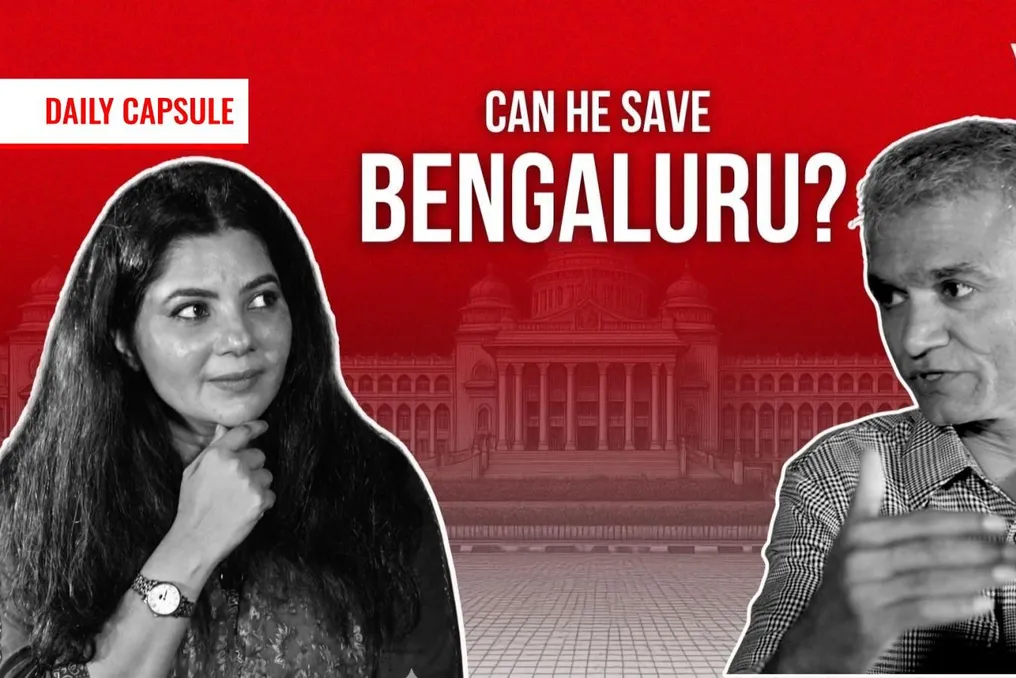
Bengaluru, the technological capital of India, despite the inscription on Vidhana Soudha stating that 'Public service is the work of God,' faces issues such as traffic jams, garbage, and damaged sidewalks. Karnataka State Minister for Greater Bengaluru, Krishna Baire Gowda, is convinced that the city can be fixed. In an interview with Shraddha Sharma, founder and CEO of YourStory and The Bharat Project, he outlined his plans and timelines.
Scale of the Transportation Problem
The seriousness of the situation is illustrated by statistics provided by the minister himself. In 2016, 6.5 million vehicles were registered in Bengaluru. Today, this number has reached 12.5 million just among local registrations. Including all transport circulating on the city's roads, the total amounts to 15 million, which corresponds to a population of approximately 15 million. Gowda noted that no other city in India has grown so rapidly in the last 25 years, and this growth rate is not observed outside of China. He also predicted that the population could increase to 18 or 20 million people.
The city's strength remains its ability to attract talent, which, according to the minister, is facilitated by the openness of the Kannada residents. He emphasized that regardless of a person's background, a sense of belonging is felt in Bengaluru.
Focus on the System, Not Complaints
Krishna Baire Gowda, a legislator representing the Bayatarayanapura constituency, actively participates in city life, removing illegal constructions from sidewalks and conducting civil works inspections, sometimes holding officials accountable for poor execution. When Shraddha noted that challenging an established system requires courage, the minister stated his approach directly. He believes that in a position of responsibility, one cannot simply 'run away from the system,' as there are enough competent people in the government who respond to challenges given the right environment and motivation.
His goal goes beyond solving individual citizen problems. Gowda insists that the priority is fixing the system itself, since not every person facing a problem can approach him personally. He reminded citizens of their rights, asserting that they do not need to knock on anyone's door to resolve basic issues.
Bengaluru Development Plan
Regarding citizen expectations, the minister pointed to a roadmap spanning five to ten years, developed by the Chief Minister who oversaw the Bengaluru portfolio over the last three years. This plan includes expanding the Namma Metro network to nearly 500 kilometers, adding 4,500 public transport buses over the next two to three years, constructing up to 300 kilometers of suburban railway, and building 150 kilometers of flyovers integrated with two tunnel corridors running north-to-south and east-to-west.
These projects have symbolic deadlines: Bengaluru celebrates its 500th anniversary in 2037, and the minister aims to transform the city long before that date. He also staked his reputation by publicly announcing the timeline for completing the metro within the next two years. He acknowledged that he must find a way to fulfill these promises, otherwise, his authority will be at risk.
Furthermore, the government is working on updating citizen interaction tools, planning more public consultations, and organizing hackathons to involve the city's tech specialists in solving urban challenges. Gowda questioned why they cannot apply some of their global solutions to their own problems, noting that Bengaluru's civil society is one of the most active in the country.
Experience in Project Implementation
The minister's confidence is supported by his past experience. As the Agriculture Minister of Karnataka from 2013 to 2018, he initiated the millet movement long before it became a global health trend, bringing humble grain crops from Karnataka farms to international markets and fostering the growth of agri-startups. As the Revenue Minister from 2023 to 2026, he introduced transparency into land registries using technology.
Despite the achievements, he remains modest, stating that he is simply doing his duty. He recalled a lesson from his school teacher in 1987: any job, even cleaning a railway station, should be done so well that it becomes the cleanest in the world. For him, the vision extends beyond infrastructure; he wants Bengaluru to support art, culture, and sporting talents, remaining a city where youth feel connected to the community. His concluding thesis was simple: 'If the system is improved, the benefit will go to everyone.'