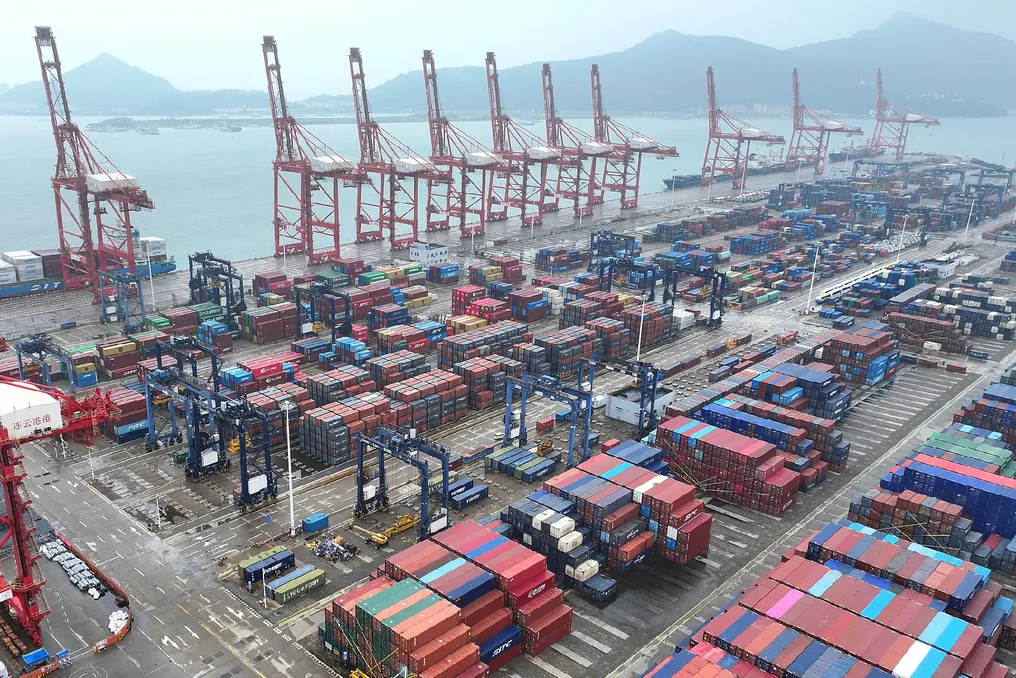
In the first half of 2026, China's foreign trade demonstrated a year-on-year growth of 16.9%, reaching a volume of 25.47 trillion yuan (equivalent to approximately $3.75 trillion). This marked the first time that trade volume for such a period exceeded the 25 trillion yuan mark, according to official data released on Tuesday.
Export and Import Dynamics
According to data from the General Administration of Customs (GAC), China maintains its status as the world's largest goods trader amid confident figures. Exports increased by 13.4% year-on-year to 14.73 trillion yuan, sustaining growth for the 11th consecutive quarter. Meanwhile, imports grew by 22.1% to 10.74 trillion yuan, which is 8.7 percentage points higher than export growth rates and contributed to a more balanced development of trade.
Import Structure in the First Half
In the first half, there was a 3.4% increase in the import of raw materials, including metals and energy resources. Imports of mechanical and electrical products rose by 28%, while agricultural product imports grew by 8.6%.
Comments and Quarterly Results
During a press conference, Wang Jun, Deputy Head of GAC, noted that China's foreign trade maintained a stable momentum in the first half of the year, characterized by strong growth, stable operation, and noticeable progress in stabilizing scale and improving structure.
In the second quarter of the current year, the total volume of imports and exports reached 13.61 trillion yuan, representing an 18.4% increase compared to the previous year, marking the highest quarterly growth rate since the third quarter of 2021. In June alone, trade value grew by 24.2% year-on-year, signifying 17 consecutive months of growth.
Trade Geography and Sectors
Trade with countries participating in the Belt and Road Initiative increased by 14.8% in the first half, reaching 12.97 trillion yuan, accounting for 50.9% of the total foreign trade volume. Trade with neighboring countries jumped by 20.6%, while trade with Latin America, Africa, and the EU showed growth of 16.2%, 19.6%, and 10.2%, respectively. Trade with Central and Eastern European countries also grew by 11% in the first half, extending ten years of continuous growth.
From January to June, private enterprises contributed to 57% of the total trade value, with their imports and exports growing by 17% to 14.53 trillion yuan. Enterprises with foreign investment and state-owned enterprises showed growth rates of 17.1% and 16.8%, respectively.
Regional and Product Leaders
Eastern regions of China led in trade scale, reaching over 20 trillion yuan in imports and exports, which is 16.5% more and accounts for 78.8% of the national total. Meanwhile, western, central, and northeastern regions recorded growth of 20.3%, 20%, and 8.6%, respectively.
Exports of mechanical and electrical products increased by 20.1% to 9.36 trillion yuan, accounting for 63.5% of total exports, which is 3.5 percentage points higher year-on-year. High-tech product exports soared by 39%, reaching 3.26 trillion yuan, and exports of own-brand goods grew by 25.4%, increasing their share of total exports by 2.4 percentage points.
New Growth Drivers
Wang emphasized that the first-half trade results reflect key characteristics of China's current economic activity: stability, innovation, vitality, and integration with the rest of the world. A new growth stimulus is also gaining momentum: imports and exports of computing equipment, such as electronic components and computer parts, surged by 56.6% in the first half, reaching 5.13 trillion yuan. Furthermore, there was strong export growth in AI-based products, eco-friendly low-carbon goods, and high-end equipment.
In the first half, 267,000 foreign trade enterprises expanded their business into new markets, with the aggregate value of their trade growing by 22.6%, accounting for nearly 70% of the national total, added Wang.
Specialized Goods and Forecasts
Liu Dalian, Director of the GAC Statistics and Analysis Department, noted that China has long held the position of the world's largest exporter of sports goods, accounting for over 40% of global exports, and many Chinese goods were seen at the 2026 FIFA World Cup. In the first half of 2026, China's export of sports goods and equipment reached 67.53 billion yuan, of which ball exports amounted to 3.08 billion yuan.
In the first half of the year, China's export of home appliances reached 360.96 billion yuan. Among these, against the backdrop of frequent global heatwaves, the export of cooling devices such as air conditioners, electric fans, and refrigerators totaled 107.91 billion yuan, meeting the needs of many households, according to Liu.
Despite external difficulties for foreign trade in the second half of the year, Wang noted that the fundamental foundations of China's foreign trade remain solid, supported by a strong innovative impetus, active market participants, and a high level of openness. He expressed confidence and the ability to maintain positive foreign trade dynamics, adding that customs authorities will continue to strengthen supervision, optimize services, and promote cross-border trade to sustain this positive trend and facilitate the successful launch of the fifteenth five-year plan (2026–2030).