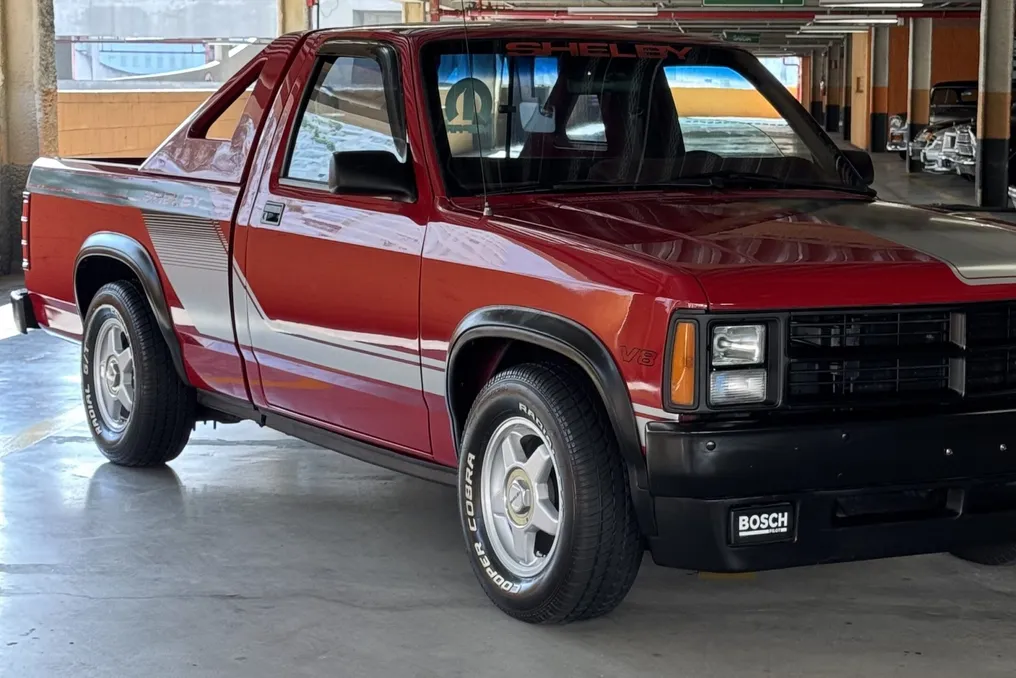
Many argue that pickup trucks are work vehicles, prioritizing robustness and load capacity over daily usability, making them unsuitable for urban routines or long trips. Traditionally, these trucks feature a body on a frame and high suspension.
Many argue that pickup trucks are work vehicles, prioritizing robustness and load capacity over daily usability, making them unsuitable for urban routines or long trips. Traditionally, these trucks feature a body on a frame and high suspension.
However, when purchasing a vehicle is motivated by enthusiasm and emotion, rational arguments lose relevance. Often, cars are chosen because they are attractive, challenging conventional wisdom. In this context, the Shelby Dakota stands out as one of the rarest and most influential sport trucks in history for introducing remarkable street performance.
The Shelby Dakota is extremely scarce, having been manufactured in only 1,500 units in 1989. It symbolizes Carroll Shelby's return to V8 engines during the 1980s. To understand its origin, one must analyze Carroll Shelby's trajectory after his partnership with Ford. Although the success of the Shelby Mustang grew exponentially, Ford's corporate bureaucracy began to restrict Shelby's creative freedom.
In 1967, Ford pressured Shelby to move production from his Los Angeles workshop to A.O. Smith facilities in Michigan. In 1969, Ford took full control of the design and production of the Shelby Mustang, relegating Shelby to the role of a mere promoter. Disillusioned, Shelby ended his racing participation after 1969 and announced his retirement in January 1970, returning to Texas to manage his farm.
During this period, Shelby remained connected to the automotive industry through his Shelby Wheel Company. However, in 1980, he was contacted by Lee Iacocca. Iacocca, who had been instrumental in the launch of the Mustang and the GT40 program, held significant influence. After being fired by Henry Ford II in 1978, Iacocca assumed the presidency of Chrysler in November of that year, saving the company from imminent bankruptcy.
Although Chrysler was saved, its early 1980s models were considered too rational and lacking personality. Shelby accepted the challenge of performance consultant for Chrysler. Initially, he worked on front-wheel-drive compacts, resulting in projects like the Omni GLH. However, Shelby's focus remained on classic rear-wheel-drive American V8s.
The ideal opportunity arose in 1987 with the launch of the first-generation Dodge Dakota, Chrysler's first modern mid-size truck for the American market. Shelby saw potential in this chassis and, for the 1989 line, replaced the original V6 with a genuine 5.2-liter V8, giving birth to the Dodge Shelby Dakota.
This cast-iron V8 engine is an evolution of the legendary 318 cubic inch LA, used in models such as the Dodge Dart and Charger manufactured in São Bernardo do Campo (SP) in the 1970s. Despite sharing piston dimensions, the Dakota's engine incorporated advanced technologies, such as single-point electronic injection, roller camshaft, and swirl port heads, surpassing the national classic in real-world performance.
While the 1970 domestic Dart declared 198 gross horsepower (about 135 net hp), the Shelby Dakota was homologated with 175 net hp. To accommodate the engine, the mechanical fan was replaced by a high-capacity electric fan, freeing up about 5 additional hp. Paired with a four-speed TorqueFlite automatic transmission, the 5.2-liter V8 generated 37.3 kgfm of torque, allowing the vehicle to reach 100 km/h in approximately 8.5 seconds, a remarkable feat for a utility vehicle in 1989.
The featured specimen is unit number 1,454 out of the 1,500 produced in Whittier, California, in 1989. It features Exotic Red paint, one of two available colors (the other being Bright White), and maintains excellent condition and high originality. The body, bumpers with Bosch headlights, and side stripes are preserved, as is the Santo Antonio aerodynamic emblem.
The cabin reflects the late 1980s, with intact original upholstery, dashboard, and door coverings showing no signs of wear. The vehicle has an original sport steering wheel, numbered plaque, factory radio, and functional air conditioning. With revised mechanics, this model represents an extreme rarity in Brazil, where it is estimated that fewer than ten units are circulating.
According to the daily horoscope for the Capricorn sign on July 15, 2026, owners of this sign are advised to exercise caution when driving vehicles.
This period is favorable for professional advancement. However, achieving financial gain will require additional effort. It is also advised to maintain high morale and not give up in any endeavor.
According to the daily horoscope for the Sagittarius sign on July 15, 2026, one should avoid distress over minor issues and instead focus attention on their affairs.
The prediction states that with the support of friends, it will be possible to advance in matters, and obstacles on the path to earning money will be removed. A favorable period for making important decisions is also noted.
According to the daily horoscope for Scorpio on July 15, 2026, success is expected in the professional sphere. However, readers are advised to take initiative and advance independently in their work.
Financially, it is advised to avoid thoughtless spending. The importance of keeping emotions under control and not placing excessive hopes on others is also emphasized.
A favorable period with potential for profit is predicted in the business sector.
