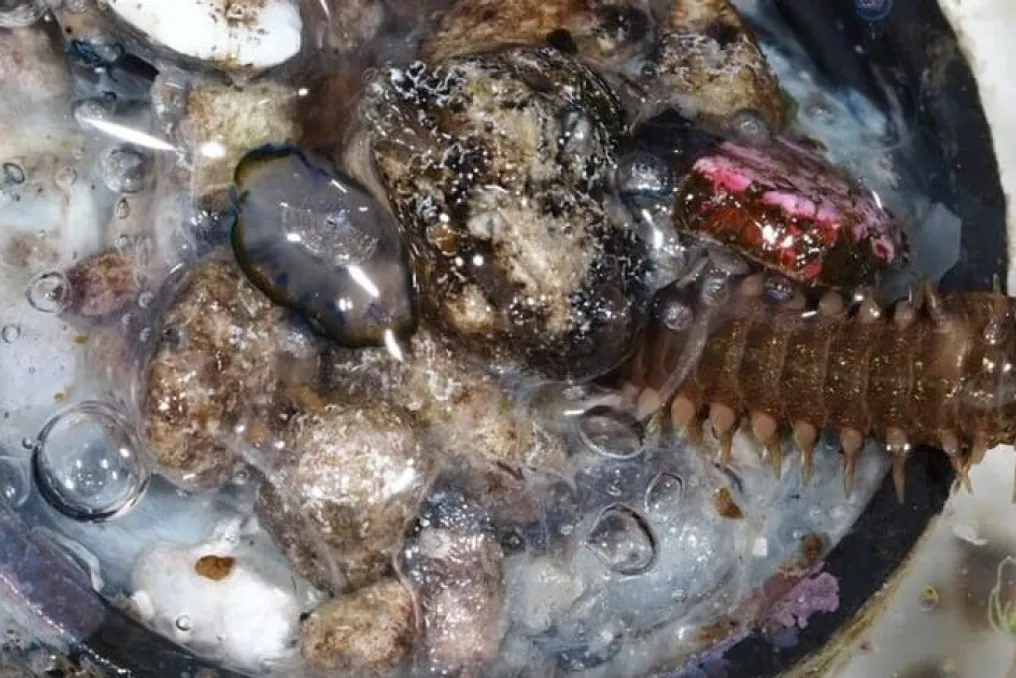
Researchers studied a community of living organisms that colonized a plastic bottle cap. This item was carried by the current from the Philippines to the coast of Japan. The study counted 309 individuals and colonies belonging to nine different taxa.
Composition and Features of the Colony
Among the passengers found on the cap were various species, including barnacles, crustaceans, flatworms, polychaetes, and foraminifera. Both local coastal species and organisms characteristic of drifting oceanic debris coexisted on the cap. According to a publication in the journal Marine Pollution Bulletin, the data from this study indicate that even small plastic particles are capable of transporting living creatures over long distances, taking them outside their usual range and contributing to the spread of invasive species.
Dispersal via Plastic Debris
Small marine inhabitants living near the coast often colonize fragments of plastic debris floating on the water surface. These organisms passively disperse far from their original habitat. Through this mechanism, coastal invertebrates have been able to reach areas of the open ocean, including the Great Pacific Garbage Patch. Sometimes, organisms traveling on plastic reach other continents.
An example from 2011 is cited, when a tsunami that struck Japan washed millions of items, including plastics, into the Pacific Ocean. Some of these items eventually reached North America, bringing with them about 300 species of coastal invertebrates from Asia. Thus, plastic pollution in the oceans creates a risk of transporting living organisms between different regions, which can harm local ecosystems. According to scientists, such cases have been recorded for at least 17 species.
Comparison with Natural Objects
Scientists note that marine organisms dispersed on floating objects long before humans appeared, such as on tree trunks. However, such natural objects quickly decomposed in water and could not cover large distances. In contrast, plastic fragments possess greater durability, allowing them to drift in the ocean for years and transport their passengers over significant distances.
Details of the Cap Study
A team of biologists led by Naoto Jimi from Nagoya University demonstrated that even a small plastic fragment can become a habitat for numerous living creatures. Between 2022 and 2023, researchers used a neural network to collect objects drifting on the surface of the Pacific Ocean off the coast of Southern Japan. Among the collected objects was a plastic bottle cap with a diameter of 3.5 centimeters. Numerous attached living organisms were found on its inner and, to a lesser extent, outer sides.
After removing the cap to the laboratory for analysis, researchers examined the passengers under a microscope and conducted genetic testing. The total number of counted individuals and colonies was 309, belonging to nine taxa. The largest representative was the polychaete worm Eunice bipapillata, reaching nine centimeters. It created a mucous tube on the cap that covered almost the entire inner surface, transforming the smooth plastic into a complex three-dimensional environment for other organisms.
Organisms on the Cap
Inside the mucous tube of E. bipapillata, two smaller polychaete worms of the species Platynereis sp. from the family Nereididae were found, which presumably used this structure as shelter. Additionally, 235 very small sessile polychaetes Spirorbis spp. from the family Serpulidae established themselves on the surface of the tube and the cap itself, whose spiral shells formed a dense white coating in places. Two flatworms of the species Acotylea sp. from the order Polycladida were also found inside the tube; these creatures are predators and scavengers usually found on the seabed.
In addition to worms, Jimi and his co-authors recorded 23 small colonies of barnacles from the family Electridae, located both outside and on the E. bipapillata tube. There were also 19 sea ducks Lepas anatifera—crustaceans with a sessile lifestyle—on the outer side of the cap. Both the Electridae barnacles and the L. anatifera sea ducks are classified as epibionts of drifting ocean objects. Finally, foraminifera were found on the cap—unicellular eukaryotes with mineral skeletons. Among them were 22 live specimens of Rosalina globularis, which usually lives in shallow coastal waters, attaching to corals and rocks, two live benthic foraminifera from the class Monothalamea, and two dead planktonic foraminifera Globorotalia crassaformis and Globigerina bulloides, as well as a fragment of a shell of an unidentified planktonic species.
Conclusions on the Cap's Journey
The researchers concluded that the cap functioned as a miniature reef, where typical epibionts of drifting objects coexisted with coastal species, both free-living and sessile. It is presumed that epibionts colonized the object first, followed by the attachment of coastal species. After cleaning the cap of epibionts, a engraved name of a Philippine beverage company was discovered, confirming the version of its journey from the Philippines or neighboring regions to Japan. The presence of the polychaete worm E. bipapillata, whose range includes tropical waters in the western Pacific Ocean but has not previously been noted in Japan, also supports this assumption. Analysis of the growth rates of the foraminifera shell R. globularis, as well as oxygen and carbon isotopes, allowed the authors to conclude that during its life it was in water with a temperature ranging from 22.3 to 29.9 degrees Celsius, confirming its arrival from the Philippines. Additional modeling showed that the cap's journey took at least 70 days, and most of this time it was under the influence of the Kuroshio Current. The results highlight the ability of small fragments of plastic debris to act as carriers of marine organisms over vast distances.