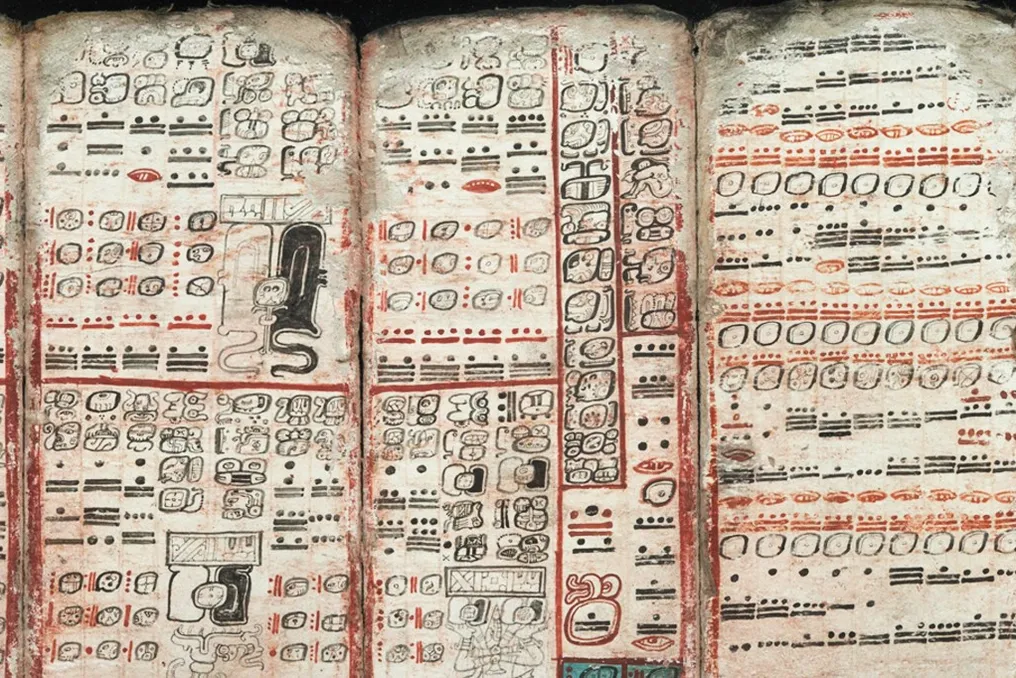
A new study managed to decipher the name of the first known Mayan astronomer-mathematician, Sak Tahn Waax, along with a complex formula dated to 781 AD.
Mayan Civilization Context
Mayan society began its development in Mesoamerica before the birth of Christ. Over time, it evolved into a vast civilization that, at its peak, housed millions of individuals distributed across the territory that today comprises Mexico, Guatemala, El Salvador, and other nations. Due to social transformations and Spanish colonization, many aspects of this powerful culture were obscured, generating mysteries, especially concerning its mathematicians and astronomers.
Discovery in Xultun
Although there are records of calendars, studies of astronomical cycles, and advanced Mayan calculations, much of this knowledge was historically lost, and the names of these geniuses had never been revealed until recently. A recent research, published in the scientific journal Antiquity, allowed for the identification of the name of an 8th-century Mayan astronomer-mathematician. Specialists from American universities focused on a small room found at the archaeological site of Xultun, an ancient Mayan metropolis located in northern Guatemala, immersed in the Petén jungle.
Analysis of Inscriptions
Xultun has been under investigation since the 1920s, but the specific room was only discovered in 2010. Initially, its walls displayed light stains that could be mistaken for dirt. However, these stains were, in fact, worn engravings with content yet to be interpreted. After being neglected, researchers periodically revisited the site.
Using software to intensify the colors of the paintings, researchers noticed that there were eleven glyphs and approximately fifty mathematical microtexts (small notes containing dates, numbers, and calculations). After a meticulous analysis employing drawings, digitally enhanced photographs, and other tools, the team concluded that it was a mathematical equation. This formula, dated to 781 AD, calculated the time required for Mars and Venus to return to the same position relative to the Sun, completing their respective cycles. The inscription consisted solely of mathematical symbols and numbers, without text.
Meaning of the Formula and Name
David Stuart, one of the authors of the study, explained to Science Alert that Mayan mathematics encompassed a unique understanding of the relationships and patterns between various temporal cycles, including the ritual count of 260 days, the solar year, and the cycles of Venus and Mars. Researchers speculate that this formula might have served as a foundation for subsequent calculations by the Mayan civilization, such as those found in the famous Dresden Codex, produced centuries later.
In addition to the formula, a name was found: Sak Tahn Waax, which translates to 'White-Chested Fox'. It is likely this is the credit or signature of the formula's creator. Researchers cannot confirm whether Sak Tahn Waax wrote the formula directly on the wall; one possibility is that another person recorded the calculations and credited the author, while another hypothesis suggests that someone wrote the formula and Sak Tahn Waax claimed authorship.
Mayan Workspace
Regardless, researchers characterize the location as a kind of royal scribes' office, where astronomers conducted their studies. Later, the Mayans themselves covered the area with earth and stones when building new structures around it.