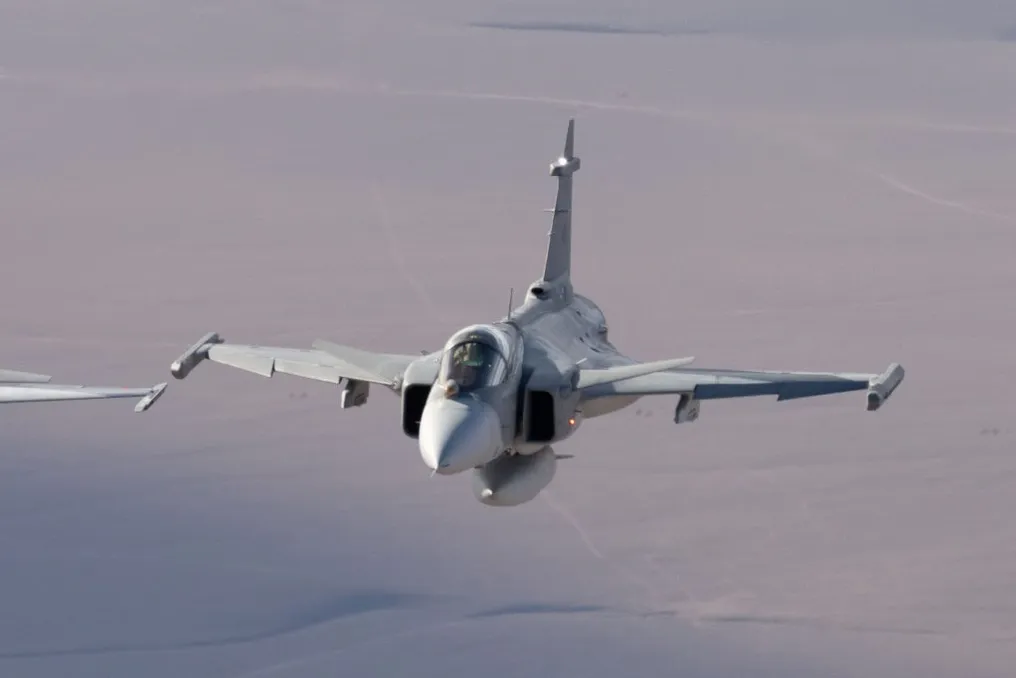
The Brazilian Air Force's (FAB) F-39E Gripen fighter made its debut in a multinational exercise held outside of national territory. This participation occurred during the SALITRE 2026 event, hosted in Chile, where six Brazilian aircraft collaborated with air forces from five other countries.
Details of the Multinational Operation
The operation gathered a contingent of over 1,500 military personnel and approximately 60 aircraft, executing missions that simulated aerial combat scenarios, covering functions such as defense, patrol, and escort. Between June 29 and July 11, the fighters operated from the Cerro Moreno Air Base, located in Antofagasta, Chile.
Within the scope of the SALITRE 2026 Multidomain Exercise, the F-39Es completed more than 50 flights and accumulated over 100 flight hours, including transit routes. The aircraft worked together with planes belonging to Chile, Argentina, Colombia, the United States, and Paraguay, utilizing advanced equipment such as the Active Electronically Scanned Array (AESA) radar, the Infrared Search and Track (IRST) sensor, and electronic warfare systems.
Technological and Operational Importance
According to Saab Brazil, this participation signals a new phase in the implementation of the Gripen program in Brazil. The involvement of the F-39E Gripen in SALITRE 2026 is seen as a continuous advancement in introducing the aircraft into the Brazilian Air Force.
During air defense missions, the Gripens were responsible for protecting allied aircraft against simulated threats. A notable point was the capability of the systems to consolidate information from various sensors and present it in a simplified manner to the pilots. Lieutenant Colonel Vítor Bombonato, commander of the 1st Air Defense Group (1st GDA), highlighted that this integration elevates decision-making capability during operations.
Bombonato explained that the situational awareness provided by the Gripen E's sensors and systems enables the fusion of a large volume of data, presenting it to the pilot in a simplified way and thus assisting the decision-making process. The resources employed included AESA radar for target tracking, IRST sensor for passive search, and data communication between aircraft and operations both within and beyond visual range (WVR and BVR).
Pre-Mission Training in Brazil
Before participating in SALITRE 2026 in Chile, the FAB conducted preparatory training in Brazil. In addition to exercises carried out with other squadrons, pilots used the Gripen simulator in Anápolis, applying scenarios modeled based on the Antofagasta region. Bombonato commented that, despite it being the first time Brazilian pilots flew in that area, they felt great familiarity with the entire operational environment upon arrival.
This participation established a new milestone for the F-39E Gripen, demonstrating its suitability to operate jointly in an international context alongside different air forces.