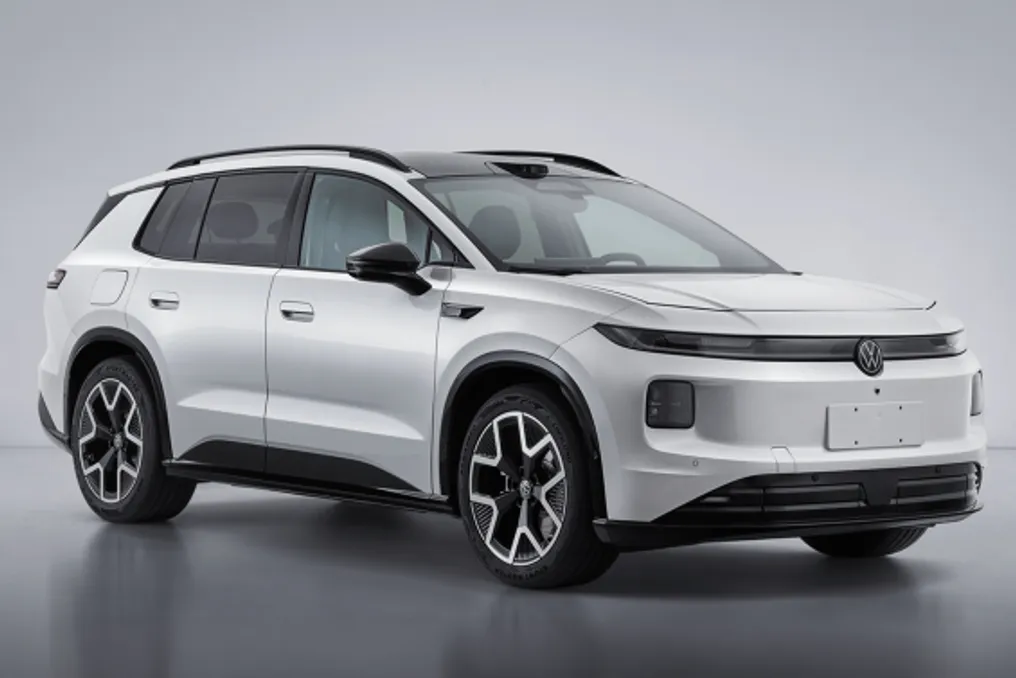
Volkswagen has intensified its strategy to regain market share in China by presenting the specifications of the ID. Aura T6. This medium electric SUV was recently registered for sale in China and has a larger size than the Tiguan, Volkswagen's best-selling SUV in Brazil.
Development and Positioning in the Chinese Market
The model was developed in partnership with the FAW-Volkswagen joint venture and is currently exclusive to the Asian market. The automaker is betting on implementing advanced autonomous driving features to mitigate the recent drop in sales in the country.
With dimensions of 4.81 meters in length, 1.88 meters in width, 1.65 meters in height, and a wheelbase of 2.84 meters, the ID. Aura T6 is slightly smaller than the VW ID.6, measuring only 6.5 cm less. Despite this, it maintains a five-seat configuration and serves as a broader replacement for the ID.4, which is 22.7 cm smaller.
Design and Embedded Technology
The vehicle's design follows Volkswagen's new visual identity adopted in China, exemplified by the ID. Era 9X. This language includes headlights integrated into the bumper, a continuous light strip at the front, active air intakes, semi-recessed door handles, and a single rear light. The vehicle can be equipped with 19 or 20-inch wheels.
A notable technological feature is the LiDAR sensor installed on the roof, which is part of the driving assistance package provided by Carizon, a collaboration between the Volkswagen Group and Horizon Robotics. According to the brand, this system allows for autopilot navigation on both roads and urban streets. The car's electronic architecture was developed in conjunction with Xpeng.
Mechanical Specifications and Battery
The T6 uses a single electric motor positioned on the rear axle, generating 231 hp, which represents an increase of 52 hp compared to the ID.6. Its top speed reaches 186 km/h. The battery is LFP type and supplied by Gotion, although its exact capacity has not yet been disclosed. Declared weights indicate two possible battery options: the entry-level version weighs 2,026 kg curb weight, while the version with greater range reaches 2,126 kg.
Market Context and Comparison with the Tiguan
This launch occurs during a challenging period for Volkswagen, as in June 2026, the company recorded deliveries of 102,840 vehicles in China, representing a 41.4% reduction compared to the same month in 2025. Under pressure from local industries to accelerate electrification, the automaker seeks to respond by combining German engineering with Chinese-sourced software and assistance systems.
For the Brazilian consumer, the Tiguan, introduced in the country in May 2026, is the closest dimensional reference. The Tiguan has a length of 4.70 m and a wheelbase of 2.79 m. The T6 is approximately 11 cm longer and has a 4.4 cm longer wheelbase, providing more interior space. The width (1.87 m) and height (1.69 m) measurements are very similar, and both accommodate five passengers.
The fundamental differences lie in the propulsion. While the T6 is fully electric, the domestically produced Tiguan operates with a 2.0 TSI gasoline turbo engine, generating 272 hp and 35.7 kgfm. It features an eight-speed automatic transmission and 4Motion all-wheel drive, reaching 100 km/h in 7.4 seconds, according to manufacturer data.