The federal government approved the increase in the mandatory percentage of anhydrous alcohol in gasoline, raising it from 30% to 32%. This decision was formalized on Tuesday morning, the 14th, by the National Energy Policy Council (CNPE).
The federal government approved the increase in the mandatory percentage of anhydrous alcohol in gasoline, raising it from 30% to 32%. This decision was formalized on Tuesday morning, the 14th, by the National Energy Policy Council (CNPE).
Initially, the new 32% composition will be valid for 180 days, with the legal possibility of extension for one more equal period, only once. This represents the second increase in just over a year, as the blend had been raised from 27.5% to 30% in June 2025.
According to the resolution issued by the council, the justification for the change lies in the instability observed in the international oil and fuel market. Increasing the participation of domestic ethanol aims to decrease dependence on imported fossil fuel derivatives and strengthen the presence of this biofuel in the Brazilian energy matrix.
Estimates from the Ministry of Mines and Energy indicate that this measure could reduce the need to import approximately 500 million liters of gasoline monthly, which would contribute to the country's self-sufficiency in supply. For the sugar-energy sector, the change will inject an additional demand of 1 billion liters of anhydrous ethanol annually.
Despite the government's claim that laboratory and road tests show no issues with drivability or mechanical damage, even in non-flex engines, the decision raises concerns in automotive engineering and among enthusiasts of classic and imported vehicles. Anhydrous ethanol has high hygroscopicity, absorbing moisture from the air, which increases the electrical conductivity of the fuel and can initiate accelerated galvanic corrosion in metal parts, such as steel tanks, feed lines, and carburetors of classic cars.
Additionally, the solvent nature of ethanol at high concentrations can deteriorate and dry out rubbers, gaskets, and hoses not designed to withstand such content, not to mention the inherent decrease in the calorific value of the mixture, which implies higher fuel consumption for the driver.
The text points out that Brazil was globally pioneering in incorporating alcohol into gasoline almost a hundred years ago, and was also the first country to produce ethanol cars on a large scale and universalize the flex vehicle. These initiatives have contributed to Brazil having a fleet with low emission rates. The addition of more ethanol to regular gasoline, therefore, should lead to an even greater reduction in these emissions.
The author criticizes electrification programs promoted by bureaucrats aligned with international organizations, arguing that Brazil already serves as an example in emission reduction and questioning the logic of increasing dependence on imported batteries and deficient electrical infrastructure while guaranteeing fuel independence.
On another front, Porsche is facing cuts due to the profitability crisis affecting the entire Volkswagen group, even Porsche, which was previously highly profitable. After a 99% drop in operating profit, Porsche is under scrutiny from the VW cost containment committee.
Information from the German newspaper Bild suggests that Porsche's preliminary list of cuts includes the Taycan, the Cayenne Coupe, and the combustion successor of the 718, which was being developed to reverse the decision to end the 982 generation in favor of an electric 718. The situation is so critical that even the Taycan is being removed from planning.
Porsche's strategy of saturating the market with various versions of the 911 is also being revised. Due to the development, calibration, and validation costs of each of the dozens of 911 variants, reducing options is seen as a quick way to contain margin loss.
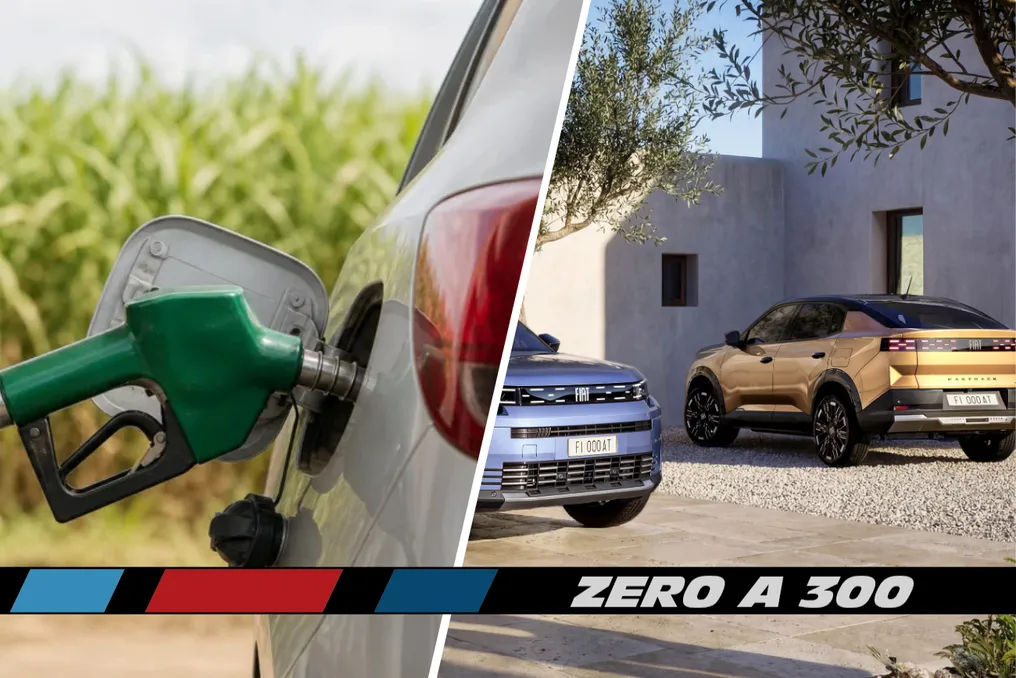
Following its initial presentation under the FaSTLAne strategic plan by Stellantis, Fiat fully revealed its two new compact mid-sized SUVs in Europe: the Grizzly and the Grizzly Fastback. This duo will be the centerpiece of the Italian brand at the Paris Motor Show in October, with sales starting in the Old Continent shortly after.
Both models are highly likely to be launched in Brazil, although they may receive different names and project adjustments. The standard Grizzly measures 4.4 meters long and may offer a seven-seater configuration with a retractable third row, although Fiat has not confirmed this. Its design stands out with taillights composed of small rectangular LED blocks and a wide, windowless C-pillar.
Internally, the Grizzly features a dashboard with angular lines, a floating two-level center console with glossy black trim, a raised multimedia center, push-button start, and electronic parking brake.
The Grizzly Fastback adopts a smoother roof profile, giving it a silhouette similar to a coupe. This version incorporates a glossy black finish, highlighting the taillights with a 'pixelated' effect. The front end is identical to the conventional model, with a high hood, centered Fiat emblem on the grille, and rectangular LED headlights. At 4.5 meters, the Fastback gains ten extra centimeters, allowing for 600 liters in the trunk, a volume comparable to the current Brazilian Fastback, but with more balanced proportions due to the longer wheelbase.
Both SUVs share the Stellantis Smart Car platform, a simplified variation of the CMP architecture used in other recent Citroën and Opel vehicles. In Europe, the line will include mild hybrid and fully electric options, delivering up to 145 hp with a manual or automatic transmission. The hybrid versions use the Stellantis group's 1.2-liter three-cylinder gasoline engine.
Although Fiat has not officially confirmed it, the launch in Brazil is considered certain. The models were developed locally under codes F2U (Grizzly SUV) and F2X (Grizzly Fastback), with an expected arrival in the Brazilian market between 2027 and 2030.
A recent test published by the Swedish magazine Vi Bilägare, in the 2026 edition, confirmed the risk associated with using multimedia screens in vehicles, reinforcing what many drivers already perceived: modern screens cause more distraction than those from previous years.
Despite marketing promises that larger screens and faster processors would improve usability, the reality presented by the Swedish test contradicts this theory. Using the same methodology as in 2022, drivers were placed on a closed track, maintaining 110 km/h, and measured the distance traveled until the completion of four simple tasks, such as adjusting temperature, turning on the seat heater, changing the radio, and adjusting brightness.
The results showed an ergonomic regression. In 2022, the average distance traveled during distraction was 756 meters. In 2026, this average increased to 813 meters, equivalent to almost two additional seconds of 'dynamic blindness' at highway speed.
Mercedes-Benz, which promotes its operating system intelligence, performed alarmingly. In the CLA, the driver took 35 seconds to interact with the menus, which was 15 seconds more than in the GLB SUV evaluated four years earlier, traveling 1,116 meters without full focus on driving. The Mazda CX-60 recorded the worst result with 1,137 meters. The Volvo XC60, although with 485 meters, was surpassed by the 2022 Volvo C40 Recharge (which required 68 meters less).
All these models were outperformed by the test control group—a 2016 Volvo V60 and a 2005 V70—demonstrating the fragility of modern systems. The author concludes by criticizing the trend of technological deterioration, comparing it to the imposition of facial monitoring cameras by the European Union, while automakers themselves remove physical buttons to reduce costs, entering the 'era of good intentions.'