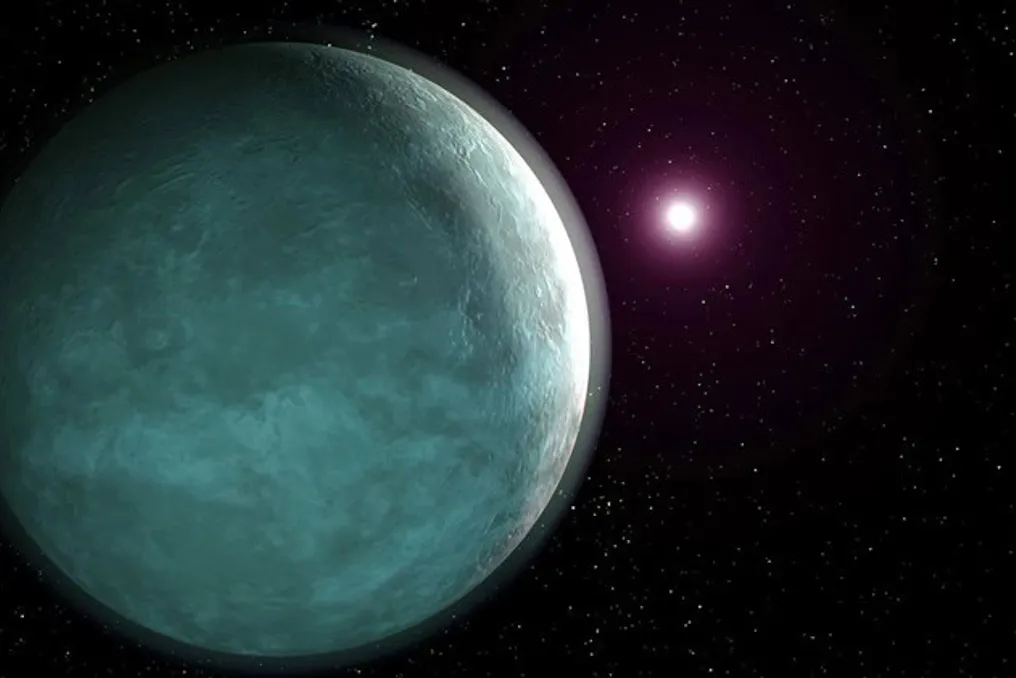
A study conducted by scientists at the University of Chicago suggests that a vast category of exoplanets, known as sub-Neptunes, may contain larger volumes of water than previously believed.
Discovery published in scientific journal
The research, released last Monday (the 13th) in the journal The Astrophysical Journal, indicates that on certain worlds located outside the Solar System, water may be concentrated in deep internal layers. Because of this, current observation instruments, including the James Webb Space Telescope, cannot detect it directly.
Popular
Analysis of models and specific planets
The researchers reached this conclusion by examining physicochemical models of planets such as TOI-270 d, located in the constellation Pictor. The focus of the study was to understand how the atmospheric composition of these bodies can mask features present in their interiors.
Simulations demonstrated that water can remain hidden inside exoplanets. Sub-Neptunes constitute one of the most frequent planetary populations identified in the galaxy, but they remain among the most complex objects to understand. Although smaller than Neptune, they do not possess sufficient attributes to be classified as Earth-like rocky planets.
Limitations of atmospheric observation
Since there is no known parallel in our Solar System, scientists rely on simulations to estimate the composition of these worlds. Current theories suggest a variable mixture of rock, gases, and water, but the exact proportion between these elements remains uncertain.
The James Webb Space Telescope aids in analyzing molecules in the atmospheres of distant planets by observing starlight passing through these gaseous envelopes during planetary transits. This method is useful for identifying chemical substances but does not automatically reveal the internal structure of these worlds.
The main challenge lies in establishing a link between what is visible in the atmosphere and the structure of the planet's deeper layers. The team led by Caroline Piaulet-Ghorayeb investigated exactly this connection by reviewing models on material distribution within sub-Neptunes.
Review of the uniform mixing hypothesis
The study challenged a previous assumption by scientists: the idea that, because they are hot planets, their molecules would be distributed uniformly, allowing the atmosphere to reflect the state of the rest of the planet. New calculations showed that this homogenization may not be so simple. Depending on the composition and internal conditions, water and hydrogen can separate.
In worlds with colder atmospheres or high water concentration, this element can migrate to regions below the hydrogen-dominated layers, making the water signature inaccessible to telescopes.
Evidence found in TOI-270 d
To investigate this scenario, the researchers used the exoplanet TOI-270 d as a reference. Webb observations detected atmospheric signatures of hydrogen, methane, and carbon dioxide, a combination that, according to scientists, may signal the existence of large volumes of water.
However, water does not behave uniquely in extreme environments; it can exist in various physical states, including supercritical fluid, which occurs under extremely high pressures and temperatures. The team assessed how variations in the ratios of hydrogen and water modify the planet's architecture, concluding that small changes in composition can alter the internal distribution of these materials.
Future perspectives and the importance of water
Eliza Kempton, a co-author of the study, clarified that current methodologies still do not allow confirmation whether TOI-270 d belongs to the group of planets with deep water or another classification. She stated: 'With current techniques, we still do not have the capacity to confirm or exclude in which category the planet TOI-270 d falls.'
Even if these worlds do not possess ideal conditions for human life, understanding their composition contributes to explaining planetary formation and evolution. Water is crucial in studies of potentially habitable environments, but its detection on distant planets is difficult, as its presence can be confused with mixtures of rock and gas.
Leslie Rogers, a co-author and associate professor, pointed out that the difficulty is linked to the physical properties of the molecule: 'Water has intermediate density, so it can be mimicked by a mixture of rock and gas.' For Caroline Piaulet-Ghorayeb, a postdoctoral researcher at the University of Chicago and first author, the discovery emphasizes that observations from new telescopes must be interpreted with caution, as 'it is very possible that these planets are hiding much more water than their atmospheres reveal.'
The investigation reinforces that atmospheric data obtained by advanced telescopes represents only one facet of these worlds, keeping the internal composition of exoplanets an open question for astronomy.