Decentralized Finance (DeFi) fundamentally differs from the traditional financial system because it lacks intermediaries. Instead, it utilizes only the user, their cryptocurrency, and software code running on a blockchain.
The Massive Growth of the DeFi Industry
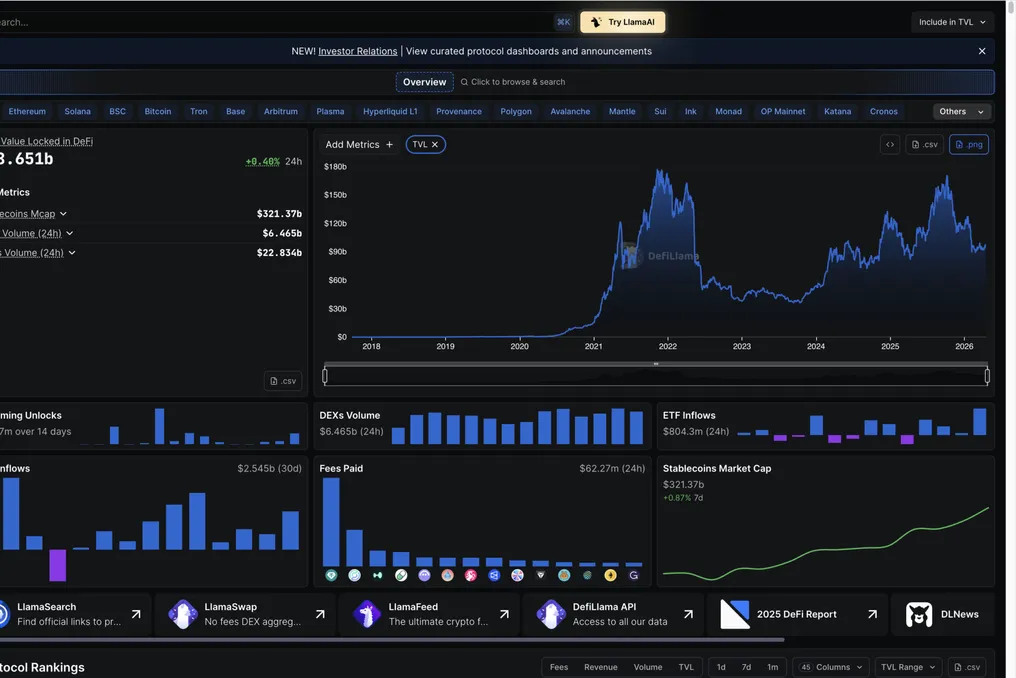
The industry is demonstrating significant growth. As of the end of 2024, the total value locked in the DeFi sector reached $133.6 billion, which is 2.5 times higher than the $50 billion recorded in December 2023. By the end of 2025, this amount increased to $172 billion.
What Does DeFi Mean?
DeFi stands for Decentralized Finance. It represents a collection of financial services, including lending, trading, savings, and earning income, that operate on public blockchains, bypassing banks or corporations. The significance of DeFi goes beyond simply eliminating banks; it means that anyone with a crypto wallet and internet access can utilize financial services that were previously restricted by geography, credit score, or income.
Users can borrow against their crypto assets, earn yield, or make price predictions for coins. The concept of DeFi began gaining momentum around 2018 when Ethereum developers started creating open financial tools on the blockchain.
Comparing DeFi and Traditional Finance
Most people are accustomed to traditional financial institutions where banks hold funds, set interest rates, and determine loan recipients. The DeFi model is completely opposite to this. In traditional banking, a central authority controls the funds, whereas in DeFi, all processes are automated using smart contracts—self-executing code. Banks operate during business hours, while DeFi functions 24/7, 365 days a year. The traditional system requires identity verification and approval, whereas DeFi only requires a crypto wallet. Furthermore, DeFi protocols are open source and can be audited by anyone online, unlike internal bank rules.
The issue of access is also important: according to World Bank data, about 1.4 billion adults worldwide remain unbanked. For DeFi, this is irrelevant because the system does not consider the user's credit history or country of residence; having a phone and a wallet is sufficient. Nevertheless, DeFi does not provide consumer protection, fraud recovery, or deposit insurance offered by banks. This underscores the critical importance of understanding DeFi's operating principles before investing funds.
The Role of Smart Contracts and dApps
Smart contracts are the driving force behind the entire system. They are computer programs deployed on the blockchain that execute actions automatically when specific conditions are met. They can be compared to a vending machine: you put money in, and the machine dispenses a product without human intervention. These programs ensure fairness and transparency because all actions are visible to everyone.
Users interact with these contracts through decentralized applications, or dApps. They look like regular websites or mobile apps, but instead of connecting to a company's server, they connect directly to the blockchain via a personal wallet. For example, when participating in yield farming in DeFi, the user does not transfer personal data or register as they would at a bank.
Major Blockchains in DeFi
Ethereum is the leading blockchain in the DeFi sector, holding over 68% of the total value locked. However, other networks such as Solana, BNB Chain, and Avalanche also capture market share, sometimes offering faster transactions or lower fees than the Ethereum network. On Ethereum itself, smart contract interactions account for nearly 62% of all daily transactions, with DeFi protocols providing about 25% of the total network transaction volume. This entire process is executed automatically by code, without human intervention.
Practical Applications of DeFi
Decentralized Exchanges (DEXs) allow users to trade cryptocurrencies directly from their wallets, eliminating the need for account registration, KYC verification, or withdrawal limits imposed by corporations. Instead of a traditional order book, DEXs use liquidity pools. Users contribute pairs of coins to a common pool, and an Automated Market Maker (AMM) algorithm sets prices based on supply and demand. Uniswap is the largest DEX by volume, and Curve is a preferred choice for many investors when exchanging stablecoins.
Lending and Staking
DeFi lending works similarly to a bank loan, but the process is less cumbersome. A user deposits crypto assets into a protocol like Aave or Compound, and other users can borrow against those assets. The smart contract automatically manages interest rates, collateral requirements, and repayment. Borrowers usually have to provide more crypto assets than they borrow, which protects lenders in case of sharp price drops. In return, lenders receive interest paid directly to their wallets, often at rates higher than those offered by banks.
Staking in DeFi involves locking up coins in a protocol to support its operation and earn rewards. In Proof-of-Stake blockchains, such as Ethereum, stakers help validate transactions and receive a portion of network fees. Protocols like Lido have made this accessible without deep technical knowledge: users deposit ETH and receive stETH—a liquid token representing their stake—while continuing to earn rewards. Lido currently holds about $27.5 billion in TVL, making it the largest individual DeFi protocol by this metric.
Yield Farming and Wallets
Yield farming goes further: traders move their cryptocurrencies between different platforms to maximize profit. Typically, they deposit capital into liquidity pools, receiving special reward tokens in return, and then stake these new assets in other dApps to maximize returns. Although potential yields can be high, risks exist, including impermanent loss, the possibility of scams, and general risks associated with the farmer's activity.
A DeFi wallet is a tool for accessing the entire crypto market. Unlike wallets on centralized exchanges, where the exchange technically controls the coins, a DeFi wallet gives full direct control to the user. MetaMask is the most common option for Ethereum and EVM-compatible networks, while Trust Wallet supports multiple blockchains in one application, popular among Solana users—Phantom.
Advantages and Risks of DeFi
DeFi has brought numerous benefits to millions of people by providing control unavailable in traditional banks and creating new ways to earn cryptocurrency. As of August 2024, the number of DeFi users exceeded 83 million. Earning potential through yield farming, liquidity provision, and staking can surpass the returns from savings accounts or government bonds. Some individuals have become millionaires by entering the DeFi sector and may even receive free funds through airdrops or participation in presales.
However, serious risks remain: smart contract bugs, exit scams, and extreme market volatility can lead to instant loss of funds. Even experienced users have lost money due to poorly audited protocols or sudden price drops causing liquidations. Moreover, most jurisdictions still define the legal and tax status of DeFi crypto activities, which may change in the future.
Conclusion on the Future of Finance
DeFi is a financial system that runs on code, not institutions, accessible to anyone with a wallet and internet, and operates without central authority permission. Although regulation has not yet kept pace with development, and the user experience requires learning, the risk of smart contracts remains real. Nevertheless, the growth of this sphere cannot be ignored.