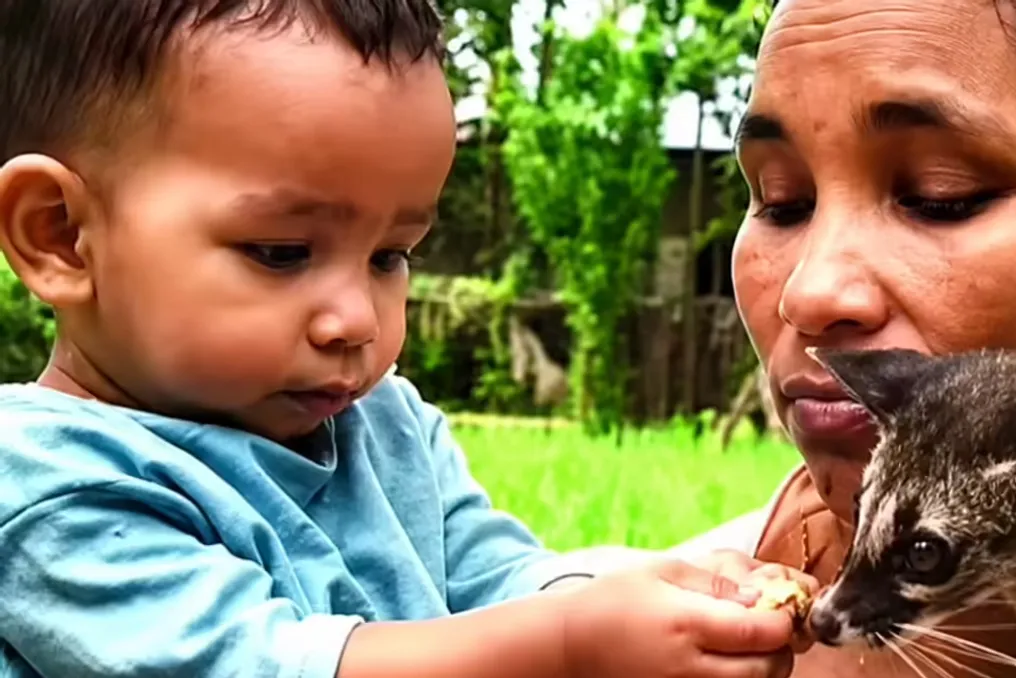
The story of how a family from Assam saved an orphaned civet has become educational material and was included in the NCERT curriculum for 10th grade. This lesson is titled 'Baby Bhakat.'
The story of how a family from Assam saved an orphaned civet has become educational material and was included in the NCERT curriculum for 10th grade. This lesson is titled 'Baby Bhakat.'
While browsing the book pages, a student saw photographs of a small palm civet resting in a woman's hands, as well as a picture of a cub next to an animal. He realized that the child in the photo was himself. For this teenager from Nagaon district in Kamrup, Assam, it was an unexpected reunion with a story he had never known before.
Seventeen years ago, when Gibbon was only six months old, his parents were raising an orphaned Asian palm civet alongside him. Today, this exceptional act of kindness has entered the NCERT syllabus for 10th grade, presenting students across India with a story that began in a small town in Assam.
The events took place in 2009 when a tiny palm civet cub, locally known as Jahamal, fell from a tree in Tetelisora village, Nagaon district. It was barely two weeks old, and its chances of survival on its own were extremely low, as, like all Asian palm civets, it was completely dependent on its mother. Born with closed eyes, the sight requires several weeks of maternal care to become independent.
When the villagers discovered the cub, they approached Dharani Saikie, a wildlife enthusiast from Vrindaban Nagar in Kamrup, affectionately called the 'Man of the Forest' for rescuing injured and suffering wild animals. Along with his elder son, Dharani brought the cub home. The family faced a difficult dilemma: how to sustain such a young animal?
After consulting with a wildlife rescue center, they learned that the best chance of survival for the cub was mother's milk. For Anjali Saikie, this decision was not easy, as she was already feeding her six-month-old son, Gibbon. After some hesitation, she agreed. The orphaned civet became her third child, and the family named him Bhakat.
For the next few months, Bhakat was not just seen as a rescued wild animal; he became part of the family. He shared meals of rice, fish, and meat with them, and at night slept in the same bed as the children. When Gibbon learned to crawl, Bhakat explored the house next to him. One was human, the other wild, but they grew up like siblings.
Their unusual bond attracted the attention of nature photographer Rommel Shunmugan, who came to Kamrup after hearing about the rescue. He spent ten days documenting the family's life with Bhakat before returning to Delhi. Over time, the family lost contact with him and decided that the photographs were part of an old assignment. Life went on, and Bhakat became a cherished memory.
Recently, Gibbon returned home after completing his 10th-grade exams at Jawahar Navodaya Vidyalaya in Dhinge and discovered something unexpected: the story of Bhakat was in his NCERT English textbook. A chapter titled 'Baby Bhakat' was included in the NCERT curriculum for 10th grade for the 2024–25 academic year and retained for 2025–26. It narrates how a family from Assam cared for an orphaned palm civet, including photographs of Dharani, Anjali, little Gibbon, and Bhakat. For Gibbon, this discovery held deep personal significance, as he did not remember those early months and was unaware that he was the child in the photos until his parents told him. The residents of Kamrup also consider this a cause for pride, noting that a story that had almost faded over time has finally found its deserved audience.
Asian palm civets have long carried an unfair reputation. Across India, they are given names shaped by myths and misconceptions: in Delhi, they are called Kabar Bijju or 'grave robber'; in Kolkata, Bham or 'baby thief'; and in Maharashtra, Kandechor, which means 'potato thief'. However, wildlife experts describe a completely different animal. Asian palm civets are shy, nocturnal, and mostly solitary mammals inhabiting tropical Asia. They feed on fruits, insects, and small animals, playing an important role in seed dispersal and rodent population control. Nevertheless, their survival is constantly threatened by habitat loss, urban expansion, human-wildlife conflict, and poaching for musk used in perfumery.
As forests shrink, civets increasingly enter cities and settlements, where they are often mistaken for pests rather than wild animals displaced from their natural habitat. The story of Bhakat offers a different perspective on them—not as intruders, but as vulnerable creatures trying to survive.
The story of Baby Bhakat preserves more than just a memory of a civet cub raised alongside a human. It immortalizes a wonderful moment when an ordinary family in a small town in Assam chose compassion over indifference. From a coconut tree in Tetelisora to the lens of a nature photographer, and then to the pages of an NCERT textbook read by millions of students, Bhakat's journey has come full circle. In classrooms across the country, this simple story quietly reminds the next generation that conservation often begins with one small act of kindness.