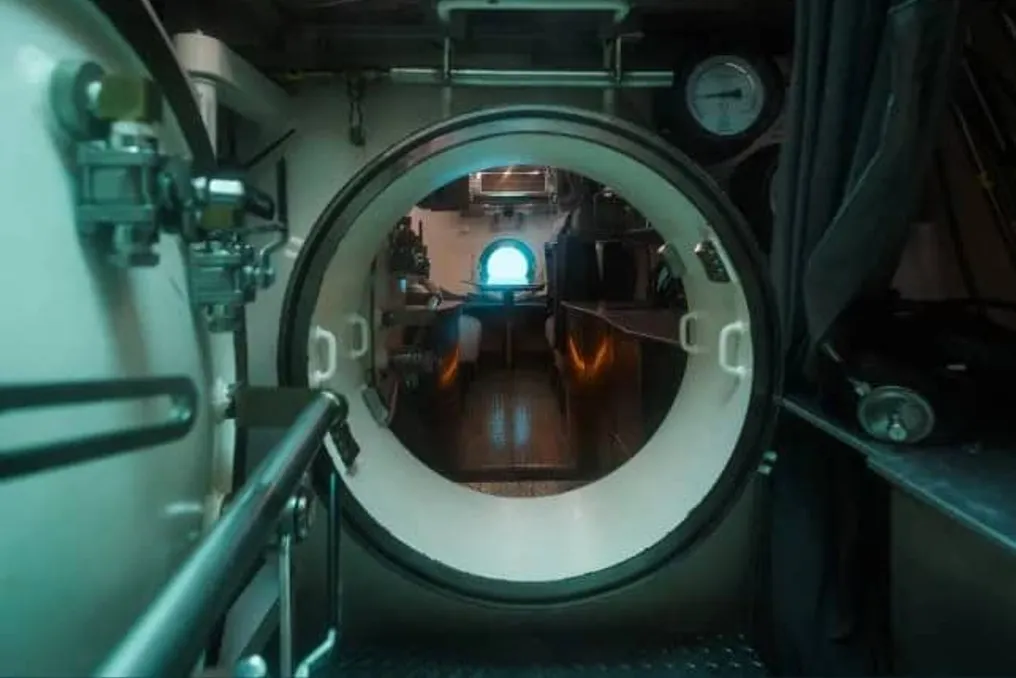
A new human-designed habitat module has begun operating in the deep ocean of the United States. This object, named Vanguard, was developed by the ocean engineering company DEEP and is soon expected to host its first temporary occupants.
A new human-designed habitat module has begun operating in the deep ocean of the United States. This object, named Vanguard, was developed by the ocean engineering company DEEP and is soon expected to host its first temporary occupants.
The Vanguard structure is designed to allow groups of researchers to live and work underwater for several days. It combines the functions of a scientific laboratory, living quarters, and a diving base. Although previous experiments have been conducted on long-term human stays at the seabed, Vanguard is the first such initiative implemented by the private company DEEP, founded in 2021.
Vanguard represents the pilot stage of a larger company project called Sentinel. According to DEEP, this project will enable short-term and even semi-permanent placements anywhere on the continental shelf by 2027.
The module was installed on a stationary platform in the Tennessee Reef area, located within the Florida Keys National Marine Sanctuary, at a depth of about 17 meters. The structure can accommodate up to four people simultaneously. Among the first mission participants will be Dawn Kernagis, Director of Scientific Research at DEEP. Her specialization is human physiology in extreme conditions, particularly the impact on the nervous system and brain. She previously participated in the NEEMO 21 underwater mission organized by NASA and has experience living in underwater habitats.
According to Kernagis, constant presence at the seabed offers significant advantages for various fields of science, particularly marine biology. One existing problem is that samples collected at great depths undergo changes upon rapid ascent to the surface due to sharp pressure changes. She explained that when a sample ascends, it decompresses, and any molecular or cellular signature begins to depend on this decompression process, which distorts the representation of the sample's state at depth. The new module will allow for the review of many studies and create the possibility of processing samples almost in real time, directly in the underwater environment. Furthermore, Vanguard is equipped with sensors that continuously monitor underwater environmental conditions, even when no people are aboard.
Inhabitants are located in an enclosed air bubble, whose pressure is regulated to remain close to the surrounding ocean pressure. In fact, Vanguard functions as a large decompression chamber, and its occupants act as saturation divers. Kernagis explained that this is similar to prolonged scuba diving, where tissues and blood become saturated with the inert gas nitrogen. This type of diving has existed for a long time and allows people to remain at depth for weeks or months after reaching saturation. To perform work outside the module, the crew uses a 'umbilical,' a hose that supplies air directly from the habitat module, eliminating the need to use traditional tanks. Thus, it is possible to be outside the structure for many hours, exceeding the typical recreational diving limit of about 60 minutes.
Researchers arrive at Vanguard via mini-submarines. Before the team enters, both the module and its occupants undergo a compression process to equalize the internal pressure with the external pressure. After the hatch is closed, gradual decompression occurs. Kernagis specified that this is equivalent to 'ascending' at the seabed, but the pressure inside the apparatus decreases to a level corresponding to surface pressure. After a night cycle, the module compresses again to a pressure slightly exceeding the external pressure. Only then do the divers return to the ocean through what is called the moon pool—an opening in the lower part of the structure providing direct access to the seabed. Throughout the stay, crew members maintain contact with the ground base via satellite communication. Energy is supplied by a generator installed on a floating buoy on the surface. Fresh water is stored in its own tank and is not recirculated, while sewage and used water are collected and discharged from the facility.
Although the initial focus is on science, DEEP believes that underwater habitats may have numerous future applications. Partners in the project include Unique Group, a technology and underwater engineering company working in the oil, gas, renewable energy, and defense sectors. Another partner is Bastion Technologies, which provides services to the United States aerospace, oil and gas, and defense industries. Kernagis noted that the use of underwater habitats in military purposes has a long history. She added that one of the company's areas of interest is studying the interaction between humans and robots in underwater operations, such as how divers interact with autonomous or remotely operated underwater vehicles.
The company's vision, according to Kernagis, goes beyond purely scientific research. 'We want to expand underwater habitation for a greater portion of humanity.' She named potential future inhabitants as artists, historians, students, and teachers, as well as politicians, noting that it would be beneficial for them to see what lies beneath the ocean surface. Nevertheless, the primary task of Vanguard remains scientific: the module will be used for continuous monitoring of its installation site, as well as for studying both the marine environment and the occupants of the structure. Kernagis concluded that they are working with the National Marine Sanctuary to ensure that the structure is used not only by them but also provides maximum benefit for scientific and conservation purposes.
For the first time, scientists were able to observe in real time the ocean floor separating and releasing lava on a mountain range located between tectonic plates in the Indian Ocean. This study, published in the journal Nature this week, details a geophysical event that occurred in April 2024 along the Southeast Indian Ridge, where the Antarctic and Australian plates showed divergence.
This separation resulted in the oceanic crust moving apart by at least two meters over a few days. The phenomenon also expelled approximately 160 million cubic meters of lava onto the seafloor, causing parts of the seabed to subside by up to 4.2 meters due to the emptying of the magma reservoir.
Precise mapping was made possible by an underwater observatory that had been installed just two months before the seismic activity. Thanks to this equipment, researchers were able to document a movement that relieved an accumulation of tectonic stress estimated between three and six decades in the region.
Jean-Yves Royer, a marine geophysicist from the National Centre for Scientific Research (CNRS) in France, commented that the scale of the event was a 'big surprise.' He stated that the expectation was only a few centimeters of vertical displacement, but the record pointed to 4.2 meters.
Isobel Yeo, a geoscientist from the National Oceanography Centre in the UK, emphasized that despite the crucial role of these meso-oceanic ridges in forming almost two-thirds of the Earth's surface, there is still very little knowledge about the frequency, magnitude, and dynamics of the eruptions and tectonic processes involved.
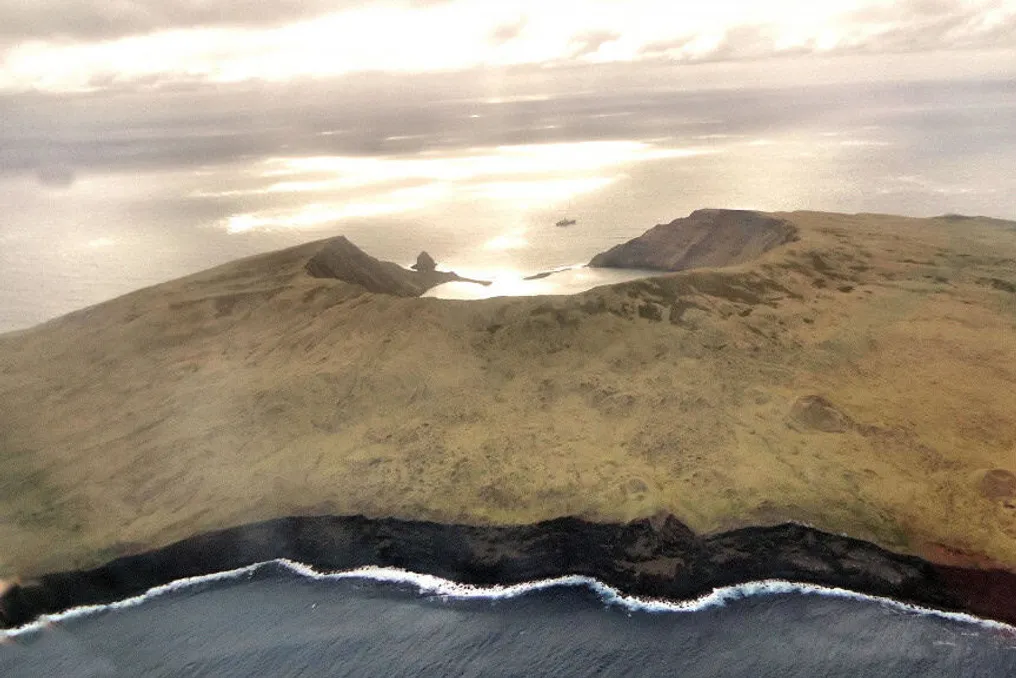
To monitor the area, the team of geophysicists implemented a monitoring network called OHA-GEODAMS in February 2024. This system comprised measurement stations spread across a 100-kilometer stretch of the geological fissure, located near Île Saint-Paul in the Indian Ocean.
Various instruments were used to record changes in the abyssal ecosystem. Among them were five hydrophones, which function as underwater microphones to capture sound waves from tremors, and pressure sensors calibrated to measure vertical variations in ocean topography.
Additionally, 15 acoustic beacons were installed on supports on the seafloor. These battery-powered stations exchanged sound signals every four hours, allowing for the calculation of sound propagation time and thus identifying changes in the horizontal distance between the tectonic plates.
The collected data indicated that the process began with the accumulation of high-pressure magma beneath the crust, forcing its passage between the rock layers and triggering tremors starting on April 26, 2024. This event culminated in the collapse of the surface over the emptied magma chamber. The instruments remain active on the ocean floor, with continuous collection of geophysical data in the area expected until 2027.