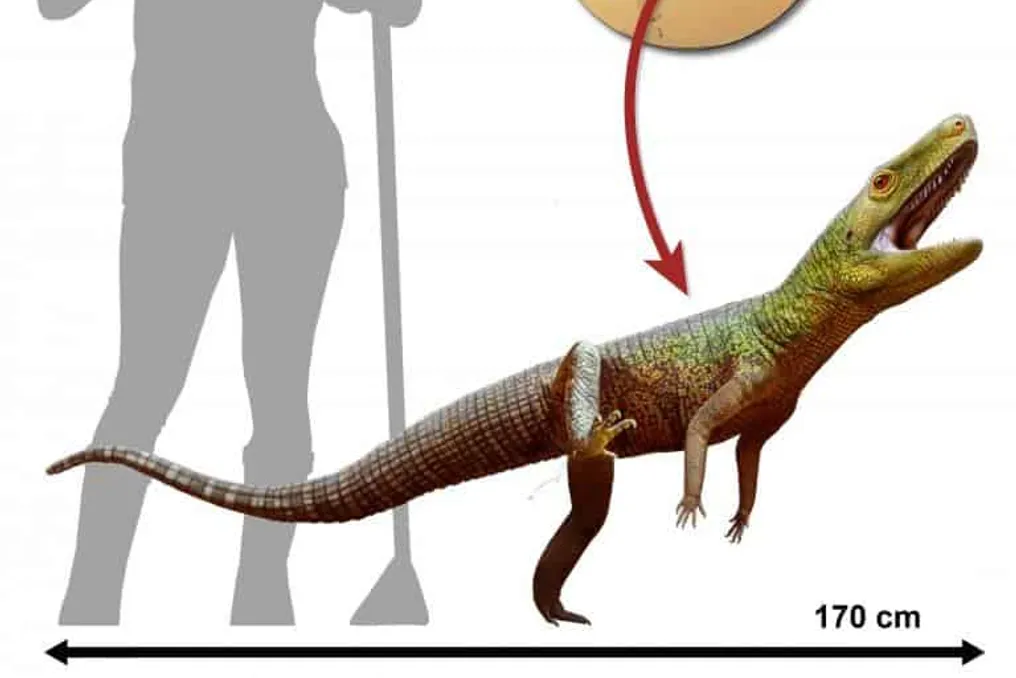
A fossil discovered in Dona Francisca, in the central region of Rio Grande do Sul, offers scientists new information to understand a stage prior to the emergence of dinosaurs and crocodiles. This new reptile species, named Silescelida acristata, lived approximately 240 million years ago, during the Middle Triassic Period.
Popular
Study and Scientific Classification
The research was conducted by specialists from the Center for Support of Paleontological Research of the Fourth Colony of the Federal University of Santa Maria (CAPPA/UFSM), in partnership with scientists from UFRGS and PUCRS. The results were published in the journal Scientific Reports and contribute to expanding knowledge about the evolution and dispersal of archosauromorphs, the ancestral group that gave rise to archosaurs, including birds, dinosaurs, and crocodiles.
Life in Reorganizing Ecosystems
Silescelida acristata inhabited the area of present-day Rio Grande do Sul during a period of restructuring of terrestrial ecosystems. This occurred about 12 million years after the Permian-Triassic extinction, an event that had drastically reduced life on the planet, paving the way for the diversification of new animal groups.
Mauricio Garcia, a doctoral student in the Program of Postgraduate Studies in Animal Biodiversity at UFSM, detailed in an article in The Conversation that several reptilian lineages began to assume new ecological roles in this process, with archosauromorphs being a group that underwent great diversification in the Triassic.
This new reptile was slender in build and moved quadrupedally, having a size similar to a small crocodile. Although it was not classified as a dinosaur or crocodile, it belonged to a lineage close to the forms that preceded the appearance of these animals.
Its diet likely consisted of smaller animals, suggesting that the species functioned as a small predator in the Triassic ecosystems of Southern Brazil.
Locomotion Details Revealed by Bones
The fossil preserves mostly limb parts, and despite being incomplete, the material provided crucial data on the mode of locomotion and the possible evolutionary connections of the animal. A notable feature found in the femur is that Silescelida acristata had its legs in a more semi-erect posture, positioned lower to the body compared to the lateral orientation of other reptiles.
This body arrangement helped reduce friction with the ground, promoting more efficient movement. According to Garcia, this change is part of a set of anatomical adaptations that would later play a significant role in the development of archosaurs. Thus, the fossil aids in investigating a phase preceding the rise of dinosaurs and crocodiles, showing that ancestral lineages exhibited variations in posture and morphology.
Relationship with Rare Group and Geographic Distribution
Phylogenetic analyses indicate that Silescelida acristata may be related to the Euparkeriidae, a little-studied group of archosauromorphs. Previously, fossils related to this group were known primarily in Africa, Asia, and Europe. The identification of a form related to the Euparkeriidae in South America expands the known geographic range of this group.
Garcia argues that this discovery implies that these reptiles were more globally distributed during the Triassic than previous fossil records indicated. Furthermore, the find increases the relevance of South America in studies on the origin and diversification of major groups of terrestrial vertebrates.
Recovery and Nomenclature of the Species
The description of this new species was only possible after recovering a fossil fragment that had been accidentally lost for over twenty years. In 2022, researchers located this piece during a technical visit to the scientific collection of the Pontifical Catholic University of Rio Grande do Sul (PUCRS), which allowed for the confirmation of the specimen's origin and its formal description.
The name Silescelida refers to the journey of the fossil, combining terms related to 'silence' (due to the period when part of the material remained forgotten) and 'leg' (referring to the preserved limb bones). The epithet acristata means 'without crest,' because the animal's femur lacks a raised bony prominence called the trochanter, where part of the caudal musculature would attach. This absence distinguishes Silescelida acristata from almost all its known close relatives.
Contribution to the History of Dinosaur Relatives
The presence of this species in the Middle Triassic of Brazil demonstrates that the evolution of archosauromorphs encompassed a wider geographic distribution than previously imagined. The fossil proves that lineages close to the Euparkeriidae also existed in South America.
The finding reinforces the importance of Rio Grande do Sul for the study of Triassic fauna, as its rocks hold records of various phases of terrestrial vertebrate evolution, including ancient dinosaurs and pre-Dinosaur Era predators. According to Garcia, fossils of this type aid in reconstructing the ecological reorganization after the Permian-Triassic extinction and the emergence of groups that would occupy different terrestrial niches.
The case of Silescelida acristata also illustrates how incomplete materials can contain vital information. Even when much of the fossils are fragmentary, isolated bones are capable of assisting in species identification and investigating evolutionary aspects.