BSNL has introduced its satellite telephony service designed to provide communication in areas where mobile towers are absent or damaged, such as remote mountainous regions, offshore installations, or disaster-stricken zones.
BSNL has introduced its satellite telephony service designed to provide communication in areas where mobile towers are absent or damaged, such as remote mountainous regions, offshore installations, or disaster-stricken zones.
Unlike regular phones that connect to the nearest mobile tower, a satellite phone connects directly to a satellite after the antenna is deployed. This satellite then relays the signal through a ground station, allowing the call to reach another satellite phone, mobile phone, or landline.
Since the service does not depend on local infrastructure, it remains operational during floods, cyclones, earthquakes, and other emergencies that disrupt telecommunication networks. The service utilizes a global L-band satellite network, providing coverage in most regions, with the exception of extreme polar zones.
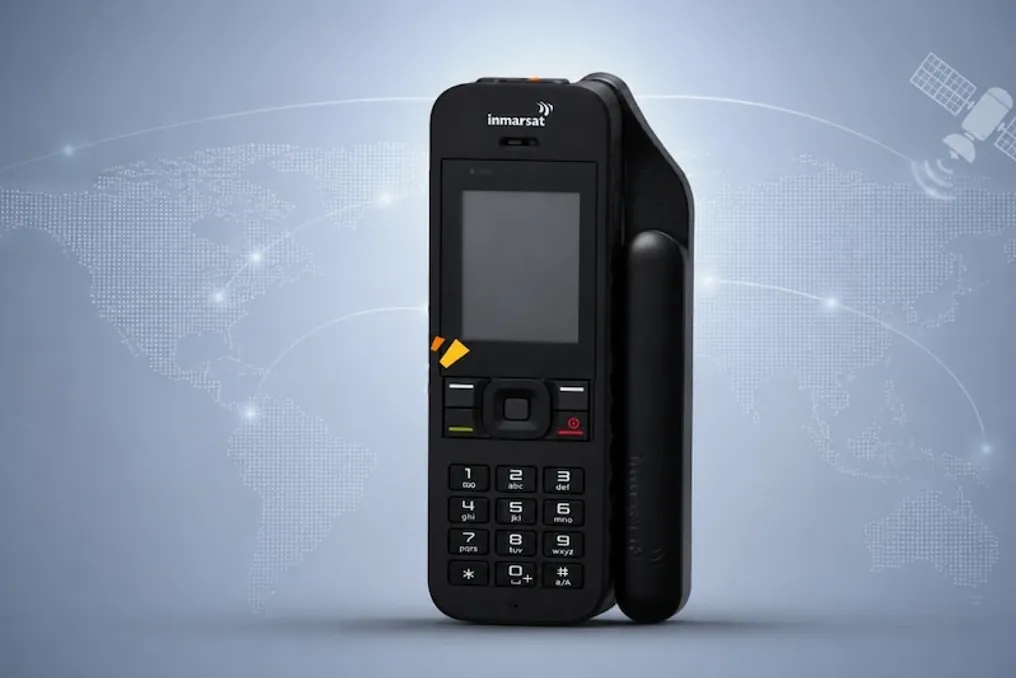
This device is not intended for entertainment purposes, such as watching videos or using social media, nor does it support high-speed internet. The BSNL service provides encrypted voice calls, SMS sending, voicemail, Bluetooth Hands-free connectivity, and incoming call alerts.
The target audience includes defense personnel, disaster response teams, scientists, miners, infrastructure staff, government officials, and expeditions working in hard-to-reach locations. Furthermore, BSNL promotes satellite communication for maritime operations, but the presented IsatPhone 2 model is approved only for land use; specialized docking systems or certified marine terminals may be required for vessels.
The phone is equipped with a 3180 mAh lithium-ion battery, which provides up to eight hours of talk time and 160 hours of standby time. Charging can be done via AC mains, Micro-USB, and car chargers. The device can operate at temperatures ranging from minus 20°C to 55°C and withstand humidity up to 95%, while the IP65 rating guarantees protection against dust and water. Its construction is shock-resistant, making it suitable for harsh outdoor conditions.
The kit includes a physical keyboard, a scratch-resistant display readable in sunlight, a GPS tracking system, an electronic compass, and a programmable auxiliary button. An emergency button allows the user to send their GPS coordinates to a selected contact. The device can also notify the user of incoming calls even with the antenna folded, although the antenna must be extended to receive the call.
For the phone to function correctly, a direct view of the sky is necessary. Dense forests, buildings, caves, tunnels, and steep mountain walls can block the signal. The user may need to move to an open area and properly position the antenna before establishing a connection.
The price of the device itself does not include service fees. Monthly prepaid tariffs start from 3,500 rupees for government clients and 5,835 rupees for commercial clients, excluding GST. Additional calls or messages cost 18 rupees for government users and 25 rupees for commercial users.
Acquisition, activation, and use of the phone must comply with the verification and disclosure requirements of the Department of Telecommunications. Clients are obliged to provide information regarding the purpose, location, and duration of use. Despite the high cost of 1.34 lakh rupees, this is a niche device; however, for specialists working outside mobile network coverage, one reliable call can be more valuable than any smartphone feature.
The state telecommunications company BSNL has launched a new satellite phone for use in regions where mobile networks do not reach. The cost of this device is set at 1.34 lakh rupees.
Despite its seemingly high price, this device is intended not for ordinary users, but for areas lacking mobile towers or during emergencies when all network infrastructure fails. The main advantage of the satellite phone is that it does not depend on terrestrial mobile towers; instead, it connects directly to satellites in orbit.
Thanks to this technology, communication becomes possible in mountains, forests, at sea, or in remote locations. BSNL has long provided Global Satellite Phone Service (GSPS) in the country, and now the company has introduced a new satellite device for both private customers and organizations. According to government regulations, obtaining this service requires submitting documents and identification, similar to standard mobile connectivity, as well as specifying the purpose, duration, and location of the phone's use.
It is important to note that this phone is not an analogue to an Android smartphone. It is not equipped with touchscreen functions, social media, video streaming, or high-speed internet. Its primary task is to ensure reliable voice communication and SMS sending during complete absence of mobile coverage. Therefore, it is actively used in disaster management, rescue operations, security services, mining, the oil and gas sector, maritime operations, and among workers in hard-to-reach areas.
The price of the phone itself is about 1.34 lakh rupees, but its operation also requires subscribing to a BSNL satellite communication tariff plan, which includes monthly rental and call charges. There are separate plans for government agencies and commercial clients. Some users may wonder about the necessity of such a specialized phone given the emergence of satellite messaging features in modern smartphones. However, as experts explain, these two technologies are fundamentally different: while some premium smartphones offer only limited emergency messaging functions, the BSNL phone is specifically designed for regular voice calls and SMS via a full satellite network.