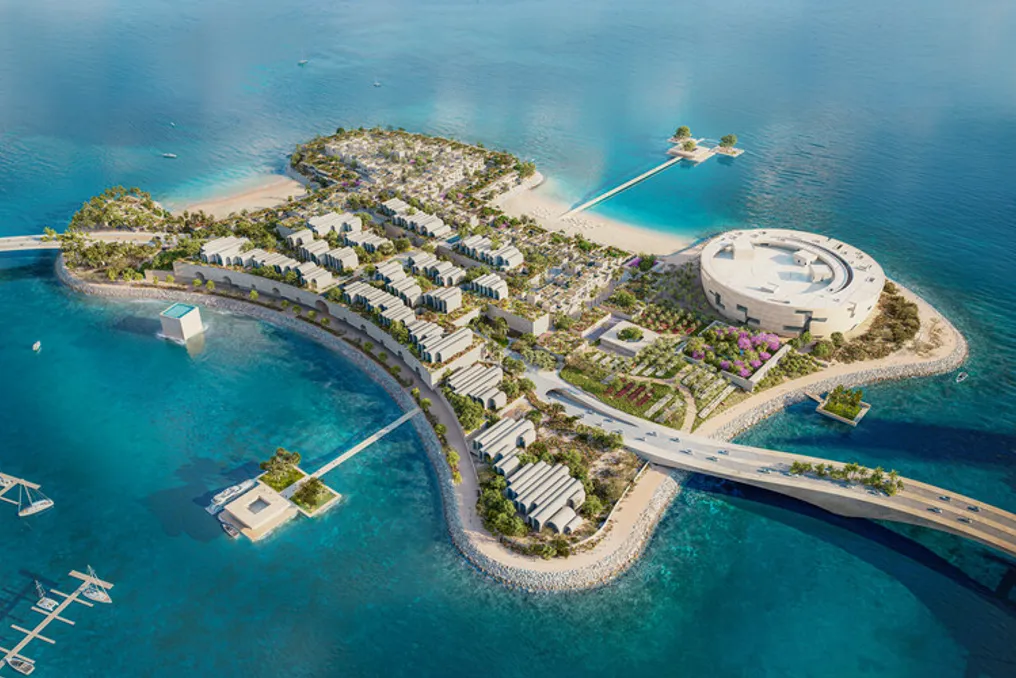
The Swiss architectural firm Herzog & de Meuron has released new visual representations concerning the future Lusail Museum, located on Al Maha Island in Qatar. This artificial island, spanning an area of 230,000 m², is situated off the coast of Lusail, near Doha, and was inaugurated in 2022, shortly before the FIFA World Cup.
Popular
Museum Project and Concept
In 2024, Qatar Museums presented the first renderings of the Lusail Museum. The new museum will function to display a collection of Orientalist art, investigating the flow of people and ideas globally, both in the past and present, while also fostering discussions and studies on contemporary global themes. Jacques Herzog conceived the structure as 'a vertically stratified souk, or a miniature city contained within a single building,' hoping that the building will serve as a cultural focal point for Lusail City.
Al Maha Island Development
Al Maha Island is now part of Lusail City, a vast 38 km² development divided into 19 districts. After hosting the FIFA World Cup in Qatar in 2022, the island is being restructured under the concept of a 'smart city,' integrating commerce, hospitality, leisure, and entertainment to support an estimated population of 450,000 inhabitants. The name Lusail refers to Al Wasil, a local plant abundant in the region, and this reference is incorporated into the landscaping, which blends public areas with native, drought-resistant vegetation. Public pathways include sea-facing sidewalks and bike paths, adorned with artworks by Qatari, regional, and international artists.
Architectural Details of the Museum
The Lusail Museum, designed by Herzog & de Meuron, will be a visual landmark on the southern end of the island. Its volume is shaped by three intersecting spheres in a circle, generating two distinct forms: one resembling a full moon and another resembling a crescent surrounding it. Access to the museum, the central lobby, the library, the auditorium, the shop, the café, and the prayer space are interconnected by an internal crescent-shaped street that receives natural zenithal lighting. The facade exhibits an earthy texture similar to sand, and the windows are deeply recessed to protect the interiors from direct solar incidence. Tactile elements in the interior design include a polished plaster staircase, a reflective metal prayer space, a wood-lined library, and upholstered niches. The museum will also promote collaboration with local and regional artisans, aiming to preserve traditional crafts.
Collection and Cultural Research
Qatar Museums will deposit its collection of Orientalist paintings in the museum, which includes works by Titian, Eugène Delacroix, Gustav Bauernfeind, Jean-Léon Gérôme, Etienne Dinet, and Paul Klee. The main focus of the exhibition will be Orientalism, covering European art between the 16th and 19th centuries. The collection also features old photographs, including pioneering works by Joseph-Philibert Girault de Prangey and Félix Teynard, depicting what was considered 'the Orient' at the time. Furthermore, the museum will present Orientalist sculptures and decorative arts, as well as modern and contemporary pieces from the fields of fashion, textile, cinema, and popular culture, alongside historical artifacts from Africa, the Middle East, and Asia. The site will also host the Lusail Institute, dedicated to advanced historical research, multimedia production, publications, and hosting public events.
Other Global Projects of the Firm
The firm Herzog & de Meuron is involved in several other global mixed-use and cultural projects. In the United States, work is progressing on the new Memphis Art Museum, whose wooden construction is scheduled for inauguration in December 2026. The team was recently hired to renovate the Congress Palace in Tirana, a mixed-use civic complex built during the People's Socialist Republic of Albania. In Switzerland, the firm completed the modernization of the Klein Titlis mountain station as part of a larger master plan for the summit, which also transforms the antenna tower into part of the visitor experience. In Paris, the controversy surrounding the firm's fully glazed Triangular Tower, Tour Triangle, is coming to an end after facing opposition, financial difficulties, and legal disputes.